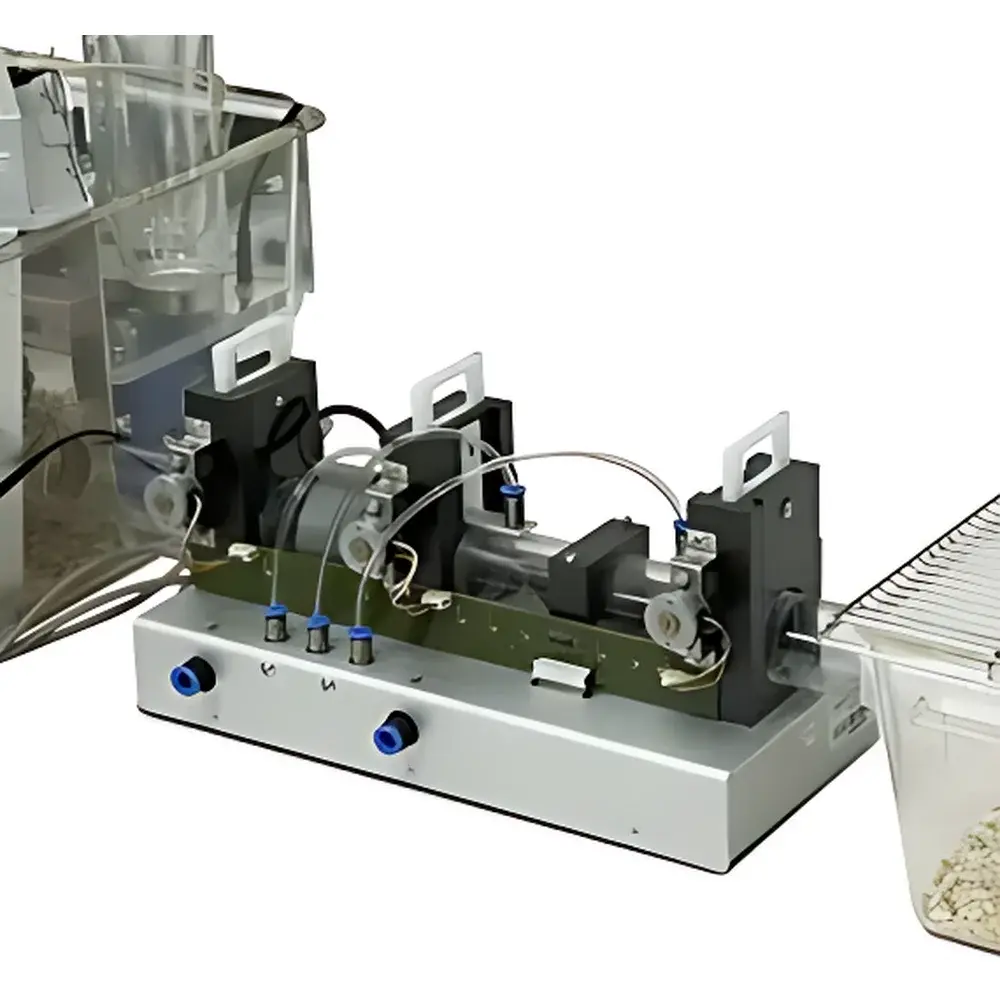
IntelliCage Add-On AnimalGate by TSE Systems
| Brand | TSE Systems |
|---|---|
| Origin | Germany |
| Model | IntelliCage Add-On AnimalGate |
| Type | Modular RFID-Based Animal Access Gate for Automated Behavioral Phenotyping |
| Compliance | CE-marked, compatible with GLP-compliant data workflows |
| Software Integration | Fully controlled via IntelliCage Plus v5.0+ (FDA 21 CFR Part 11–ready audit trail, electronic signature support) |
| Optional Hardware | Integrated high-precision load cell (±0.1 g resolution, 500 g max capacity) |
Overview
The IntelliCage Add-On AnimalGate is a modular, RFID-enabled access control module engineered to extend the IntelliCage platform into a multi-compartment, behaviorally programmable housing and testing system. Designed and manufactured in Germany by TSE Systems—a leader in automated rodent phenotyping instrumentation—the AnimalGate operates on the same dual-frequency (125 kHz / 13.56 MHz) transponder architecture as the core IntelliCage system. It enables bidirectional, animal-specific gate actuation based on real-time identification of implanted or subcutaneously tagged C57BL/6, BALB/c, or other standard laboratory mouse strains. Unlike manual gating or fixed-access enclosures, this system implements dynamic, software-defined access rules—allowing researchers to enforce temporal, identity-based, or state-dependent entry permissions to external modules such as ActivityBoxes, FeederBoxes, WaterPort Modules, or custom-built assay chambers. Its integration forms the structural and functional backbone of scalable, longitudinal behavioral experiments requiring minimal human intervention and maximal experimental reproducibility.
Key Features
- RFID-based selective access control: Recognizes individual mice via ISO 11784/11785-compliant transponders and triggers gate opening only for authorized subjects.
- Bidirectional passage detection: Logs directionality (inbound vs. outbound), dwell time, and sequence of entries—critical for circadian rhythm analysis and spatial learning paradigms.
- Optional integrated precision weighing: High-resolution load cell (±0.1 g) enables continuous, non-invasive body mass monitoring during gate transit—supporting metabolic phenotyping and chronic health assessment.
- Modular scalability: Up to four AnimalGates can be daisy-chained per IntelliCage unit, enabling up to eight distinct access zones in a single rack-mounted configuration.
- Hardware-level fail-safe logic: Mechanical locking remains engaged unless validated by both RFID handshake and software authorization—ensuring protocol integrity during power loss or network interruption.
- Low-latency actuation: Gate response time < 120 ms post-identification, minimizing behavioral artifacts associated with delayed access.
Sample Compatibility & Compliance
The AnimalGate is validated for use with adult male and female mice (18–35 g) housed under standard SPF conditions. It supports all IntelliCage-compatible transponder types—including injectable glass-encapsulated chips (e.g., BioMark HDX) and ear-tag variants—and maintains full backward compatibility with legacy IntelliCage Base and IntelliCage Plus hardware revisions. All firmware and software components comply with European CE directives for laboratory equipment (2014/30/EU EMC, 2014/35/EU LVD). Data acquisition and storage adhere to ALCOA+ principles; IntelliCage Plus software provides full 21 CFR Part 11 compliance including role-based user authentication, immutable audit trails, and electronic signatures—making it suitable for preclinical studies conducted under GLP or early-phase translational research governed by ICH-GCP standards.
Software & Data Management
Control and configuration are performed exclusively through IntelliCage Plus v5.0 or later—a Windows-based application with native support for hierarchical experimental design. Users define access rules using Boolean logic (e.g., “IF mouse_ID ∈ Group_A AND time ∈ [08:00–12:00] THEN open Gate_3”), schedule dynamic rule changes across days or phases, and export timestamped event logs in CSV/SQL formats. Raw data includes gate ID, animal ID, entry/exit timestamps, direction flag, weight measurement (if enabled), and error codes. The software also supports automated synchronization with third-party systems including LabArchives ELN, OpenLab ECM, and custom Python/R pipelines via RESTful API endpoints. All data files are SHA-256 hashed upon export to ensure chain-of-custody integrity.
Applications
- Automated operant conditioning: Enforcing reward-contingent access to food/water sources without experimenter presence.
- Social preference and isolation paradigms: Controlling inter-cage interaction windows between designated subject pairs.
- Circadian entrainment studies: Restricting access to running wheels or feeding zones according to light-dark cycle phase.
- Pharmacological challenge assays: Temporally gating access to drug-dosing stations while logging baseline activity pre- and post-intervention.
- Chronic stress modeling: Introducing unpredictable gate blockages or delayed reinforcement to quantify resilience markers.
- Multimodal phenotype integration: Correlating gate-transit metrics (latency, frequency, weight change) with concurrent video-tracking (EthoVision XT), EEG, or telemetric physiological data.
FAQ
Is the AnimalGate compatible with existing IntelliCage installations?
Yes—it requires IntelliCage Plus hardware revision 3.2 or higher and firmware v4.1+, with no physical retrofitting needed.
Can multiple gates be assigned to different experimental groups simultaneously?
Yes—each gate supports independent rule sets, and group assignment is managed at the animal-ID level within IntelliCage Plus.
Does the system support weight-based access logic (e.g., “only animals >25 g may enter”)?
Yes—when equipped with the optional load cell, real-time weight values are evaluated against user-defined thresholds during gate arbitration.
What happens during network downtime or software crash?
The gate defaults to a secure closed state; no unauthorized access occurs without active software validation.
Is calibration required after installation?
No—factory-calibrated load cells require no field recalibration; RFID alignment is verified automatically during initial system commissioning.