
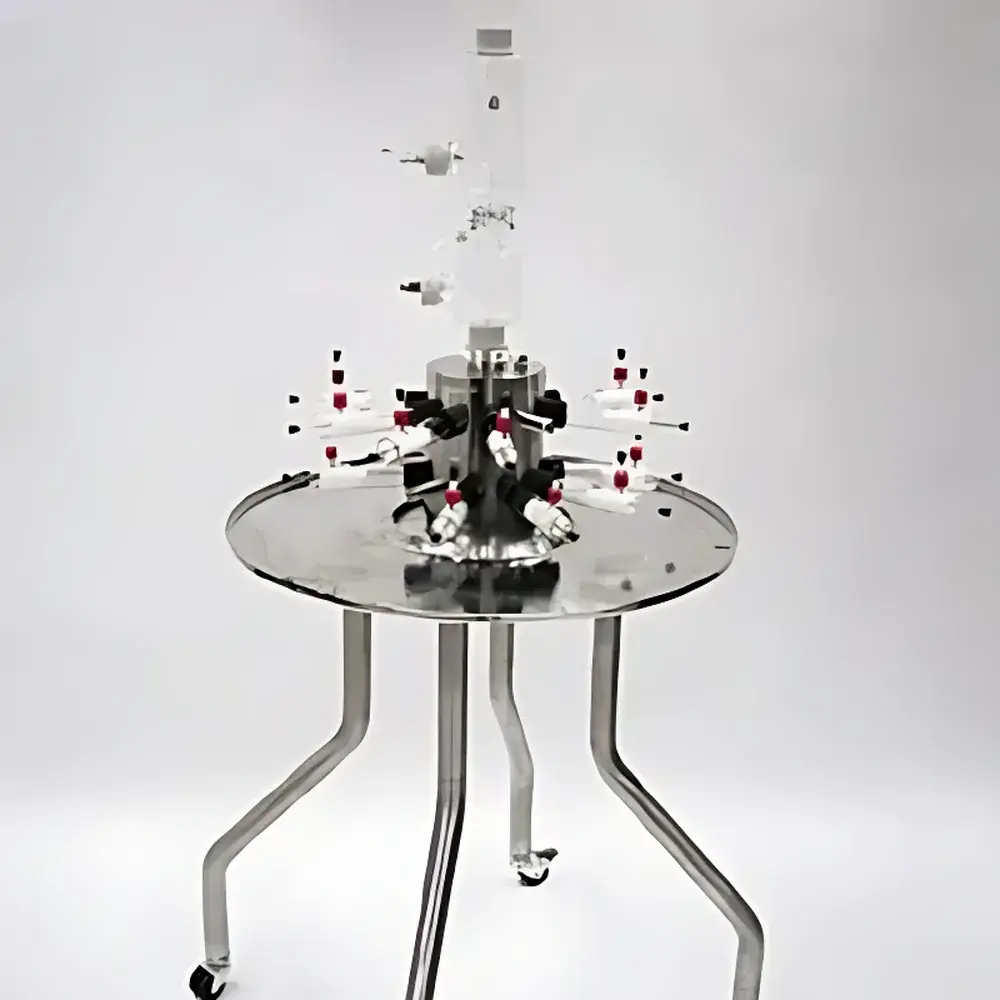
Head Nose Only Units by TSE Systems
| Brand | TSE Systems |
|---|---|
| Origin | Germany |
| Model | Head Nose Only Units |
| Construction | Modular stainless steel or aluminum frame |
| Animal Compatibility | Mice to guinea pigs (customizable for other species) |
| Exposure Configuration | Head-only restraint with nasal inhalation pathway |
| Aerosol Delivery | Integrated aerosol inlet ports with optional conditioning unit |
| Environmental Monitoring | Sensor ports for real-time temperature, humidity, and aerosol concentration monitoring |
| Mobility Option | Castor-mounted mobile base with locking brakes |
| Compliance | Designed per OECD TG 412, ASTM E1709, and ISO 10993-12 guidelines |
| Regulatory Support | Compatible with GLP-compliant data acquisition and audit-trail-enabled software integration |
Overview
The Head Nose Only Units by TSE Systems are precision-engineered head-only inhalation exposure systems designed for controlled, quantitative delivery of airborne test substances—including vapors, gases, and aerosols—to laboratory animals. Based on the well-established Couette flow principle and validated airflow dynamics (Pauluhn, 1994 & 2007; Phalen, 2009), each unit ensures laminar, uniform air distribution across all animal ports, minimizing turbulence-induced particle deposition variability and enabling high reproducibility in dose–response studies. Unlike whole-body chambers, this system restricts exposure exclusively to the respiratory tract via nasal inhalation, eliminating dermal and oral contamination pathways—critical for toxicokinetic modeling, pharmacokinetic profiling, and regulatory safety assessment where route-specific bioavailability must be isolated.
Key Features
- Modular, stackable architecture allows scalable configuration—from single-animal units to multi-tier arrays accommodating up to 48 simultaneous exposures, with independent flow control per tier.
- Stainless steel or anodized aluminum structural frames ensure corrosion resistance, cleanability, and compliance with ISO 14644-1 Class 7 cleanroom-compatible handling protocols.
- Animal restraint tubes are constructed from borosilicate glass or autoclavable polycarbonate, selected based on chemical compatibility and optical clarity requirements for behavioral observation.
- Integrated aerosol conditioning module (optional) enables precise control of relative humidity (20–80% RH), temperature (18–30°C), and particle size distribution (via impactor staging or diffusion dryer integration).
- Each port includes standardized ¼” NPT threaded interfaces for connection to real-time aerosol monitors (e.g., SMPS, APS, CPC), environmental sensors, and exhaust scrubbing systems.
- Mobile configuration features industrial-grade casters with dual-locking brakes, enabling safe relocation between fume hoods, BSL-2 suites, or dedicated exposure laboratories without disassembly.
Sample Compatibility & Compliance
The system supports consistent exposure of mice (18–30 g), rats (150–300 g), and guinea pigs (300–700 g); custom tube diameters and restraint geometries are available for rabbits, non-human primates, or juvenile models upon request. All materials contacting aerosol streams comply with USP Class VI and ISO 10993-1 biocompatibility standards. Design adherence to OECD Test Guideline 412 (Subacute Inhalation Toxicity), ASTM E1709-22 (Standard Practice for Conducting Inhalation Studies), and ISO 10993-12 (Sample Preparation and Reference Materials) facilitates direct alignment with regulatory submission requirements. Exhaust management options include HEPA/activated carbon filtration or ducted venting to facility abatement systems.
Software & Data Management
TSE’s Exposure Control Suite (v3.2+) provides synchronized logging of mass flow controllers, pressure differentials, environmental sensor outputs, and exposure duration per animal port. Data export conforms to ASTM E2500-22 (Standard Guide for Specification, Design, and Verification of Pharmaceutical and Biopharmaceutical Manufacturing Systems) and supports 21 CFR Part 11-compliant user authentication, electronic signatures, and immutable audit trails. Raw time-series datasets are exportable in CSV, HDF5, and .mat formats for integration with MATLAB, Python-based toxicokinetic modeling tools (e.g., PK-Sim®, MoBi®), or institutional LIMS platforms.
Applications
- Regulatory inhalation toxicity testing under OECD, EPA, and PMDA frameworks.
- Inhalation pharmacology studies for inhaled therapeutics (e.g., corticosteroids, bronchodilators, mRNA nanocarriers).
- Nanomaterial safety assessment per ISO/TS 12901-2, including agglomerate dispersion stability and deposition efficiency analysis.
- Combustion aerosol toxicology (e.g., diesel exhaust, wildfire smoke, e-cigarette emissions) with real-time PM2.5/PM10 correlation.
- Dose-range finding for highly potent compounds where material conservation (<50 µg/test) and containment integrity are mandatory.
FAQ
Can the system be used for volatile organic compound (VOC) exposure studies?
Yes—when paired with calibrated vapor generators and PID/FID detectors, the system maintains stable vapor-phase concentrations with <±3% CV over 6-hour exposures.
Is validation documentation provided for GLP audits?
TSE supplies IQ/OQ documentation templates, airflow mapping reports, and calibration certificates traceable to NIST standards—fully editable for sponsor-specific QA workflows.
What maintenance intervals are recommended for the aerosol conditioning module?
Desiccant cartridges require replacement every 200 operational hours; stainless steel impactor stages should be ultrasonically cleaned after each study using isopropanol and verified via gravimetric challenge testing.
Are there options for integrating real-time particle size spectrometry?
Yes—the system features standardized mounting brackets and electrical feedthroughs compatible with TSI’s SMPS+ and Grimm 1.109 spectrometers, with synchronization via TTL triggers and analog voltage output.
How is animal welfare addressed during prolonged exposures?
All restraint tubes meet FELASA and AAALAC International recommendations for ventilation rate (>15 ACH), thermal comfort (ΔT < 1.5°C across tube length), and stress minimization via tapered entry geometry and optional acoustic dampening liners.
Related Products





