
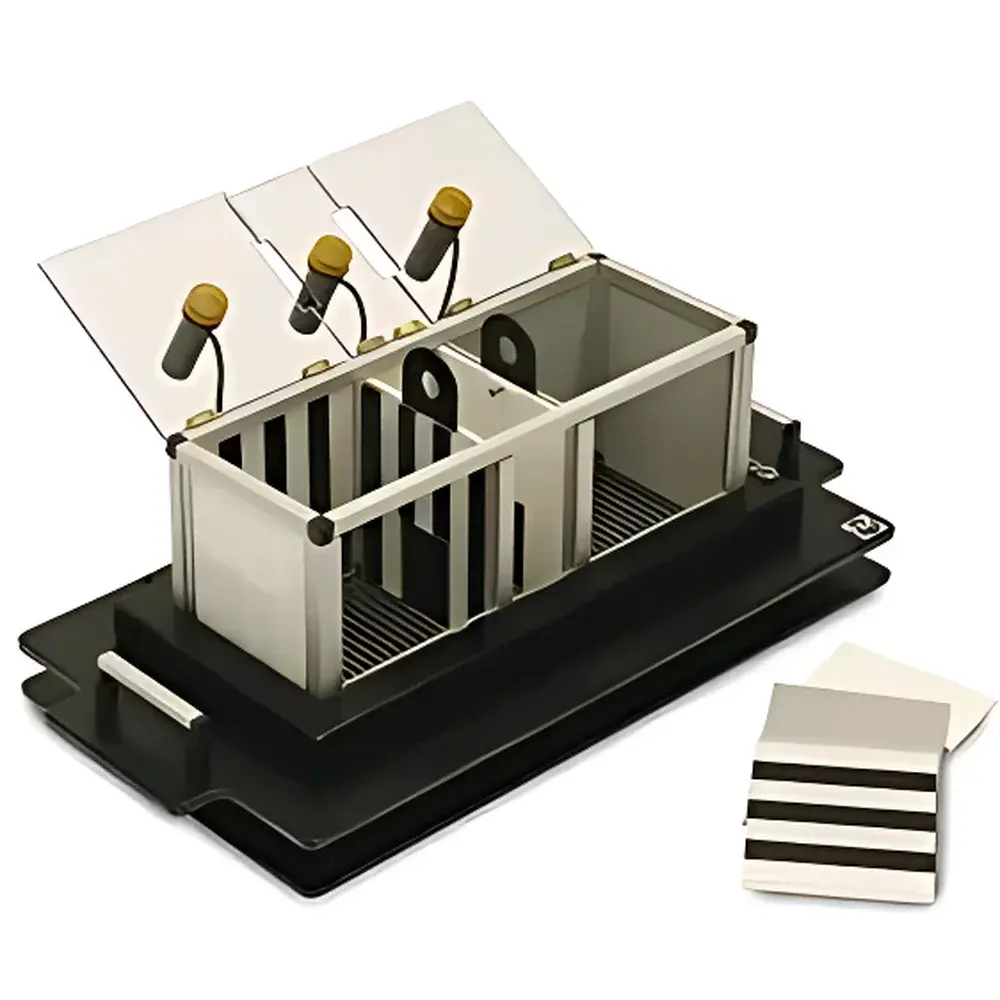
TSE Systems Place Preference System (CPP) for Rodent Behavioral Analysis
| Brand | TSE Systems |
|---|---|
| Origin | Germany |
| Model | Place Preference System |
| Application | Automated Conditioned Place Preference Testing in Mice and Rats |
| Cage Configuration | Three-chamber design with interchangeable walls and floor inserts |
| Environmental Cues | Four wall options (white, gray, black, black-and-white striped), integrated LED lighting per chamber, tactile floor inserts available |
| Door Options | Manual or software-controlled sliding doors |
| Detection | High-resolution infrared beam array (16×16 grid per chamber) |
| Software | Windows-based acquisition and analysis suite with real-time tracking |
| Data Output | Chamber entries, dwell time per compartment, total path length, latency to first entry, transition count |
| Multi-cage Support | Up to 8 cages controlled simultaneously from one PC |
| Compliance | Designed for GLP-compliant behavioral phenotyping workflows |
Overview
The TSE Systems Place Preference System is a rigorously engineered, fully automated platform for conducting Conditioned Place Preference (CPP) experiments in laboratory rodents—primarily mice and rats. CPP is a well-validated, ethologically grounded behavioral paradigm rooted in associative learning theory, wherein animals form Pavlovian associations between pharmacological stimuli (e.g., psychoactive compounds, analgesics, or withdrawal-inducing agents) and distinct environmental contexts. The system implements the standard three-chamber apparatus configuration, enabling precise spatial discrimination and unbiased measurement of preference shifts following conditioning. Its core measurement principle relies on objective, non-invasive infrared (IR) beam-break detection across spatially defined zones, eliminating observer bias and ensuring high inter-lab reproducibility. Unlike manual scoring methods, this system captures continuous locomotor trajectories and discrete event timestamps at millisecond resolution—critical for detecting subtle motivational changes, habituation effects, or state-dependent memory retrieval.
Key Features
- Modular three-chamber test arena constructed from opaque, acoustically dampened polycarbonate, minimizing external sensory interference.
- Interchangeable wall panels (white, gray, black, black-and-white striped) allow rapid reconfiguration of visual contextual cues without hardware recalibration.
- Integrated, independently controllable LED lighting per chamber supports illumination-based cue differentiation and circadian-synchronized protocols.
- Optional tactile floor inserts—including textured plastic grids, smooth acrylic, perforated metal, and rubberized surfaces—enable multimodal contextual discrimination (visual + somatosensory).
- Configurable door mechanisms: solid partitions for confinement phases, sliding doors (manually actuated or software-triggered), and tunnel-style gateways for controlled inter-compartment access.
- High-density IR sensor matrix (16×16 beams per chamber) enables sub-centimeter spatial resolution and robust detection of rearing, stretching, and fine motor transitions—not merely gross locomotion.
- Real-time data acquisition initiates automatically upon subject placement; no manual start/stop intervention required.
Sample Compatibility & Compliance
The system accommodates standard adult C57BL/6, BALB/c, Sprague-Dawley, and Wistar subjects (mice: 20–30 g; rats: 250–450 g). Chamber dimensions comply with NIH Office of Laboratory Animal Welfare (OLAW) and FELASA guidelines for minimum usable floor area and vertical clearance. All materials meet EU Directive 2001/95/EC for product safety and are autoclavable (wall panels and floor inserts). The platform supports audit-ready operation under GLP frameworks: software enforces user role-based access control, electronic signatures, and immutable raw-data logging with timestamped metadata (date, operator ID, protocol version, cage ID). While not FDA 21 CFR Part 11-certified out-of-the-box, the architecture permits integration with validated LIMS environments via standardized CSV/JSON export and ODBC-compliant database hooks.
Software & Data Management
The native Windows application (v5.2+) provides synchronized multi-cage monitoring, protocol templating, and batch analysis. Each session generates a structured dataset including: chamber entry/exit events, cumulative dwell time (ms), path length (cm), velocity profiles, immobility bouts (>1 s), and transition matrices. Export formats include .xlsx (for statistical packages such as SPSS or R), .mat (MATLAB), and .ndf (Neurodata Format) for cross-platform neuroinformatics pipelines. Built-in validation tools verify beam integrity pre-trial and flag occlusion artifacts during acquisition. Raw binary logs are retained alongside processed metrics, satisfying ALAA and EARA requirements for full data traceability.
Applications
This system is routinely deployed in preclinical neuroscience, addiction research, and CNS drug discovery programs. Validated use cases include: quantification of opioid reward (e.g., morphine, oxycodone), assessment of aversive properties of nicotine withdrawal, evaluation of antidepressant-like effects (e.g., ketamine-induced place preference reversal in chronic stress models), and characterization of dopaminergic modulators in Parkinsonian rodent cohorts. It also supports extinction/reinstatement paradigms when paired with TSE’s optional cue-reactivation modules (e.g., context-specific tone/light pairing). Increasingly adopted in academic core facilities and contract research organizations (CROs) for IACUC-mandated behavioral phenotyping batteries.
FAQ
Is the system compatible with optogenetic or chemogenetic experimental setups?
Yes—dedicated TTL trigger ports enable synchronization with laser stimulation units or infusion pumps; chamber lighting can be externally gated via programmable GPIO signals.
Can data from multiple animals be pooled for group-level statistics within the software?
Yes—the analysis module supports hierarchical grouping (e.g., genotype × treatment × timepoint) and exports ANOVA-ready tables with effect size estimates (η², Cohen’s d).
What maintenance is required for long-term reliability?
Annual calibration of IR beam alignment using TSE’s certified jig kit is recommended; firmware updates are delivered via secure HTTPS portal with version-controlled release notes.
Does the system support video-based secondary validation?
While the primary detection is IR-based, optional USB3 machine-vision cameras (sold separately) can be time-locked to beam-event streams for orthogonal verification of posture or grooming episodes.
How is animal identification managed across repeated testing sessions?
RFID reader integration (via ISO 11784/11785-compliant antenna) allows automatic subject ID recognition upon cage entry—eliminating manual log entry errors.





