
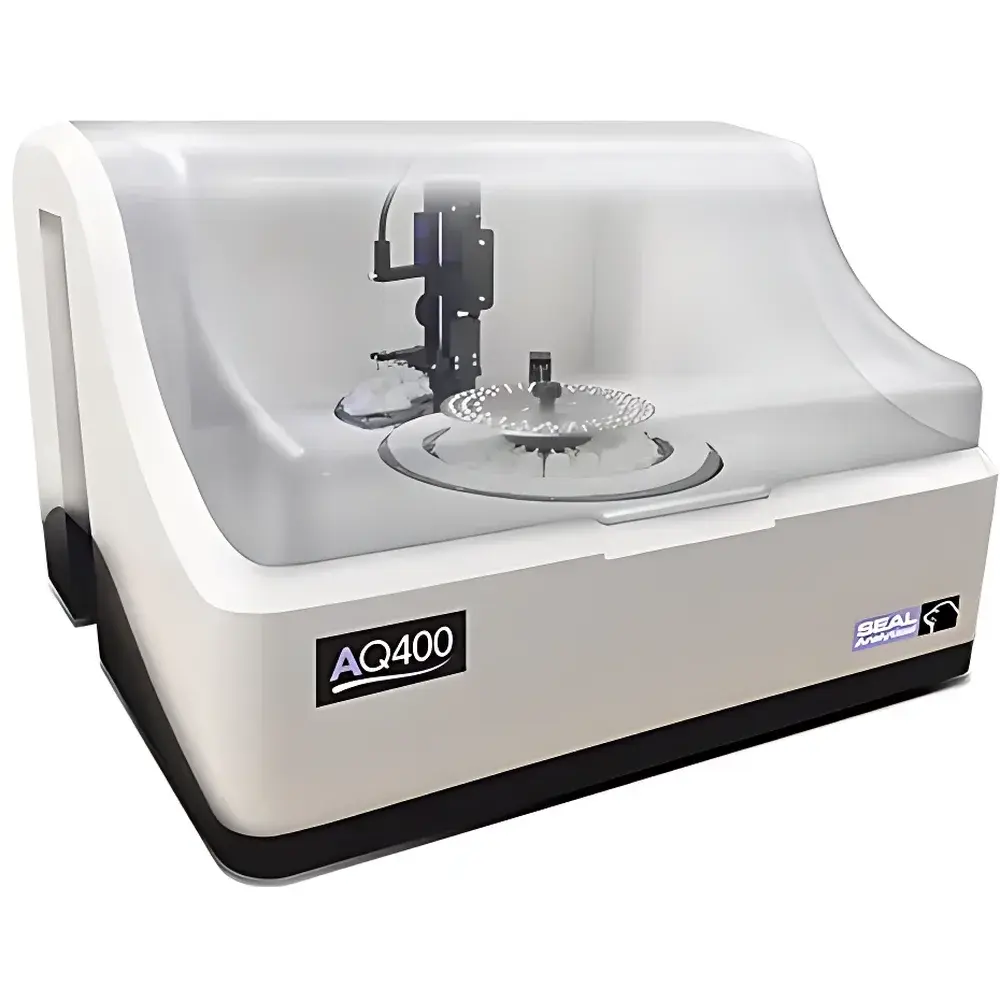
SEAL AQ400 Automated Discrete Analyzer
| Brand | SEAL |
|---|---|
| Origin | USA |
| Model | AQ400 |
| Instrument Type | Laboratory Water Quality Analyzer |
| Detection Parameters | COD, Ammonia-N, Nitrate-N, Nitrite-N, Orthophosphate, Hexavalent Chromium, Alkalinity, Color, Hardness |
| Compliance | EPA-Approved Methods |
| Optical Cell | Quartz, 1 cm standard pathlength (optional extended pathlength) |
| Sample/Reagent Capacity | High-throughput carousel configuration |
| Automation Level | Fully unattended operation with onboard cooling/non-cooling reagent positions |
| Detection Principle | UV-Vis Spectrophotometry (Discrete Reaction Kinetics) |
| Software | Method-driven, CFR Part 11-compliant data handling with audit trail |
| Regulatory Alignment | Designed for GLP/GMP and ISO/IEC 17025 environments |
Overview
The SEAL AQ400 Automated Discrete Analyzer is a high-precision, EPA-validated platform engineered for regulatory-compliant water, wastewater, and soil extract analysis in environmental testing laboratories. Unlike continuous flow or segmented flow systems, the AQ400 implements true discrete chemistry—mimicking validated manual wet-chemistry protocols through robotic precision. Each sample undergoes individualized reaction control: discrete aliquots of sample and reagents are delivered into optically calibrated quartz cuvettes, incubated for defined reaction times under temperature-stabilized conditions, and measured via dual-beam UV-Vis spectrophotometry. This architecture eliminates carryover, minimizes matrix interference, and ensures method fidelity across complex environmental matrices. The system operates on standardized EPA methods—including Method 351.2 (Nitrate/Nitrite), 350.1 (Alkalinity), 365.4 (Phosphorus), and 410.4 (COD)—and supports full traceability per 21 CFR Part 11 requirements through time-stamped, user-verified audit trails.
Key Features
- True discrete analysis architecture with individual quartz cuvettes—eliminates cross-contamination and enables simultaneous multi-parameter testing without reconfiguration
- Dual-pathlength optical system: standard 1 cm quartz cells with optional extended-pathlength configurations for enhanced sensitivity in low-concentration analyte detection (e.g., nitrite, orthophosphate)
- High-capacity sample and reagent carousels with integrated Peltier-cooled and ambient reagent zones—supports up to 120 samples and 30+ reagents per run
- Programmable robotic arm with sub-5 µL liquid handling accuracy—enables precise micro-volume dispensing, automatic dilution, spike recovery, and blank subtraction
- Onboard method validation tools: automated standard curve generation (up to 10 points), QC sample insertion, and real-time drift correction using reference standards
- Full walk-away operation: unattended overnight runs with auto-cleaning cycles, waste level monitoring, and fault-responsive shutdown protocols
- Low reagent consumption: typical assay volumes range from 20–200 µL per test, reducing annual reagent costs by >60% versus conventional batch analyzers
Sample Compatibility & Compliance
The AQ400 is validated for use with raw surface water, treated drinking water, municipal and industrial wastewater, digested soil extracts, and leachates per U.S. EPA, ISO, and ASTM standard methods. It accommodates turbid, colored, and high-solids samples through programmable filtration integration and adaptive dilution logic. All measurement protocols comply with ISO/IEC 17025:2017 analytical validity requirements, including documented linearity (R² ≥ 0.999), limit of detection (LOD) verification, and repeatability assessment (RSD ≤ 2.5% at mid-range concentrations). The instrument’s firmware and software meet FDA 21 CFR Part 11 criteria for electronic records and signatures, supporting audit-ready reporting for regulatory submissions and third-party accreditation audits.
Software & Data Management
AQ400 Control Suite is a Windows-based, method-centric application that embeds analytical logic directly into assay definitions—not just instrument control. Each EPA or ISO method is pre-configured with reaction timing, wavelength selection, calibration algorithms, and acceptance criteria. Data integrity safeguards include immutable audit logs, role-based user permissions, electronic signature workflows, and LIMS interoperability via ASTM E1384-compliant HL7 and CSV export. Raw absorbance data, kinetic reaction curves, and QC charts are stored in encrypted SQLite databases with daily automated backup. Reports conform to EPA Form 3330-1 and ISO 17025 clause 7.8 requirements, including uncertainty estimation per GUM guidelines.
Applications
The AQ400 delivers validated performance across core environmental testing domains: nutrient speciation (NH₃-N, NO₃⁻-N, NO₂⁻-N, TKN, ortho-P, total P), oxidant demand (COD, alkalinity), toxic metals (Cr⁶⁺), and physical-chemical parameters (color, hardness, chloride, sulfate, cyanide, phenolics, silicate). Its discrete format enables method-specific optimization—e.g., high-temperature digestion for COD followed by immediate photometric readout without flow-cell memory effects. Laboratories deploying the AQ400 report 40–65% reduction in analyst hands-on time, >95% method transfer success from manual SOPs, and consistent compliance with state NPDES permit reporting windows.
FAQ
Does the AQ400 support EPA Method 410.4 for COD analysis?
Yes—the system uses direct-read quartz cuvettes with heated digestion and dichromate oxidation, meeting all procedural and performance criteria outlined in EPA Method 410.4.
Can the AQ400 interface with our existing LIMS?
It supports bidirectional data exchange via ASTM E1384-compliant HL7 messaging, ODBC connectivity, and scheduled CSV/Excel exports with configurable field mapping.
What maintenance is required between runs?
No manual intervention is needed—the system performs automated rinsing, needle purging, and cuvette cleaning post-analysis; only quarterly syringe replacement and annual photometer calibration are recommended.
Is method validation documentation provided?
SEAL supplies IQ/OQ documentation packages, EPA method verification reports, and ISO/IEC 17025 alignment checklists as part of standard delivery.
How does the AQ400 handle out-of-range samples?
It executes intelligent auto-dilution using onboard diluent reservoirs, re-runs the assay, and appends both raw and corrected results to the final report with full traceability.







