
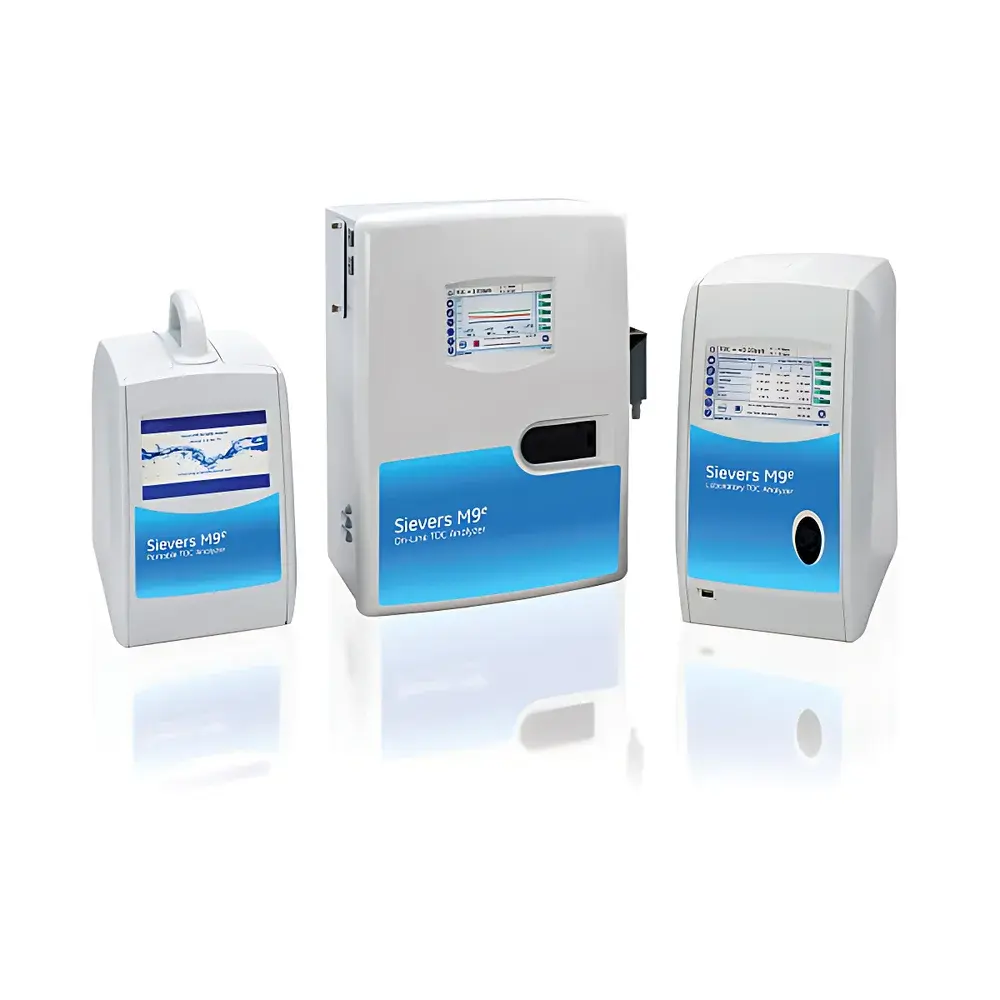
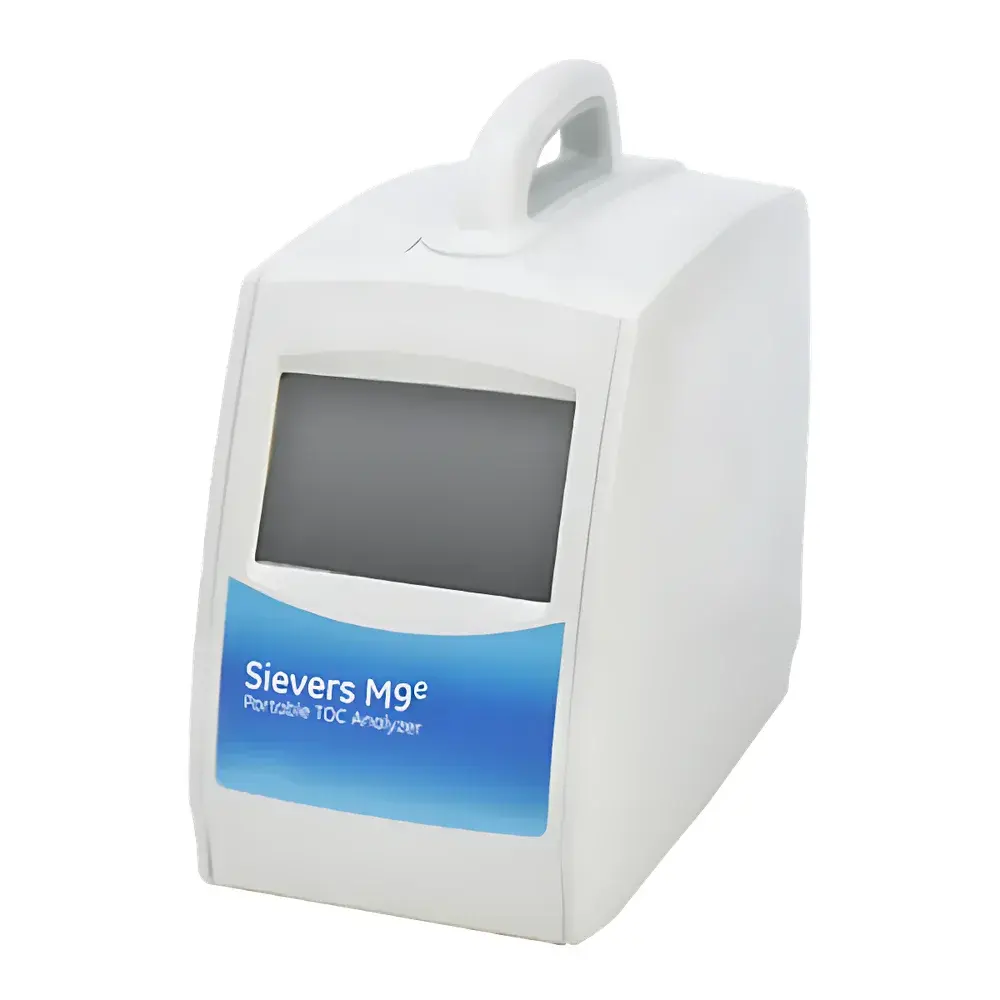
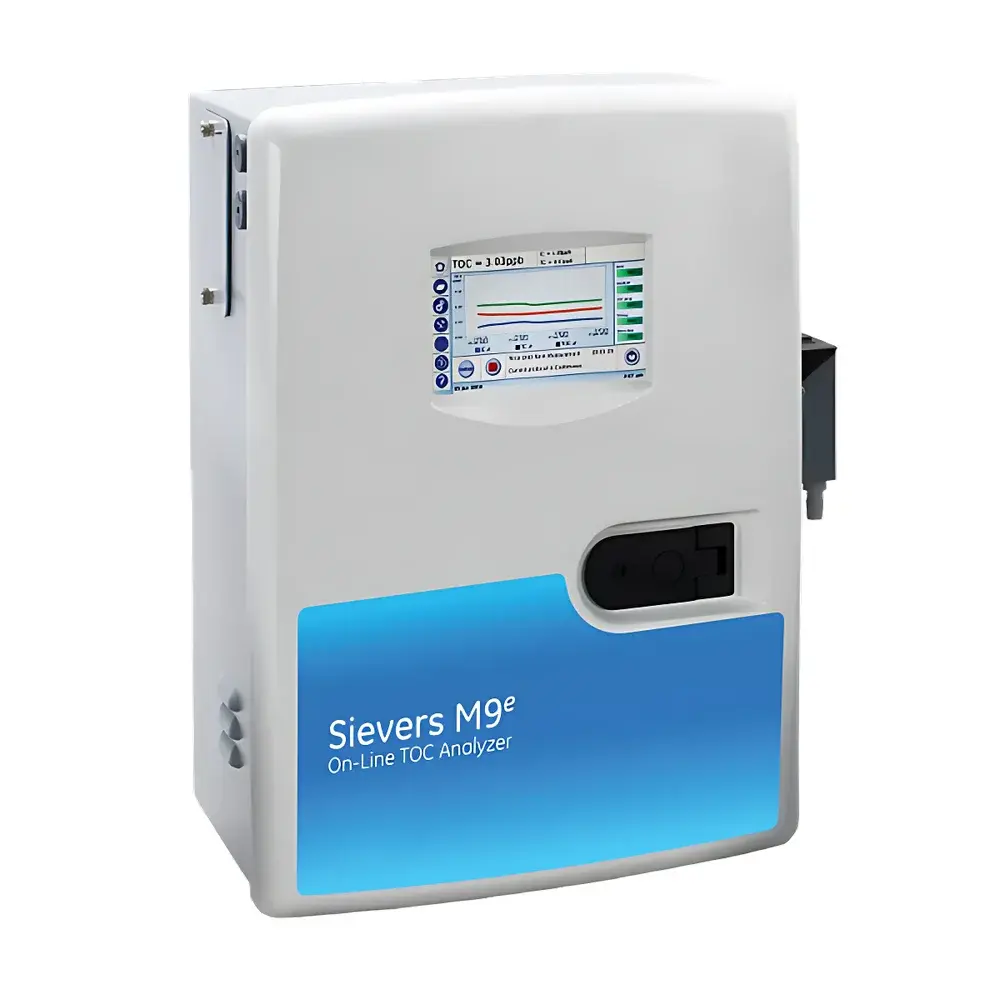
Sievers M9e Total Organic Carbon Analyzer
| Brand | Sievers (Veolia) |
|---|---|
| Origin | USA |
| Manufacturer Type | Original Equipment Manufacturer (OEM) |
| Product Category | Imported Instrument |
| Model | Sievers M9e |
| Instrument Type | Online TOC Analyzer |
| Detection Principle | Membrane Conductivity Detection |
| Oxidation Method | UV/Persulfate Oxidation |
| Measurement Range | 0.03 ppb to 50 ppm |
| Accuracy | ±2% or ±0.5 ppb (whichever is greater) |
| Resolution | 0.01 ppb |
| Detection Limit | 0.03 ppb |
| Repeatability | <1% RSD |
Overview
The Sievers M9e Total Organic Carbon (TOC) Analyzer is an engineered solution for ultra-trace organic carbon quantification in high-purity water systems, particularly within semiconductor, flat-panel display, and pharmaceutical manufacturing environments. It employs membrane-conductivity detection following UV/persulfate oxidation—a robust, non-selective oxidation method that converts all oxidizable carbon species (including non-volatile, low-molecular-weight organics) into CO₂, which is then selectively measured via a gas-permeable hydrophobic membrane and conductivity cell. This principle ensures high specificity for carbon-derived ions while rejecting interfering ionic species (e.g., chloride, sulfate, silica), delivering exceptional selectivity and stability in complex matrix waters. Designed for both online continuous monitoring and discrete laboratory analysis, the M9e operates across an industry-leading dynamic range of 0.03 ppb to 50 ppm—enabling seamless transition from ultrapure process water validation to reclaimed water quality assurance without hardware reconfiguration.
Key Features
- Ultra-low detection limit of 0.03 ppb TOC with 0.01 ppb resolution—validated per ASTM D5905 and USP <643> guidelines for purified water and water for injection (WFI).
- Two operational modes: Standard mode (2-minute analysis cycle) and optional Turbo mode (4-second analysis time), optimized for rapid fault isolation in water recovery loops.
- Auto-adaptive flow control: Dynamically adjusts sample and reagent flow rates per sample conductivity and TOC concentration to maintain optimal oxidation efficiency and detector response linearity.
- 12-month calibration stability—reducing operational overhead and supporting compliance with FDA 21 CFR Part 11 requirements for audit-ready instrument qualification.
- Integrated sample conductivity measurement (0.01–2,000 µS/cm) with ±0.005 µS/cm accuracy—enabling real-time compensation for ionic background interference and supporting multi-parameter water quality assessment.
- Minimal maintenance architecture: Less than 2 hours of preventive maintenance annually; consumables include UV lamp (6-month service life), acid reagent (typically 6 months), and persulfate oxidant (3-month shelf-stable cartridge options: 150 mL or 300 mL).
Sample Compatibility & Compliance
The M9e accommodates a broad spectrum of aqueous samples—from raw municipal or well water through activated carbon effluent, reverse osmosis permeate, electrodeionization output, and final point-of-use ultrapure water (UPW). Its membrane-conductivity detection system exhibits inherent resistance to common interferences such as high chloride (>100 ppm), silica, and residual oxidants, eliminating the need for dilution or pretreatment in most UPW applications. The analyzer meets ETL and CE safety standards and supports regulatory compliance frameworks including ISO 9001, ISO/IEC 17025, USP <643>, EP 2.2.44, JP 2.07, and ASTM D5905. For GxP environments, its embedded software logs full audit trails (user actions, calibration events, error codes) and supports electronic signatures when integrated with validated LIMS or MES platforms.
Software & Data Management
The M9e features an embedded 7-inch WVGA (800 × 480) color touchscreen interface running a deterministic real-time OS. Data acquisition, calibration verification, system diagnostics, and report generation are fully automated. USB device and host ports (3×) enable direct connection to printers, external storage, or peripheral controllers; Modbus TCP/IP and Ethernet interfaces support integration into plant-wide SCADA and DCS architectures. All measurements are timestamped and stored with metadata (sample ID, operator, temperature, pressure, conductivity), and export formats include CSV, PDF, and XML for traceability. Firmware updates are performed via secure HTTPS download, maintaining integrity under IEC 62443-3-3 cybersecurity guidelines.
Applications
- Semiconductor and display fab UPW loop monitoring—from intake to point-of-use, including RO reject streams and reclaim circuits.
- Pharmaceutical water system validation and routine surveillance per USP <643> and EU Annex 1 requirements.
- Activated carbon bed performance evaluation via breakthrough curve tracking.
- RO membrane fouling diagnostics through pre- and post-membrane TOC differentials.
- Environmental compliance reporting for wastewater reuse facilities subject to EPA NPDES permits.
- Research-grade carbon mass balance studies in closed-loop industrial water systems.
FAQ
What oxidation method does the M9e use, and why is it preferred for UPW applications?
The M9e employs UV/persulfate oxidation—a non-thermal, homogeneous method that achieves >99% oxidation efficiency for recalcitrant compounds (e.g., acetic acid, methanol) without introducing metal catalysts or requiring elevated temperatures. This eliminates carryover risk and ensures compliance with semiconductor industry specifications for metallic residue limits.
Can the M9e operate continuously in online mode without manual intervention?
Yes. With scheduled auto-calibration, daily system suitability checks, and predictive consumables monitoring, the M9e supports unattended 24/7 operation for up to 12 months between calibrations—fully documented in its IQ/OQ/PQ validation package.
Is the M9e compliant with FDA 21 CFR Part 11 for electronic records and signatures?
While the base firmware provides full audit trail functionality (user logins, parameter changes, calibration history), Part 11 compliance requires site-specific configuration—including role-based access control, electronic signature workflows, and secure network architecture—which is supported via Veolia’s validated software add-ons and implementation services.
How does the Turbo mode affect measurement uncertainty at low concentrations?
Turbo mode (4-second analysis) is optimized for higher-concentration ranges (0.20 ppb–10 ppm) and maintains ±10% accuracy per ASTM D5905; for sub-ppb quantification, Standard mode is recommended to preserve <1% RSD repeatability and ±0.5 ppb absolute accuracy.
What safety precautions apply to the UV lamp?
The low-pressure mercury UV lamp contains elemental mercury and must be disposed of in accordance with local, state, and federal hazardous waste regulations (e.g., U.S. EPA 40 CFR Part 273). Replacement lamps are supplied with certified recycling instructions and UN-certified shipping containers.







