
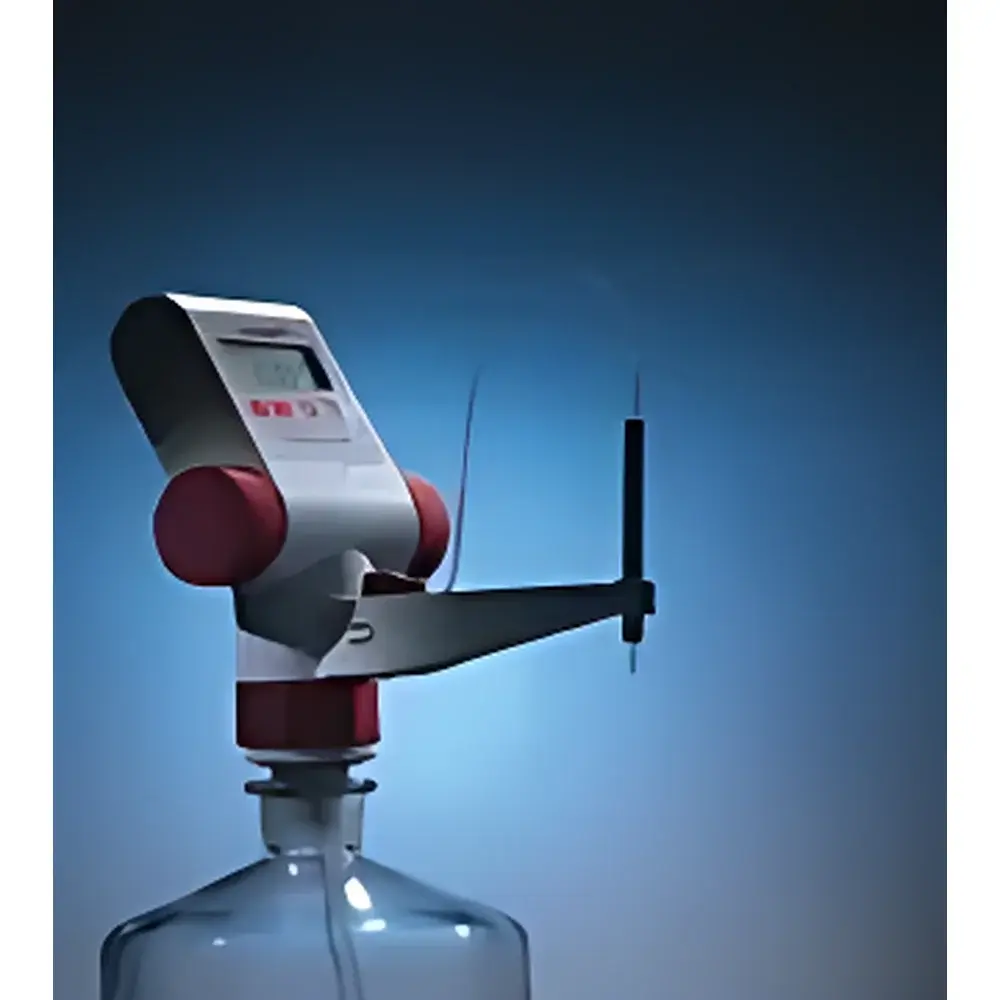
VITLAB® Continuous E/RS Electronic Digital Burette
| Brand | VITLAB |
|---|---|
| Origin | Germany |
| Model | VITLAB® Continuous E/RS |
| Capacity | 25 mL (E) / 50 mL (RS) |
| Accuracy | ≤ ±0.2 % |
| Coefficient of Variation | ≤ 0.1 % |
| Minimum Increment | 0.01 mL |
| Maximum Cumulative Dispense | 999.9 mL |
| Display | Rotatable 360° LCD with Tilted Panel |
| Power | Two 1.5 V LR03/AAA batteries |
| Fluid Path Materials | Borosilicate glass, PTFE, ETFE, PFA, FEP, Pt–Ir alloy |
| Compliance | DIN EN ISO 8665-3, DIN EN ISO 8655-6, GLP-aligned calibration protocol |
| Accessories Included | PP threaded adapters (GL32, GL38, S40), adjustable aspiration tube (200–350 mm), adjustable dispensing tube (140–220 mm), user manual, quality certification |
Overview
The VITLAB® Continuous E/RS is a precision-engineered electronic digital burette designed for high-reproducibility volumetric titration in both laboratory and field-deployed environments. Unlike conventional glass burettes or full-scale automated titration systems, this instrument bridges the gap between manual simplicity and metrological rigor—delivering traceable, pulse-free liquid delivery based on patented dual-piston positive displacement technology. Its operating principle relies on synchronized filling and dispensing cycles, eliminating the need for pre-filling steps and minimizing operator-induced variability. The device operates independently of mains power, enabling reliable use in confined spaces, mobile labs, or remote sampling locations where AC infrastructure is unavailable. All critical wetted components—including piston seals, valves, and fluid pathways—are constructed from chemically inert materials (borosilicate glass, PTFE, ETFE, PFA, FEP, and platinum–iridium alloy), ensuring long-term stability and compatibility with aggressive reagents across pH 0–14, including concentrated acids, alkalis, and organic solvents.
Key Features
- Patented dual-piston pump mechanism ensures continuous, pulse-free liquid delivery without interruption between fill and dispense phases.
- Integrated reflux valve prevents reagent waste during priming—zero droplet loss prior to first dispensing.
- Tilt-adjustable, 360° rotatable large-format LCD display enhances ergonomic readability under varying bench orientations and lighting conditions.
- High-resolution measurement capability with 0.01 mL minimum increment and cumulative volume tracking up to 999.9 mL.
- Tool-free, GLP-compliant calibration procedure aligned with DIN EN ISO 8655-6 requirements—performed in minutes without disassembly.
- Modular dispensing tube with height and angular adjustment enables unobstructed visibility of reagent bottle labels during operation.
- Universal bottle interface system includes PP threaded adapters for GL32, GL38, and S40 necks, plus a polypropylene universal adapter for standard lab bottles.
- Low-center-of-gravity mechanical design significantly reduces risk of tipping and accidental leakage—especially critical when using small-volume reagent containers.
Sample Compatibility & Compliance
The VITLAB® Continuous E/RS is validated for use with aqueous, organic, and corrosive solutions commonly employed in acid–base, redox, complexometric, and precipitation titrations. Its fluid-contact materials meet stringent chemical resistance specifications per DIN EN ISO 8665-3 for volumetric instruments used in analytical chemistry. Device performance—including accuracy (≤ ±0.2 %) and repeatability (coefficient of variation ≤ 0.1 %)—is certified against internationally recognized metrological standards. Calibration documentation supports audit readiness for GLP and GMP-regulated environments, and the instrument’s design facilitates integration into quality-controlled workflows requiring documented traceability and operator accountability.
Software & Data Management
As a standalone electromechanical instrument, the Continuous E/RS does not incorporate embedded software or digital connectivity. However, its deterministic mechanical architecture and real-time digital display provide immediate, tamper-resistant volume readouts that satisfy core data integrity principles under FDA 21 CFR Part 11 Annex 11 and EU GMP Annex 11 guidelines—provided manual recording procedures are implemented with appropriate procedural controls (e.g., dated entries, operator signatures, and version-controlled logbooks). Optional external data logging can be achieved via compatible barcode scanners or digital note-taking platforms integrated into laboratory information management systems (LIMS).
Applications
- Routine quantitative analysis in QC/QA laboratories across pharmaceuticals, food & beverage, environmental testing, and academic research.
- Field-based titrimetric analysis for water quality monitoring (e.g., chloride, hardness, alkalinity) where portability and battery operation are essential.
- Teaching laboratories requiring intuitive, error-resistant instrumentation for student training in volumetric technique fundamentals.
- Small-batch synthesis and formulation development where precise, repeatable reagent addition is required without full automation investment.
- Calibration verification of other volumetric devices (e.g., pipettes, flasks) using gravimetric or coulometric reference methods.
FAQ
Does the Continuous E/RS require external power or computer connection?
No—it operates exclusively on two 1.5 V LR03/AAA batteries, supporting over 10,000 full dispense cycles per set under typical usage conditions.
Can it be calibrated in-house without specialized tools?
Yes—calibration follows a fully manual, tool-free process compliant with DIN EN ISO 8655-6, requiring only distilled water and an analytical balance.
Is the dispensing tube compatible with narrow-neck reagent bottles?
Yes—the adjustable dispensing tube (140–220 mm range) and included S40 adapter enable secure, leak-tight coupling with bottles as narrow as 24 mm ID.
What maintenance is required to sustain metrological performance?
Routine cleaning with compatible solvents and periodic inspection of piston seals and valve seats—no scheduled recalibration is mandated unless operational deviation exceeds ±0.2 %.
How does the dual-piston design improve safety compared to single-piston systems?
By eliminating pulsation and pressure spikes, the dual-piston architecture prevents sudden ejection of reagents, reduces aerosol generation, and minimizes stress on tubing and bottle closures—particularly critical with volatile or hazardous substances.



