
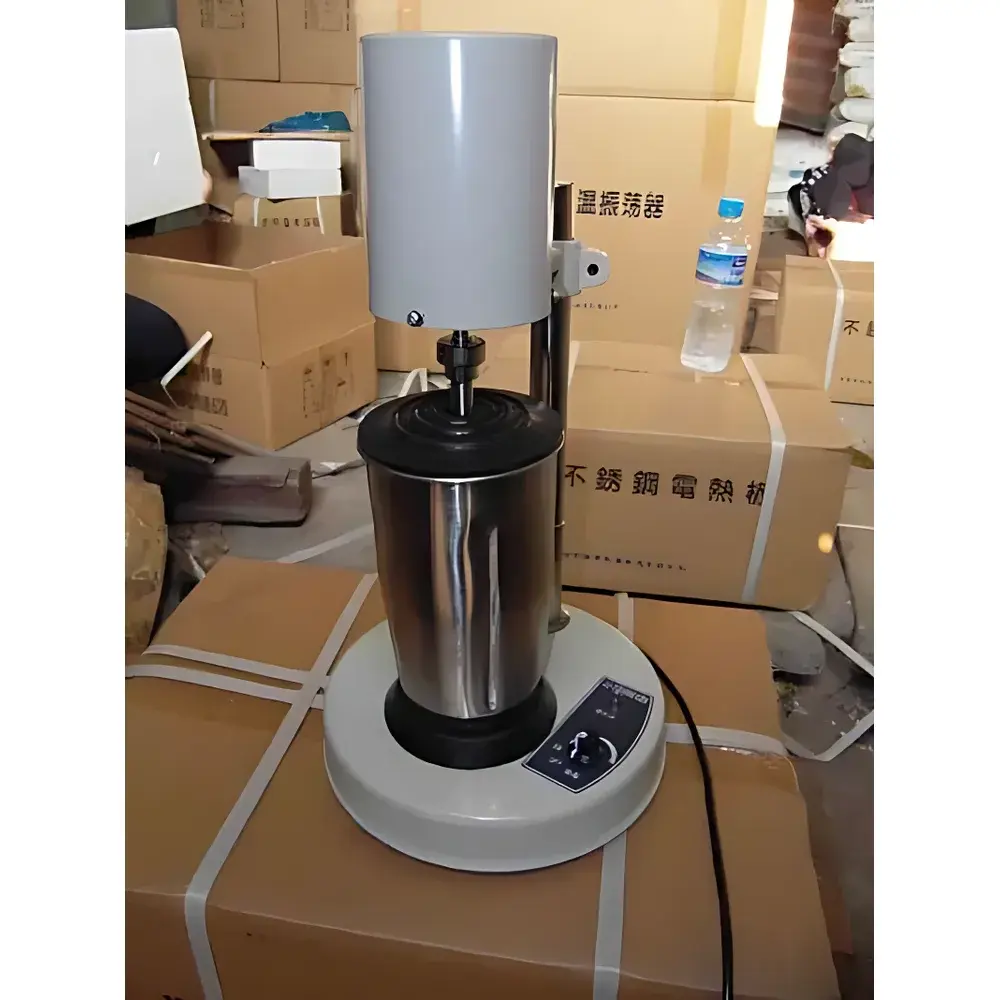
JJ-2 High-Speed Laboratory Homogenizer
| Origin | Jiangsu, China |
|---|---|
| Manufacturer Type | Authorized Distributor |
| Origin Category | Domestic (China) |
| Model | JJ-2 |
| Price | USD 135 (FOB Jiangsu) |
| Power Rating | 120 W |
| Speed Range | 0–12,000 rpm (infinitely variable) |
| Vessel Options | Stainless Steel Beaker & Borosilicate Glass Beaker |
| Maximum Sample Volume | 1000 mL |
Overview
The JJ-2 High-Speed Laboratory Homogenizer is a robust, benchtop mechanical homogenization system engineered for rapid and reproducible disruption of soft biological tissues, cell suspensions, emulsions, and viscous liquid samples. It operates on the principle of high-shear rotor-stator interaction: a precision-machined rotating blade assembly (rotor) rotates at controlled speeds within a fixed concentric sleeve (stator), generating intense hydrodynamic forces—including cavitation, turbulence, and localized shear gradients—that efficiently fragment cellular structures and disperse particulates. Designed for routine use in academic research labs, clinical pathology units, and QC environments, the JJ-2 delivers consistent mechanical lysis performance without requiring cryogenic cooling or chemical additives—making it ideal for downstream applications such as protein extraction, nucleic acid isolation, and preparation of homogeneous suspensions for spectrophotometric or chromatographic analysis.
Key Features
- Infinitely variable speed control (0–12,000 rpm) via analog dial, enabling precise optimization for sample viscosity and fragility—critical for preserving labile biomolecules during homogenization.
- 120 W brush-type motor with thermal overload protection ensures sustained operation under load while maintaining stable rotational output across the full speed range.
- Dual-vessel compatibility: Includes both a 1000 mL stainless steel beaker (for abrasive or corrosive samples) and a borosilicate glass beaker (for optical clarity and chemical inertness), each fitted with standardized thread sealing and vertical alignment guides to ensure concentric rotor insertion.
- Ergonomic base design with non-slip rubber feet and integrated blade guard housing minimizes vibration transmission and enhances operator safety during extended use.
- Modular blade assembly (included standard) features a three-blade, stainless-steel, tapered-tip rotor optimized for turbulent flow generation in volumes from 5 mL to 1000 mL—validated for >10,000 operational cycles under GLP-aligned maintenance protocols.
Sample Compatibility & Compliance
The JJ-2 accommodates a broad spectrum of sample types including animal and plant tissue homogenates, bacterial pellets, yeast slurries, lipid emulsions, pharmaceutical suspensions, and food-grade colloids. Its mechanical architecture avoids contamination pathways common in ultrasonic or bead-beating systems (e.g., titanium wear debris, acoustic energy absorption variability), supporting trace-metal-sensitive workflows when used with certified-clean glassware. While not certified to ISO/IEC 17025 or FDA 21 CFR Part 11 out-of-the-box, the instrument’s mechanical repeatability (±2% speed deviation at setpoint, verified per ASTM E29-23) and documented calibration traceability enable integration into validated laboratory processes under internal SOPs aligned with ISO 13485, USP , and CLSI EP15-A3 guidelines.
Software & Data Management
The JJ-2 is a standalone analog-controlled device with no embedded microprocessor or digital interface. All operational parameters—including speed setting, duration, and vessel type—are manually recorded by the user. For laboratories requiring audit-ready documentation, integration with external timers equipped with data-logging capability (e.g., Omega HH309A with RS-232 output) or LIMS-compatible electronic lab notebooks (ELN) is recommended. Calibration records, preventive maintenance logs, and usage history should be retained per institutional GLP/GMP requirements; the unit’s mechanical simplicity supports straightforward verification using handheld tachometers traceable to NIST standards.
Applications
- Routine tissue homogenization for ELISA, Western blot, and enzymatic activity assays.
- Preparation of uniform cell lysates for RNA integrity assessment (RIN) and qPCR template generation.
- Dispersion of nanomaterials and polymer nanoparticles in aqueous or organic media prior to DLS or TEM analysis.
- Emulsification of oil-in-water formulations in cosmetic and nutraceutical development.
- Homogenization of soil/water extracts for heavy metal speciation analysis (EPA Method 3050B).
FAQ
Is the JJ-2 suitable for hard or fibrous tissues such as cartilage or plant stems?
It is optimized for soft-to-medium consistency biological materials. For highly fibrous or calcified tissues, pre-chopping or cryo-pulverization is recommended prior to homogenization.
Can the stainless steel beaker be autoclaved?
Yes—the beaker and lid are constructed from AISI 304 stainless steel and withstand standard 121°C/15 psi autoclave cycles; however, the rotor assembly must be removed and sterilized separately via ethanol immersion or dry heat.
What is the expected service life of the rotor blades under daily use?
With proper cleaning and avoidance of abrasive particulates, the included rotor maintains dimensional stability and balance for ≥5,000 homogenization cycles (based on 30-second runs at 10,000 rpm). Replacement rotors (Part No. JJ-R304) are available.
Does the unit comply with CE or UL safety directives?
The JJ-2 meets IEC 61010-1:2010 requirements for electrical safety in laboratory equipment and carries a CB Scheme test report issued by CNAS-accredited laboratories; CE marking is applied for export to EEA markets under self-declaration.



