
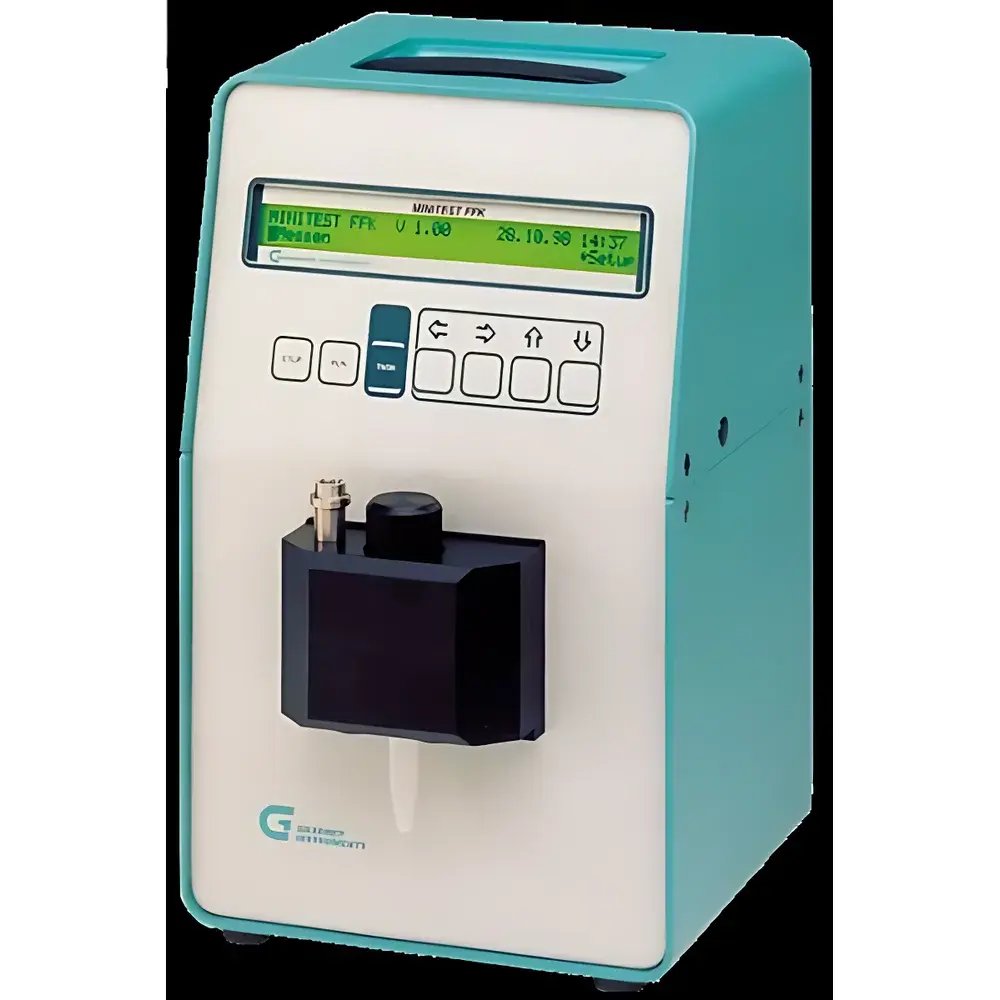
GRABNER MINITEST FFK Automated Grease Low-Temperature Flow Tester
| Brand | GRABNER |
|---|---|
| Origin | Austria |
| Model | MINITEST FFK |
| Product Type | Portable Instrument |
| Standard Compliance | DIN 51805 |
| Temperature Range | –60 to +30 °C |
| Temperature Accuracy | ±0.1 °C |
| Pressure Measurement Range | 0–300 kPa |
| Pressure Accuracy | ±0.1 kPa |
| Power Supply | 100–240 V AC, 50/60 Hz, 200 W |
| Dimensions (W×H×D) | 196 × 315 × 175 mm |
| Weight | 10 kg |
| Interface | RS232 |
| Display Languages | English, German |
| Cooling Method | Peltier-based thermoelectric control |
| Sample Handling | Standalone operation, no auxiliary equipment required |
Overview
The GRABNER MINITEST FFK is an automated, benchtop-capable instrument engineered for the precise determination of grease low-temperature flow behavior in accordance with DIN 51805 — the internationally recognized standard for corrosion-resistant lubricant flow testing under sub-ambient conditions. Unlike empirical drop-point or cone penetration methods, the MINITEST FFK applies a controlled, incremental pressure to a standardized grease column confined within a calibrated capillary tube while maintaining rigorously stabilized thermal conditions. The resulting flow onset pressure—defined as the minimum pressure at which continuous extrusion occurs at a specified temperature—is quantified with high reproducibility and traceable metrology. This parameter directly correlates with real-world performance in centralized lubrication systems operating in arctic or alpine environments, where insufficient low-temperature fluidity can lead to feed-line blockage, pump cavitation, or bearing starvation.
Key Features
- Fully automated measurement sequence—from thermal equilibration to pressure ramping and flow detection—eliminating operator-dependent variability and reducing test time by >70% compared to manual DIN 51805 implementations.
- Peltier-based thermoelectric cooling system enables stable, vibration-free temperature control from –60 °C to +30 °C without liquid nitrogen, dry ice, or external chillers—significantly lowering operational cost and infrastructure dependency.
- Integrated high-resolution pressure transducer (0–300 kPa, ±0.1 kPa accuracy) coupled with digital signal conditioning ensures repeatable detection of flow initiation thresholds across multiple test cycles.
- Self-contained architecture: requires no ancillary hardware (e.g., external compressors, refrigerated baths, or vacuum pumps); operates independently with only power input and optional RS232 output.
- Lightweight (10 kg), compact footprint (196 × 315 × 175 mm), and dual-power capability (AC mains or 12 V DC vehicle supply) support field deployment, mobile labs, and OEM integration into lubricant formulation workflows.
- Multi-language UI (English, German) with intuitive menu navigation and on-screen real-time display of temperature, pressure, and status indicators.
Sample Compatibility & Compliance
The MINITEST FFK is validated for use with NLGI Grades 000 through 3 greases—including lithium-, calcium-, aluminum-, and polyurea-thickened formulations—as well as specialty synthetic greases containing ester, PAO, or silicone base stocks. Sample volume requirement is ≤5 mL per test, minimizing material consumption during R&D screening. All measurements comply strictly with the procedural requirements of DIN 51805, including capillary geometry specifications, thermal soak duration (≥15 min at target temperature), and pressure ramp rate (10 kPa/min). The instrument’s calibration protocol follows GRABNER’s internal traceability chain to national metrology institutes (e.g., BEV, Austria), and its design supports audit readiness for GLP and ISO/IEC 17025-accredited laboratories.
Software & Data Management
Data acquisition and reporting are managed via embedded firmware with RS232 serial interface—enabling direct connection to label printers for hard-copy certificates or to Windows-based PCs running terminal emulation or custom SCADA interfaces. Each test record includes timestamp, setpoint temperature, measured temperature deviation, applied pressure profile, detected flow pressure, and pass/fail flag against user-defined specification limits. While the MINITEST FFK does not include proprietary PC software, its ASCII-formatted output is compatible with common laboratory information management systems (LIMS) and statistical process control (SPC) platforms. Audit trail functionality meets baseline requirements for data integrity under FDA 21 CFR Part 11 when paired with appropriate IT governance controls (e.g., user access logs, electronic signatures).
Applications
- Formulation development of low-temperature greases for automotive chassis, wind turbine pitch/yaw systems, and mining equipment operating below –40 °C.
- Quality control release testing of commercial greases against OEM specifications (e.g., VW TL 521 01, Daimler MB 212.3).
- Stability assessment of greases subjected to thermal cycling or long-term cold storage.
- Comparative benchmarking of thickener efficiency and base oil volatility effects on low-temperature rheology.
- Supporting ASTM D1092 and ISO 2137 correlation studies where flow pressure serves as a proxy for apparent viscosity at shear rates approximating central lubrication delivery conditions.
FAQ
Does the MINITEST FFK require calibration certification prior to first use?
Yes. Each unit ships with a factory calibration certificate referencing DIN 51805 verification procedures and traceable to accredited standards. Annual recalibration is recommended for regulated environments.
Can the instrument be used with non-standard capillary geometries?
No. Compliance with DIN 51805 mandates strict adherence to defined capillary dimensions (inner diameter 1.0 ±0.02 mm, length 50 ±1 mm); only GRABNER-supplied, certified capillaries ensure valid results.
Is pressure data logged continuously or only at flow onset?
Pressure is sampled at 10 Hz throughout the entire ramp cycle; full time-series datasets are available via RS232 for post-test analysis.
What maintenance is required for the Peltier cooling module?
No routine maintenance is needed. The solid-state thermoelectric system has no moving parts or consumables; periodic inspection of heat-sink cleanliness and ambient ventilation is sufficient.
How does the MINITEST FFK compare to ASTM D1092 “Drop Point” testing?
DIN 51805 (MINITEST FFK) measures functional flow resistance under pressure at defined sub-zero temperatures, whereas ASTM D1092 determines the temperature at which grease softens enough to drip—a fundamentally different physical endpoint with limited correlation to actual pumping performance.



