
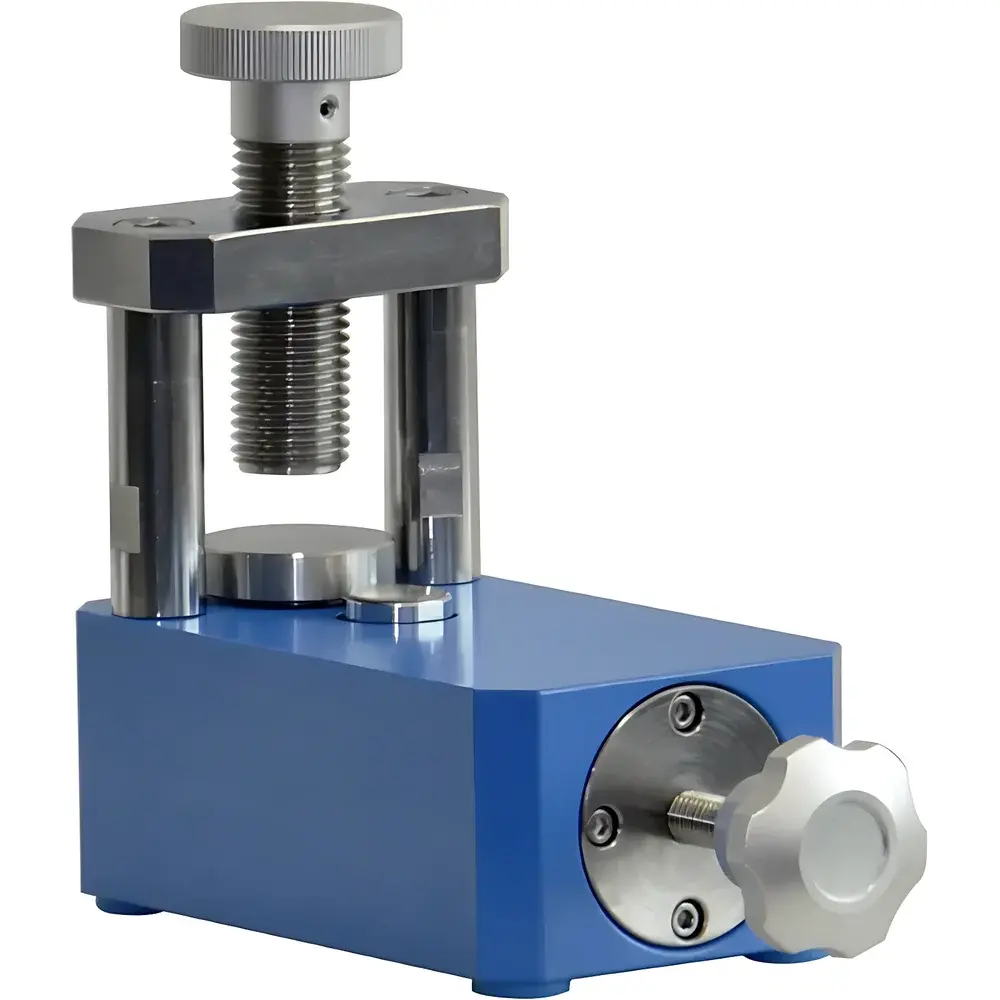
Top Instruments FW-2 Dedicated Φ7 mm Micro-Pellet Die Set for Laboratory Powder Press
| Brand | Top Instruments (TP) |
|---|---|
| Origin | Tianjin, China |
| Manufacturer Type | OEM Manufacturer |
| Origin Category | Domestic (China) |
| Model | FW-2 |
| Pricing | Upon Request |
| Pressure Range | 0–20 kN |
| Die Cavity Diameter | Φ7 mm |
| Cavity Depth | 5 mm |
| Punch Material | Tungsten Carbide |
| Punch Hardness | HRC > 65 |
| Die Material | AISI 304 Stainless Steel |
| Piston Diameter | Φ28 mm |
| Piston Stroke | 5 mm |
| Column Count | 2 |
| Column Spacing | 54 × 55 mm |
| Overall Dimensions (Press-Compatible Assembly) | 100 × 220 × 220 mm |
| Compact Die Unit Dimensions | 76 × 30 × 70 mm |
| Total Weight (Press + Die) | 4.8 kg |
| Die Set Weight | 0.35 kg |
Overview
The Top Instruments FW-2 Dedicated Φ7 mm Micro-Pellet Die Set is a precision-engineered tooling solution designed exclusively for integration with manual or hydraulic laboratory powder presses—particularly those requiring reproducible, small-batch sample compaction for spectroscopic, X-ray diffraction (XRD), and elemental analysis applications. Unlike generic die systems, the FW-2 is dimensionally optimized to deliver uniform axial load distribution across a fixed 7 mm diameter cavity with precisely controlled 5 mm depth, ensuring consistent pellet geometry, density, and surface flatness critical for quantitative FTIR transmission measurements, KBr pellet preparation, and pressed-powder XRF calibration standards. Its modular architecture allows rapid installation and removal without realignment, maintaining mechanical concentricity between punch and die bore under loads up to 20 kN (equivalent to 2 metric tons-force). The system operates on fundamental principles of uniaxial cold compaction, where applied pressure induces particle rearrangement, elastic/plastic deformation, and interparticle bonding—enabling formation of mechanically stable, low-porosity pellets suitable for downstream instrumental analysis.
Key Features
- High-precision Φ7 mm cylindrical cavity with ±0.005 mm tolerance and mirror-finish internal surface (Ra < 0.2 µm) to minimize wall friction and ensure ejection integrity
- Tungsten carbide punch with HRC > 65 hardness and polished working face—resistant to galling, wear, and micro-chipping during repeated high-pressure cycles
- AISI 304 stainless steel die body offering corrosion resistance, non-magnetic properties, and compatibility with acidic or halogenated sample matrices
- Two-column rigid support frame (54 × 55 mm spacing) providing lateral stability and minimizing deflection-induced eccentric loading during compression
- Short 5 mm piston stroke optimized for rapid cycle time while maintaining full cavity fill control—especially advantageous for low-density, cohesive powders
- Compact footprint (76 × 30 × 70 mm for die unit alone) enabling use in confined glovebox environments or inert-atmosphere press enclosures
Sample Compatibility & Compliance
The FW-2 die set accommodates a broad spectrum of inorganic and organic powdered materials—including metal oxides, pharmaceutical actives (APIs), geological reference materials, catalyst precursors, and polymer blends—provided particle size distributions fall within the D50 range of 1–100 µm. It supports both binder-free compaction and formulations incorporating microcrystalline cellulose, KBr, or polyethylene as binding agents. All wetted components comply with ISO 8502-3 for surface cleanliness validation and meet general requirements for GLP-compliant sample preparation workflows. While not certified to ISO/IEC 17025 as a standalone instrument, the FW-2 is routinely deployed in laboratories accredited to ISO/IEC 17025:2017 for materials testing, where its dimensional traceability (calibrated via coordinate measuring machine per ISO 10360-2) and documented material certifications support audit readiness.
Software & Data Management
As a passive mechanical tooling component, the FW-2 does not incorporate embedded electronics or firmware. However, it is fully compatible with digital press controllers supporting force feedback logging (e.g., via USB-connected load cells), enabling correlation of applied load (kN), dwell time (s), and resulting pellet thickness (measured post-ejection with micrometer or laser displacement sensor). Users may integrate FW-2 operation into LIMS or ELN platforms by recording metadata—including lot number, operator ID, ambient RH/temperature, and target density—alongside spectral or diffraction data generated from resulting pellets. For regulated environments, electronic records generated using validated press control software may be structured to satisfy FDA 21 CFR Part 11 requirements for audit trails and electronic signatures.
Applications
- Preparation of standardized KBr pellets for mid-IR spectroscopy (ASTM E1252, ISO 18387)
- Formation of homogenous pressed pellets for wavelength-dispersive XRF quantification (ISO 29541, ASTM E1621)
- Compaction of battery cathode/anode powders for electrochemical characterization and cross-sectional SEM analysis
- Routine QC pellet fabrication in pharmaceutical labs adhering to USP <1119> and ICH Q5C guidelines
- Reference material certification workflows requiring matrix-matched pellet geometry across multiple batches
FAQ
Is the FW-2 die set compatible with non-Top Instruments presses?
Yes—its standardized mounting interface (flat-bottomed, center-pinned design) ensures mechanical interoperability with most benchtop hydraulic and manual presses featuring ≥Φ30 mm platen clearance and vertical stroke ≥5 mm.
Can the die be cleaned with organic solvents without compromising integrity?
Yes—AISI 304 stainless steel and tungsten carbide are chemically inert toward ethanol, acetone, chloroform, and dilute acids; ultrasonic cleaning is recommended for residue removal.
What is the maximum recommended operating pressure to preserve long-term dimensional accuracy?
For optimal service life exceeding 5,000 cycles, sustained operation below 18 kN is advised; peak loads up to 20 kN are permissible for short-duration calibration or R&D use.
Does Top Instruments provide NIST-traceable calibration documentation for the die dimensions?
Upon request, a Certificate of Conformance (CoC) including CMM measurement reports for cavity diameter, depth, and concentricity—traceable to NIST SRM 2191a—is available at time of shipment.






