
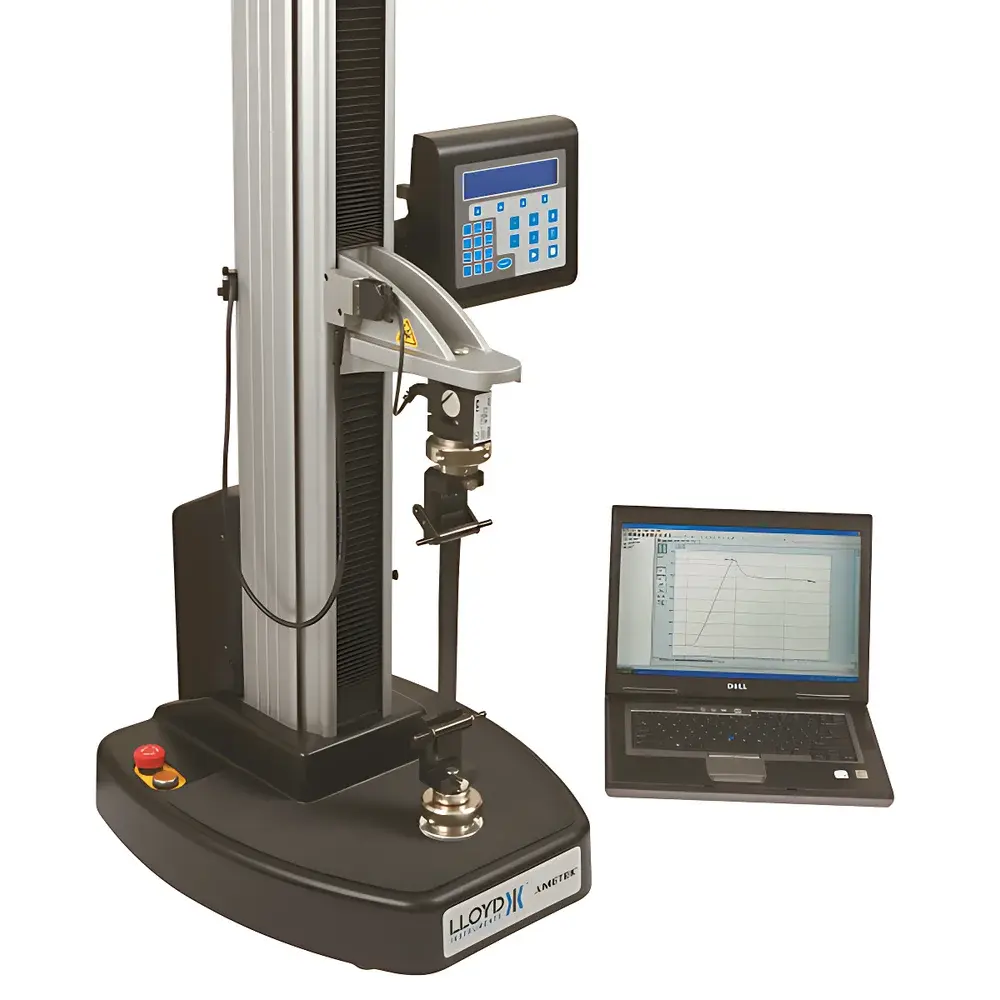
Lloyd Instruments LS Series Universal Testing Machine
| Brand | Lloyd Instruments |
|---|---|
| Origin | USA |
| Model | LS1, LS2.5, LS5 |
| Type | Electromechanical Universal Testing Machine |
| Compliance | ASTM E4, ISO 7500-1, ISO 5893, USP <1041>, FDA 21 CFR Part 11 (via NEXYGENPlus software) |
| Load Frame Design | Benchtop, High-Rigidity Dual-Column Architecture |
| Sensor Interface | Auto-Detecting YLC Series Load Cells |
| Software Platform | NEXYGENPlus v6.x (Windows 10/11 compatible) |
| Test Space | Up to 1,050 mm vertical travel (LS5), 760 mm (LS2.5), 560 mm (LS1) |
| Maximum Load Capacity | 1 kN (LS1), 2.5 kN (LS2.5), 5 kN (LS5) |
| Crosshead Speed Range | 0.001–2,000 mm/min (programmable in 0.001 mm/min increments) |
| Position Resolution | 0.1 µm |
| Force Resolution | 1 part in 500,000 of full scale |
| Data Acquisition Rate | Up to 10 kHz |
| Environmental Operating Range | 10–40 °C, 20–80% RH non-condensing |
Overview
The Lloyd Instruments LS Series Universal Testing Machine is an electromechanical force-testing platform engineered for precision mechanical characterization of materials across research, quality control, and regulatory-compliant production environments. Built upon a high-rigidity dual-column benchtop architecture, the LS system employs closed-loop servo-controlled actuation to deliver traceable, repeatable force and displacement measurements under tensile, compression, flexure, peel, puncture, and shear loading conditions. Its measurement principle adheres to fundamental mechanical metrology standards—force is transduced via calibrated YLC-series load cells compliant with ISO 7500-1 Class 0.5 accuracy, while position is resolved using high-resolution optical encoders synchronized with real-time data acquisition at up to 10 kHz. Designed for integration into GLP- and GMP-aligned workflows, the LS Series supports audit-trail-enabled test execution, electronic signatures, and 21 CFR Part 11 compliance when operated with NEXYGENPlus software—making it suitable for regulated sectors including medical device validation, pharmaceutical packaging integrity testing, and ISO 13485-certified manufacturing.
Key Features
- Benchtop footprint with scalable vertical test space: 560 mm (LS1), 760 mm (LS2.5), and 1,050 mm (LS5), enabling large-sample or multi-specimen configurations without floor-standing infrastructure.
- Auto-sensing YLC load cell interface: Plug-and-play recognition of calibrated load cells ranging from 5 N to 5 kN, eliminating manual configuration and reducing setup errors.
- Precision crosshead motion control: Programmable speed range from 0.001 to 2,000 mm/min with sub-micron positioning resolution (0.1 µm) and force resolution down to 1 part in 500,000 of full scale.
- NEXYGENPlus v6.x software suite: Fully integrated test method library supporting over 120 pre-validated ASTM, ISO, DIN, and JIS methods—including ASTM D882 (thin plastic films), ISO 1133 (melt flow index accessories), ASTM F88 (peel strength), and ISO 1421 (rubber tensile).
- Modular accessory ecosystem: Compatible with >200 standardized fixtures—including pneumatic grips, wedge-action clamps, bend fixtures, puncture probes, and environmental chambers (−70 to +300 °C)—enabling rapid reconfiguration for diverse material classes.
- Regulatory-ready data management: Built-in electronic signature support, user access levels, audit trail logging, and PDF/Excel report export with embedded metadata (test parameters, calibration history, operator ID, timestamp).
Sample Compatibility & Compliance
The LS Series accommodates specimens ranging from micro-scale biomedical sutures (<0.1 mm diameter) to macro-scale composite laminates (up to 300 mm wide). It is routinely deployed for mechanical evaluation of polymers, elastomers, foams, adhesives, textiles, paperboard, pharmaceutical blister packs, orthopedic implant coatings, and flexible electronics substrates. All systems are supplied with factory calibration certificates traceable to NIST and UKAS-accredited standards. Mechanical verification follows ASTM E4 and ISO 7500-1 protocols; software validation documentation is available for IQ/OQ/PQ execution in regulated laboratories. The platform meets essential requirements for ISO/IEC 17025 accreditation when used with documented SOPs and periodic inter-laboratory verification.
Software & Data Management
NEXYGENPlus serves as the central command interface for test design, execution, analysis, and reporting. Its modular architecture supports custom method development using drag-and-drop logic blocks—enabling conditional branching (e.g., “hold at 80% yield stress for 60 s”), cyclic profiling, and multi-stage ramp-hold sequences. Real-time curve overlay, automatic yield point detection (0.2% offset, tangent, or inflection methods), and modulus calculation per ASTM D638 or ISO 527 are embedded. Raw data exports include .csv, .txt, and native .nxd formats; reports generate directly to Microsoft Word and Excel via COM automation—preserving formatting, charts, and statistical summaries. For enterprise deployment, NEXYGENPlus integrates with LIMS and ELN platforms via ODBC and RESTful API endpoints.
Applications
- Medical device mechanical validation: Suture tensile strength (ASTM D2256), balloon burst pressure (ISO 10555-4), catheter column strength (ISO 80369-7).
- Pharmaceutical packaging: Blister peel adhesion (ASTM F88), child-resistant closure torque (ISO 8317), film puncture resistance (ASTM F1306).
- Automotive polymer QA: Tensile modulus of PP composites (ISO 527-2), rubber hardness correlation (ASTM D412), gasket compression set (ISO 815).
- Academic materials science: Strain-rate-dependent behavior of hydrogels, creep-recovery analysis of thermoplastics, interfacial fracture energy of laminates.
- Consumer packaging R&D: Seal integrity of pouches, tear propagation resistance of metallized films, drop-test simulation via controlled impact loading.
FAQ
What load cell options are supported on the LS Series?
The LS platform natively supports Lloyd’s YLC-series load cells from 5 N to 5 kN, all featuring integral TEDS (Transducer Electronic Data Sheet) for automatic identification, calibration parameter recall, and temperature compensation.
Can NEXYGENPlus generate 21 CFR Part 11-compliant reports?
Yes—when configured with role-based user accounts, electronic signatures, and audit trail logging enabled, NEXYGENPlus satisfies core Part 11 requirements for record retention, authenticity, and tamper evidence.
Is thermal testing possible with the LS Series?
Yes—optional environmental chambers (from -70 °C to +300 °C) mount directly to the LS frame and integrate seamlessly with NEXYGENPlus for synchronized temperature ramping and mechanical loading profiles.
How often does the system require recalibration?
Lloyd recommends annual verification against traceable standards; however, internal verification checks can be performed daily or per-shift using certified reference load blocks and displacement artifacts per ISO 7500-1 Annex B.
Does the LS Series support third-party夹具 or custom fixtures?
Yes—the machine uses standardized M6 and 1/4″-20 threaded mounting interfaces, and mechanical drawings for fixture adapters are available under NDA for OEM integration or in-house machining.



