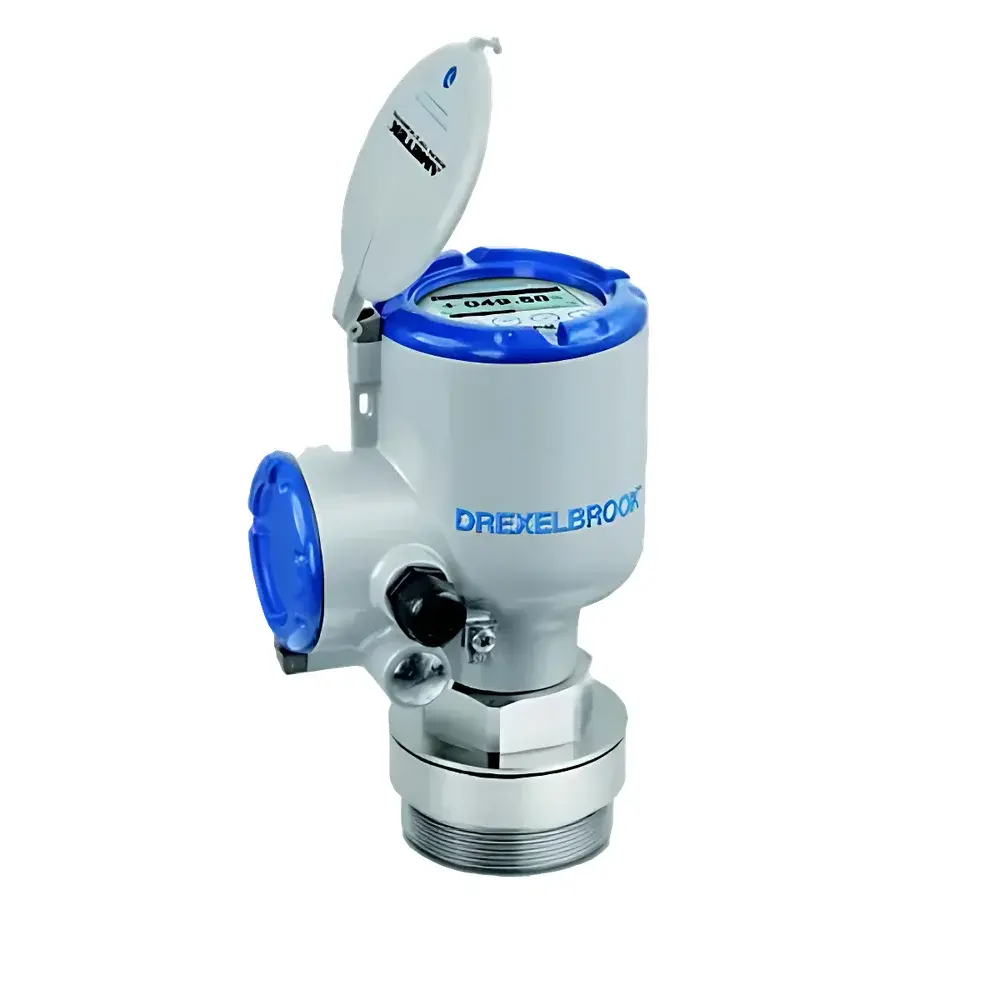
Drexelbrook DR7500 Series FMCW Radar Level Transmitter
| Brand | Drexelbrook |
|---|---|
| Origin | Shanghai, China |
| Manufacturer Type | Authorized Distributor |
| Product Category | Domestic (China-Made) |
| Model | DR7500 Series |
| Output Signal | 4–20 mA with HART Protocol |
| Power Supply | 2-Wire Loop-Powered |
| Measurement Principle | Frequency-Modulated Continuous Wave (FMCW) Radar |
| Max. Measuring Range | 100 m |
| Accuracy | ±2 mm |
| Beam Angle | As low as 4° |
| Antenna Type | Planar Convex Lens Antenna |
| Process Temperature Range | –50 °C to +150 °C (configurable options) |
| Process Pressure Rating | –0.1 MPa to +4 MPa |
| Environmental Suitability | High-dust, high-turbulence, and obstructed-vessel applications |
| Advanced Functionality | Empty-Tank Analysis (ETA), Dynamic Interference Suppression, Fast-Moving Target Tracking |
Overview
The Drexelbrook DR7500 Series is a high-frequency, frequency-modulated continuous wave (FMCW) radar level transmitter engineered for precision, reliability, and adaptability in demanding industrial process environments. Operating at 80 GHz, the DR7500 leverages narrow-beam focusing and advanced signal processing to deliver millimeter-level accuracy—even in vessels with internal obstructions, limited diameter (narrow tanks), or turbulent surface conditions. Unlike pulse-based radar transmitters, FMCW technology continuously sweeps across a defined frequency band and calculates distance by measuring the frequency difference between transmitted and reflected signals—enabling superior signal-to-noise ratio, enhanced resolution, and immunity to false echoes from tank walls, agitators, ladders, or heating coils. Its planar convex lens antenna provides consistent beam shaping without mechanical moving parts, ensuring long-term stability and minimal maintenance over extended service life.
Key Features
- 80 GHz FMCW radar operation for ultra-narrow beam divergence (as low as 4°), minimizing side-lobe interference and improving targeting accuracy in complex vessel geometries.
- Planar convex lens antenna design—non-contact, corrosion-resistant, and optimized for consistent energy distribution under thermal cycling and vibration.
- 2-wire loop-powered architecture with integrated HART 7 protocol support, enabling seamless integration into legacy and modern DCS/PLC systems for diagnostics, configuration, and real-time parameter monitoring.
- Empty-Tank Analysis (ETA) algorithm dynamically characterizes tank geometry during commissioning and continuously adapts echo interpretation to suppress fixed-path reflections (e.g., nozzles, supports, weld seams).
- High dynamic response capability—capable of tracking rapid level changes and even fast-moving solid surfaces (e.g., conveyor-fed bulk solids, cascading slurry flows) with sub-second update rates.
- Robust process rating: configurable for operating temperatures from –50 °C to +150 °C and pressures from vacuum (–0.1 MPa) up to 4 MPa, validated per IEC 61508 SIL 2 functional safety requirements.
Sample Compatibility & Compliance
The DR7500 Series is certified for use across liquid, slurry, paste, and bulk solid applications—including aggressive chemicals, viscous oils, abrasive slurries, and dusty powders. It meets ATEX II 1G Ex ia IIC T6 Ga, IECEx ia IIC T6 Ga, and UL/cULus Class I, Div 1, Groups A–D hazardous area classifications. Electromagnetic compatibility complies with IEC 61326-1 (industrial environment) and IEC 61000-6-2/6-3. The device supports traceable calibration and audit-ready data logging aligned with ISO/IEC 17025 laboratory practices and GLP/GMP operational frameworks. Optional firmware versions include FDA 21 CFR Part 11-compliant electronic signature and change-control functionality for regulated pharmaceutical and food-grade processes.
Software & Data Management
Configuration and diagnostics are performed via Drexelbrook’s PC-based LevelView™ software or through HART-enabled handheld communicators (e.g., AMS Device Manager, FieldCare). The DR7500 supports full HART variable mapping—including primary level value, signal quality index, echo curve visualization, temperature-compensated output, and diagnostic status flags (e.g., “Signal Weak”, “Echo Clutter Detected”, “Antenna Coating Alert”). All configuration changes are timestamped and logged with user ID attribution when connected to a compliant asset management system. Firmware updates are delivered via secure signed packages, preserving integrity and version control in accordance with IEC 62443-3-3 cybersecurity guidelines.
Applications
- Chemical processing: Level monitoring of corrosive reagents, solvents, and polymer melts in pressurized reactors and distillation columns.
- Water and wastewater: Interface detection in oil/water separators, sludge level control in digesters, and influent flow balancing in lift stations.
- Power generation: Condensate tank level supervision, coal bunker inventory, and limestone slurry storage in flue gas desulfurization (FGD) systems.
- Food & beverage: Hygienic-level measurement of dairy products, syrups, and fermenting wort in sanitary stainless-steel vessels with CIP/SIP compatibility.
- Mining & minerals: High-dust silo level tracking for cement, fly ash, and iron ore fines—resistant to buildup and particulate scattering effects.
FAQ
What distinguishes FMCW radar from pulse radar in level measurement?
FMCW radar continuously transmits a swept-frequency signal and computes distance from the beat frequency between transmitted and received waves—delivering higher resolution, better signal discrimination in cluttered vessels, and immunity to amplitude-based noise sources.
Can the DR7500 measure interface levels (e.g., oil/water)?
Yes—when configured with dual-echo analysis mode and appropriate dielectric contrast (>10), it reliably detects and reports both upper and lower interface positions in stratified media.
Is remote configuration supported over HART without physical access?
Yes—HART multidrop or point-to-point communication allows full parameter access, live echo curve review, and firmware updates via existing control system infrastructure.
How does Empty-Tank Analysis improve measurement reliability?
ETA captures and stores static reflection signatures during initial commissioning, then subtracts them in real time—effectively eliminating false echoes from permanent internal structures.
Are custom antenna materials available for extreme chemical exposure?
Yes—optional PTFE-coated, Hastelloy C-276, or ceramic-faced antennas are available to extend service life in highly corrosive or abrasive process environments.