
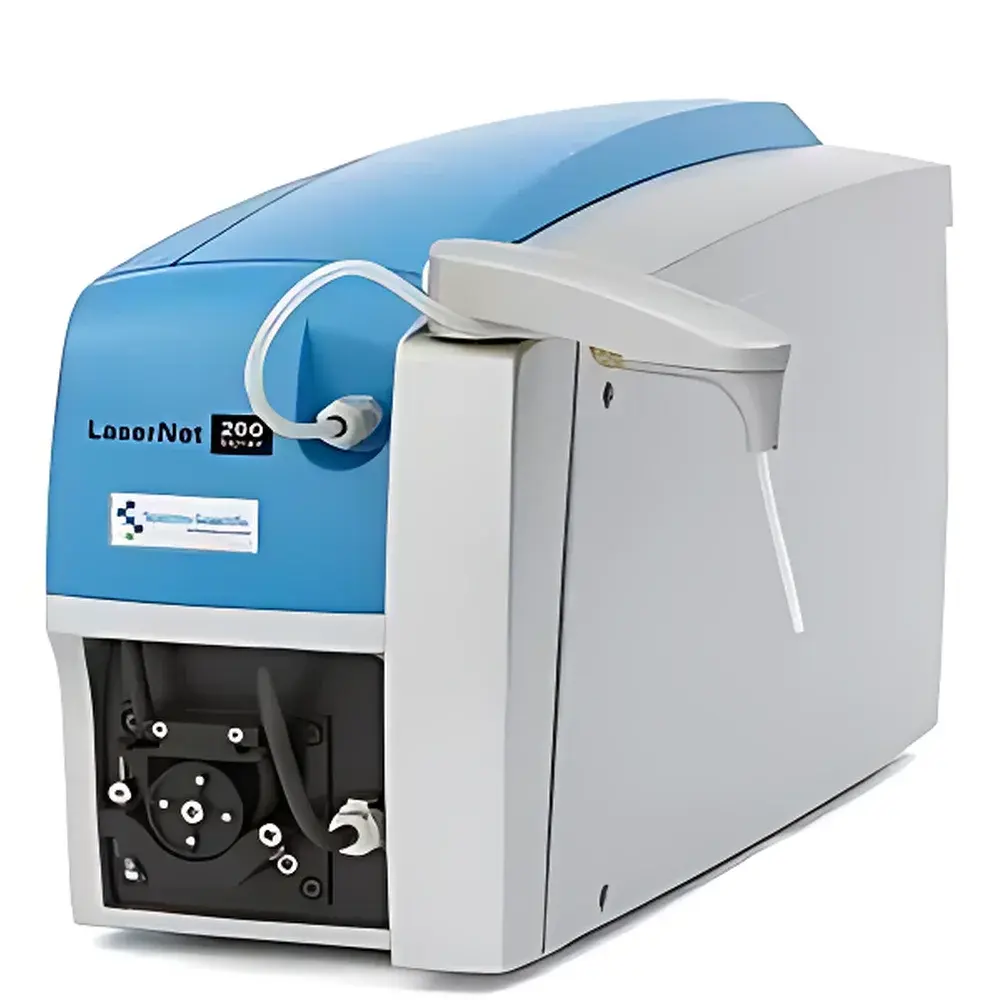
Spectro Scientific LaserNet 230 Multi-Parameter Wear Debris Analyzer
| Brand | Spectro Scientific |
|---|---|
| Origin | USA |
| Manufacturer | Yes |
| Import Status | Imported |
| Model | LaserNet 230 |
| Product Category | Laboratory Instrument |
| Detection Scope | Tribological Wear & Contamination Analysis |
| Compliance | ASTM D7596, ASTM D8120, ISO 4406, NAS 1638, SAE AS4059, GOST, HAL, NAVAIR 01-1A-17 |
| Particle Sizing Range | 4–100 µm |
| Saturation Limit | ≤2% error at up to 10⁷ particles/mL |
| Viscosity Compatibility | ISO VG 15–320 (undiluted) |
| Ferrous Detection Time | 20 s |
| Ferrous Size Resolution | ≥25 µm |
| Non-Ferrous Particle Classification | ≥20 µm |
| Auto-Sampler Option | Yes (ASP, 24-position) |
Overview
The Spectro Scientific LaserNet 230 is a fully automated, direct-imaging wear debris analyzer engineered for precision-based condition monitoring of lubricating oils in critical rotating and reciprocating machinery. Utilizing high-resolution laser microscopy combined with real-time digital image acquisition and AI-assisted morphological classification, the instrument quantifies and categorizes particulate contaminants and wear debris based on size, shape, optical contrast, and magnetic response. Unlike indirect methods such as ferrography or elemental spectroscopy, the LaserNet 230 delivers traceable, morphology-driven diagnostics—enabling root-cause identification of wear mechanisms (e.g., cutting, sliding, fatigue) and contamination ingress (e.g., silica, water droplets, fibers). Designed for integration into predictive maintenance programs, it supports oil health assessment without sample dilution across a broad viscosity range (ISO VG 15–320), including highly sooted turbine and hydraulic fluids.
Key Features
- Direct digital imaging particle analysis compliant with ASTM D7596 for simultaneous automatic particle counting, sizing (4–100 µm), and ISO 4406/NAS 1638 cleanliness code generation
- Ferrous particle detection and quantification per ASTM D8120, reporting large ferrous particle concentration (PPM), percent large ferrous particles (PLFP), and Ferrous Wear Severity Index (FWSI)
- Automated morphological classification of wear debris ≥20 µm into seven distinct categories: cutting wear, sliding wear, fatigue wear, non-metallic particles, water droplets, air bubbles, and fibers—with manual reclassification capability
- Laser auto-gain control enabling reliable imaging of dark, soot-laden oils containing >1% soot without signal saturation or contrast loss
- Differentiation of water droplets and entrained air bubbles via refractive index and edge sharpness algorithms—eliminating false-positive counts in wet or aerated samples
- Integrated ferromagnetic sensor with 20-second measurement cycle for total ferrous content, plus size-resolved distribution of ferrous particles ≥25 µm
- Optional Automated Sample Processor (ASP): 24-position carousel with programmable agitation, post-measurement rinse cycles, and unattended operation supporting up to 250 samples per day in laboratory environments
Sample Compatibility & Compliance
The LaserNet 230 accommodates undiluted mineral oils, synthetic hydrocarbons, polyalphaolefins (PAO), phosphate esters, and distillate fuels within ISO viscosity grades 15–320. Its optical design and fluidic architecture eliminate the need for solvent dilution or filtration pretreatment—reducing analytical bias and operator variability. All reported metrics—including particle counts, size distributions, cleanliness codes, and FWSI values—are traceable to internationally recognized standards: ASTM D7596 (imaging-based particle analysis), ASTM D8120 (ferrous quantification), ISO 4406 (contamination coding), NAS 1638 (aerospace fluid cleanliness), SAE AS4059 (aviation fluid standards), and GOST/RU standards for industrial lubricants. The system meets GLP/GMP documentation requirements through audit-ready data logging, user-access controls, and electronic signature support aligned with FDA 21 CFR Part 11 principles.
Software & Data Management
The LaserNet 230 operates via Spectro’s proprietary NetLube™ software platform, which provides full instrument control, real-time image review, trend analytics, and customizable reporting. Raw image archives, metadata logs (including timestamp, operator ID, calibration status, and environmental parameters), and classified particle datasets are stored in a secure SQL database with version-controlled backups. Trending tools enable longitudinal analysis of FWSI, ferrous PPM, non-ferrous category ratios, and cleanliness code shifts—supporting statistical process control (SPC) and failure mode forecasting. Export formats include CSV, PDF, and XML for integration with CMMS (Computerized Maintenance Management Systems) and enterprise LIMS platforms. Software validation documentation (IQ/OQ/PQ protocols) and cybersecurity hardening (TLS 1.2+, role-based access, session timeout) are available for regulated industries.
Applications
The LaserNet 230 serves reliability engineers, tribologists, and lubrication analysts in power generation, aerospace, marine propulsion, wind energy, heavy equipment manufacturing, and rail transportation. Typical use cases include early-stage detection of gear pitting, bearing spalling, piston ring scuffing, and hydraulic valve erosion; verification of filter efficiency and breather integrity; root-cause analysis following unscheduled downtime; and qualification of new lubricants or re-refined oils. Its ability to distinguish between mechanical wear signatures and environmental contamination makes it indispensable for forensic oil analysis during warranty investigations and asset life-cycle assessments.
FAQ
Does the LaserNet 230 require oil dilution prior to analysis?
No—samples are analyzed undiluted across ISO VG 15–320, eliminating dilution-related errors and preserving native particle dispersion.
How does the system differentiate water droplets from air bubbles?
Using dual-parameter image analysis: water droplets exhibit higher edge contrast and spherical symmetry under laser illumination, while air bubbles show lower optical density and variable meniscus geometry.
Can the LaserNet 230 be validated for GxP compliance?
Yes—NetLube™ supports 21 CFR Part 11-compliant electronic records, audit trails, and user authentication; IQ/OQ/PQ documentation packages are provided.
What is the minimum detectable ferrous particle size for FWSI calculation?
FWSI is derived from particles ≥25 µm; total ferrous mass includes contributions from all magnetically responsive particles within the 4–100 µm sizing range.
Is the ASP module compatible with all LaserNet 230 configurations?
Yes—the Automated Sample Processor is an optional add-on that integrates seamlessly with any LaserNet 230 unit and supports full walk-away operation with scheduled cleaning protocols.






