
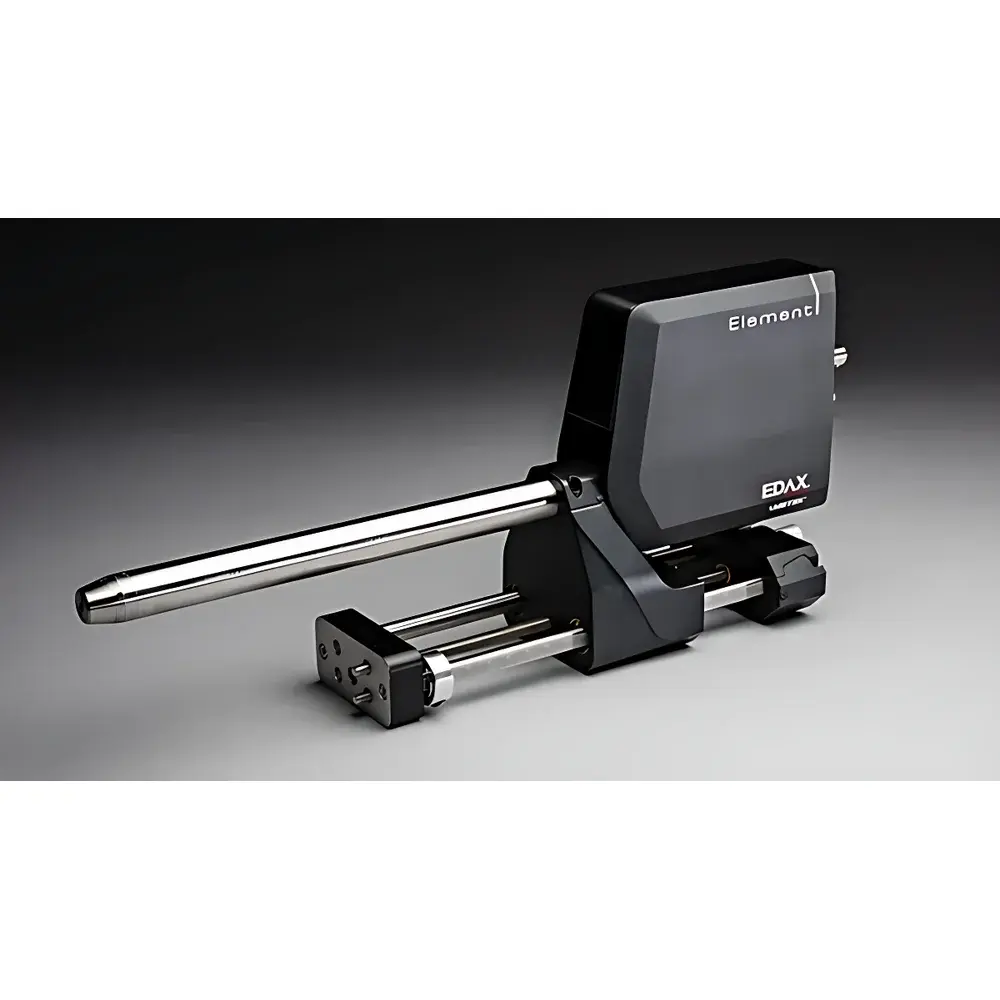
EDAX Element Energy Dispersive Spectrometer
| Brand | EDAX |
|---|---|
| Origin | USA |
| Manufacturer Type | Authorized Distributor |
| Origin Category | Imported |
| Model | Element |
| Quotation | Upon Request |
| Energy Resolution | 129 eV (Mn Kα) |
| Peak-to-Background Ratio | 10,000:1 |
| Maximum Count Rate | 500 kcps |
| Detector Active Area | 30 mm² |
Overview
The EDAX Element Energy Dispersive Spectrometer (EDS) is a high-performance, compact silicon drift detector (SDD)-based microanalysis system engineered for integration with scanning electron microscopes (SEM) and transmission electron microscopes (TEM). It operates on the principle of energy-dispersive X-ray spectroscopy, where characteristic X-rays emitted from a specimen under electron beam excitation are resolved by their energy using a solid-state SDD. The Element system delivers exceptional spectral resolution, high count-rate capability, and optimized low-energy X-ray detection—enabling reliable qualitative and quantitative elemental analysis from boron (B, Z=5) to uranium (U, Z=92), with particular sensitivity in the light-element range (C, N, O, F). Designed specifically for industrial laboratories, failure analysis centers, and quality control environments, the Element EDS prioritizes analytical speed, reproducibility, and operational robustness without compromising scientific rigor.
Key Features
- Silicon nitride (Si3N4) ultra-thin window detector: maximizes transmission efficiency for low-energy X-rays (below 1 keV), enabling high-fidelity detection of carbon, nitrogen, oxygen, fluorine, and sodium.
- 129 eV energy resolution at Mn Kα (5.895 keV): ensures precise peak separation and accurate identification of overlapping elemental lines (e.g., Si Kα vs. W Mα, or S Kα vs. Pb Mα).
- 500 kcps maximum input count rate: supports high-beam-current analyses and rapid mapping without significant dead-time distortion or spectral pile-up.
- 30 mm² active detector area: balances collection efficiency with spatial resolution and geometric flexibility for optimal working distance and take-off angle configuration.
- Modular, ruggedized mechanical design: resistant to mechanical shock, plasma cleaning environments, and corrosive laboratory atmospheres—validated for long-term stability in GLP/GMP-compliant production labs.
- Integrated thermoelectric cooling: eliminates liquid nitrogen dependency while maintaining stable detector temperature (–20 °C typical), ensuring consistent spectral calibration over extended acquisition sessions.
Sample Compatibility & Compliance
The Element EDS system is compatible with a broad spectrum of conductive and non-conductive solid samples—including metals, ceramics, polymers, composites, printed circuit boards (PCBs), battery electrodes, and geological thin sections—when paired with standard SEM sample preparation protocols (e.g., carbon or gold sputter coating where required). Its low-voltage performance (down to 5 kV) enables high-spatial-resolution analysis of surface-sensitive features without excessive beam penetration. From a regulatory standpoint, the system supports audit-ready workflows compliant with ISO/IEC 17025, ASTM E1508, and USP guidelines for analytical instrument qualification. APEX™ software includes full electronic signature support, user-access logging, and 21 CFR Part 11–compliant audit trails for regulated pharmaceutical and medical device manufacturing environments.
Software & Data Management
APEX™ is a native 64-bit, multi-threaded software platform developed exclusively for EDAX hardware. It provides real-time spectrum acquisition, live elemental mapping, automated phase identification (via integrated library matching), and standardized quantification using ZAF or φ(ρz) matrix correction models. The interface supports customizable workflow templates, drag-and-drop report generation (PDF, CSV, HTML), and batch processing of large map datasets. All raw spectra and processed results are stored in an open HDF5-based file format, ensuring long-term data integrity and third-party interoperability. Version-controlled software updates, remote diagnostics, and secure network deployment options facilitate centralized IT management across multi-instrument facilities.
Applications
- Failure analysis of electronic components: identification of solder joint intermetallics, contamination on PCB traces, and delamination-related elemental segregation.
- Materials characterization in additive manufacturing: verification of alloy composition homogeneity, detection of oxide inclusions in Ti-6Al-4V powder beds, and porosity-associated elemental partitioning.
- Quality assurance in automotive and aerospace supply chains: rapid verification of coating thickness and composition (e.g., Zn/Ni plating, Al-Si coatings), inclusion analysis in forged aluminum alloys.
- Geoscientific and environmental forensics: mineral phase discrimination in soil particulates, heavy metal speciation in fly ash, and microplastic polymer identification via trace additive fingerprinting.
- Life sciences correlative microscopy: localization of metallic nanoparticles (e.g., Au, Fe3O4) in tissue ultrathin sections alongside TEM imaging.
FAQ
What is the minimum accelerating voltage required for reliable carbon detection?
Carbon Kα (0.277 keV) can be reliably detected at 5 kV beam energy on polished, coated samples; optimal signal-to-noise is achieved at 10–15 kV depending on sample conductivity and topography.
Does the Element EDS require liquid nitrogen cooling?
No—thermoelectric (Peltier) cooling is fully integrated and maintains stable detector operation without cryogen handling or refills.
Can APEX™ software be deployed on virtualized Windows environments?
Yes—APEX™ 64-bit supports VMware Workstation and Microsoft Hyper-V deployments, provided GPU passthrough and real-time I/O latency requirements are met per EDAX’s system validation protocol.
Is spectral deconvolution automated during live acquisition?
Yes—real-time peak fitting using iterative least-squares algorithms is enabled by default, with manual override options for complex overlapping regions (e.g., L-lines in rare-earth elements).
How is detector calibration maintained over time?
APEX™ performs automatic energy calibration using internal Mn Kα reference peaks at startup and during scheduled maintenance cycles; drift compensation is applied dynamically during long-duration mapping sessions.






