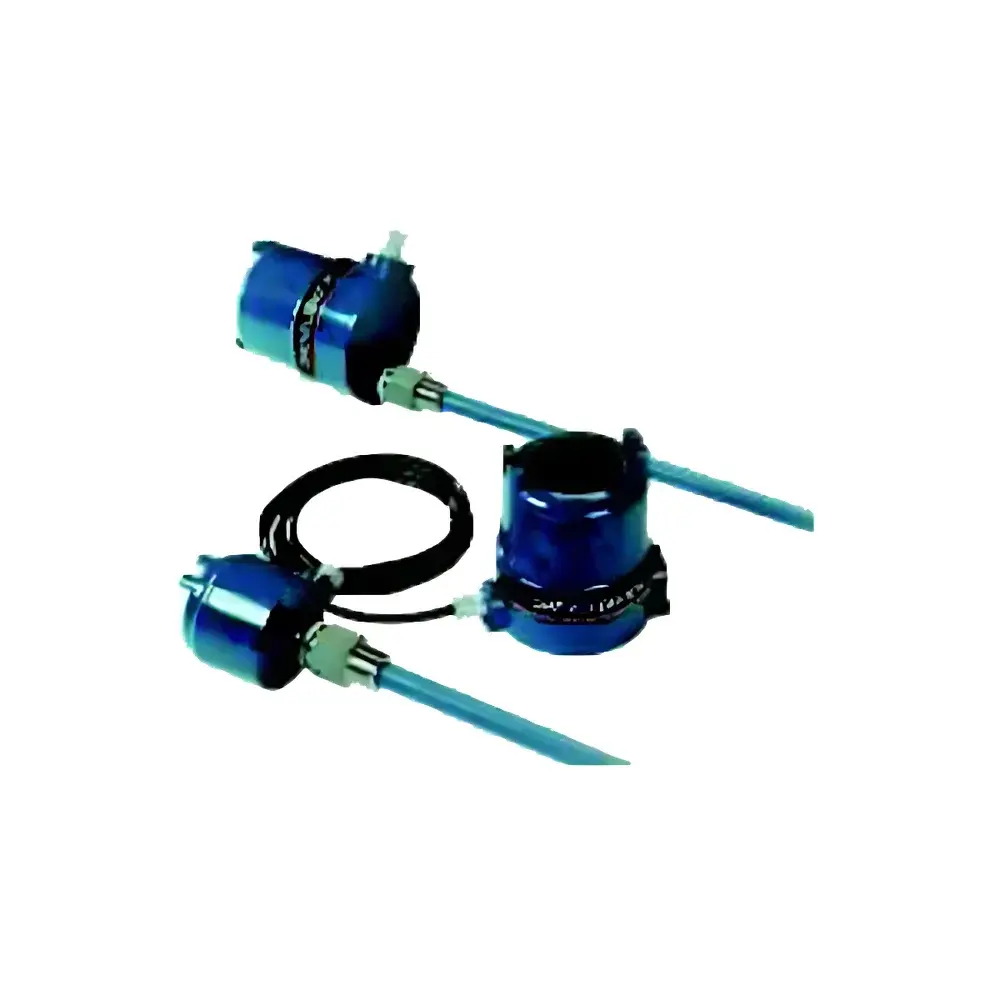
Drexelbrook UII Series RF Admittance Level Transmitter
| Brand | Drexelbrook |
|---|---|
| Origin | Shanghai, China |
| Manufacturer Type | Authorized Distributor |
| Product Category | Domestic (China-made) |
| Model | UII Series RF Admittance Level Transmitter |
| Pricing | Upon Request |
| Product Type | Level Meter |
Overview
The Drexelbrook UII Series RF Admittance Level Transmitter is an industrial-grade continuous level measurement instrument engineered for reliable, high-fidelity detection of liquid, slurry, and interface levels in demanding process environments. It operates on the principle of radio-frequency (RF) admittance — a refined extension of capacitance-based sensing that incorporates conductance and susceptance components to deliver superior immunity to coating, buildup, and dielectric variation. Unlike traditional capacitive sensors, the UII Series actively compensates for parasitic capacitance and stray current paths, enabling stable operation even when probe surfaces accumulate conductive or non-conductive material. Designed for integration into SIL-2-capable safety instrumented systems (SIS), it supports continuous level monitoring in tanks, silos, reactors, and separators across chemical, petrochemical, pharmaceutical, food & beverage, and wastewater treatment applications.
Key Features
- True zero-blind-zone measurement architecture — eliminates dead zones common in guided wave radar or ultrasonic devices
- High-speed response capability up to 4 kHz sampling frequency, suitable for dynamic level control loops requiring rapid feedback
- Robust RF admittance signal processing with adaptive sensitivity tuning to accommodate wide-ranging dielectric constants (εr = 1.2 to 80)
- Configurable two-wire 4–20 mA analog output with HART® 7 protocol support for diagnostics, configuration, and field calibration
- Multiple hazardous area certifications including ATEX II 1/2G Ex ia IIC T6 Ga, IECEx ia IIC T6 Ga, and FM/CSA Class I Div 1 Groups A–D, T6
- Modular mechanical design supporting both integral (compact) and remote-mounted (separated electronics + probe) configurations
- High-temperature and high-pressure variants available — rated up to 250 °C and 100 bar with appropriate probe materials (e.g., Inconel 600, Hastelloy C-276)
- Probe options include rigid rods, flexible cables, and coaxial shielded elements for optimized performance in viscous, foaming, or agitated media
Sample Compatibility & Compliance
The UII Series is validated for use with liquids, emulsions, suspensions, and immiscible liquid–liquid interfaces where dielectric contrast exists between phases. It performs reliably in applications involving aggressive chemicals, high-solids slurries, sticky polymers, and steam-jacketed vessels. The transmitter complies with IEC 61508 (SIL-2 capable), IEC 61000-6-2/-6-4 (EMC immunity and emissions), and IEC 60079-0/-11 (explosive atmospheres). All units undergo factory calibration traceable to NIST standards and are supplied with full test documentation per ISO/IEC 17025 requirements. Optional FAT/SAT protocols align with ASME BPE and FDA 21 CFR Part 11 data integrity expectations for GMP-regulated facilities.
Software & Data Management
Configuration and diagnostics are performed via Drexelbrook’s proprietary PC-based UII Configuration Utility or through HART-enabled handheld communicators (e.g., AMS Device Manager, FieldCare). The utility supports device parameterization, loop verification, step-response testing, and diagnostic logging. Audit trails record all configuration changes with timestamps and user IDs. Firmware updates maintain backward compatibility and incorporate enhancements to noise rejection algorithms and temperature compensation models. Exportable CSV reports include calibration history, alarm logs, and trend snapshots for QA/QC documentation and regulatory review.
Applications
- Continuous level monitoring of caustic soda, sulfuric acid, and hydrocarbon solvents in API manufacturing
- Interface detection between oil/water or solvent/aqueous layers in extraction columns and decanters
- Level control in high-viscosity polymer melt tanks with minimal maintenance downtime
- Non-contact interface measurement in pressurized LNG storage vessels with cryogenic jacketing
- Redundant level safety shutdown in boiler drum level systems compliant with ISA-84.00.01
- Batch-level verification in sanitary CIP/SIP skids meeting 3-A Sanitary Standards
FAQ
What distinguishes RF admittance from basic capacitance measurement?
RF admittance adds conductance and susceptance analysis to standard capacitance sensing, enabling discrimination between true level change and false signals caused by coating, condensation, or vessel wall effects.
Can the UII Series measure interface levels in dual-phase systems?
Yes — when dielectric constants of the upper and lower phases differ sufficiently (Δεr ≥ 5), the UII detects the transition zone with repeatability better than ±1 mm under stable thermal conditions.
Is third-party SIL certification available for the UII Series?
Yes — TÜV Rheinland-certified SIL-2 compliance documentation is provided upon request for specific configuration sets, including proof test intervals and PFD calculations.
How does the transmitter handle heavy build-up on the probe surface?
Its driven-shield technology actively nullifies the effect of adherent material by maintaining equal potential between probe and shield, effectively eliminating error contributions from coating thickness up to 10 mm.
What mounting options are supported for retrofit installations?
Standard flange mounts (ANSI/ISO/DIN), threaded connections (NPT, BSP), and sanitary clamp fittings (Tri-Clamp®, DIN 11851) are available; custom adapters can be engineered for legacy nozzle geometries.