
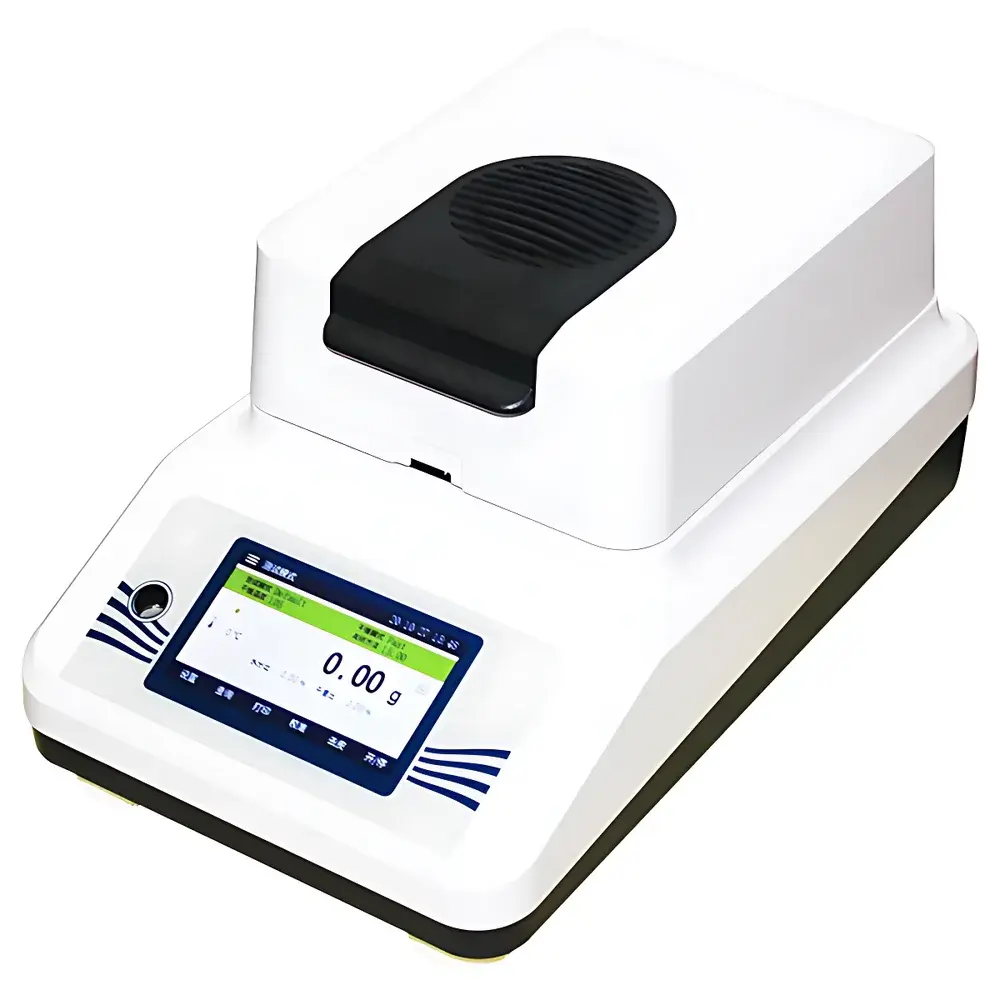
Yoke TSF-100A-1 Infrared Moisture Analyzer with Halogen Heating and 4.3″ Touchscreen
| Brand | Yoke |
|---|---|
| Origin | Shanghai, China |
| Manufacturer | Yoke Instrument Co., Ltd. |
| Model | TSF-100A-1 |
| Heating Method | Halogen Lamp |
| Weighing Range | 0–100 g |
| Readability | 1 mg |
| Repeatability (3 g sample) | ±0.3% |
| Sample Capacity | 0.5–10 g (recommended: 3–10 g) |
| Temperature Range | 50–160 °C (1 °C increments) |
| Drying Time | 1–99 min (1 min increments) |
| Drying Modes | Standard, Rapid |
| Display | 4.3" TFT capacitive touchscreen |
| Interface | USB (printer & PC connectivity) |
| Pan Diameter | 80 mm |
| Dimensions (L×W×H) | 340 × 210 × 180 mm |
| Net Weight | 3.6 kg |
| Operating Environment | 10–30 °C, ≤75% RH |
| Compliance | GB/T 29249–2012 |
Overview
The Yoke TSF-100A-1 Infrared Moisture Analyzer is a precision halogen-based thermogravimetric instrument engineered for rapid, reproducible moisture content determination across solid and semi-solid samples. It operates on the principle of loss-on-drying (LOD), wherein a precisely controlled halogen heating source drives off volatile components—primarily water—while an integrated high-stability weighing system continuously monitors mass loss in real time. Unlike conventional oven-drying methods requiring hours, the TSF-100A-1 achieves final moisture results in minutes, with measurement resolution of 1 mg and moisture readout accuracy to 0.01%. Its design incorporates thermal isolation between the heating module and the load cell—a critical engineering feature that eliminates thermal drift during active drying, ensuring gravimetric integrity throughout the entire test cycle. The instrument conforms to GB/T 29249–2012, the Chinese national standard for electronic moisture analyzers based on the gravimetric drying method, and serves as a validated alternative to ASTM E1447, ISO 712, and USP <921> for routine moisture quantification where regulatory alignment with LOD protocols is required.
Key Features
- Halogen heating system: Delivers uniform, rapid thermal energy (50–160 °C, adjustable in 1 °C steps), enabling accelerated drying without surface charring or thermal degradation of sensitive matrices.
- Thermally isolated monolithic load cell: Prevents heat-induced signal drift, maintaining weighing stability and repeatability of ±0.3% (for 3 g reference samples) under dynamic thermal load.
- 4.3-inch capacitive touchscreen interface: Supports intuitive parameter configuration—including temperature setpoint, drying duration, mode selection (Standard/Rapid), and endpoint criteria—without external software or keyboard input.
- Real-time multi-parameter display: Simultaneously plots moisture %, dry weight %, sample mass (g), temperature (°C), elapsed time (min), and drying mode on a single screen with auto-scaling axes.
- Dual drying protocols: Standard mode prioritizes accuracy via gradual ramp-and-hold profiles; Rapid mode applies maximum power for throughput-critical QC environments—both fully user-definable and repeatable.
- USB host interface: Direct connection to USB printers for GLP-compliant hard-copy reports and to Windows-based PCs for data export (CSV/Excel), audit trail logging, and integration into LIMS or ELN platforms.
Sample Compatibility & Compliance
The TSF-100A-1 accommodates a broad spectrum of non-volatile, low-to-moderate volatility materials including pharmaceutical excipients (lactose, microcrystalline cellulose), food powders (flour, sugar, starch), agricultural grains (corn, soybean meal), chemical intermediates (salts, polymers), and environmental solids (soil, sludge, filter media). Samples must be homogeneous and placed centrally on the 80 mm aluminum pan to ensure uniform heat exposure. The instrument meets GB/T 29249–2012 requirements for measurement uncertainty, temperature uniformity, and drying repeatability. While not inherently 21 CFR Part 11 compliant out-of-the-box, its USB data export functionality supports traceable recordkeeping when paired with validated third-party software for electronic signatures and audit trails—enabling alignment with GMP/GLP documentation practices in regulated laboratories.
Software & Data Management
No proprietary software installation is required for basic operation—the device functions autonomously via its embedded firmware. All measurement data—including timestamped curves, final moisture values, drying parameters, and operator ID (manually entered)—are stored internally and exported via USB as timestamped CSV files. Each exported dataset contains column headers compliant with ISO/IEC 17025 reporting conventions: “Sample_ID”, “Date_Time”, “Initial_Mass_g”, “Final_Mass_g”, “Moisture_%”, “Dry_Weight_%”, “Temp_Setpoint_C”, “Drying_Time_min”, “Mode”, and “Operator”. For enterprise-level deployment, the instrument integrates seamlessly with laboratory informatics systems through standardized serial-over-USB CDC protocols, supporting automated ingestion into QMS or ERP platforms without middleware.
Applications
- Pharmaceutical manufacturing: Raw material release testing per USP <921>; blend uniformity verification; lyophilized product residual moisture validation.
- Food quality control: Batch consistency checks for flour, milk powder, coffee, spices, and pet food; shelf-life modeling support.
- Agricultural commodity trading: Moisture certification of grains, oilseeds, and feedstuffs prior to storage or export.
- Chemical R&D: Solvent residue analysis in catalysts, pigments, and specialty resins.
- Environmental testing labs: Solid waste moisture characterization for landfill disposal compliance (EPA Method 9095B equivalent).
FAQ
What calibration procedures are required before first use?
External calibration using certified weights (e.g., 10 g and 50 g Class M2) is mandatory for mass verification. Temperature calibration is factory-performed using NIST-traceable thermocouple standards and does not require user intervention unless physical damage occurs.
Can the instrument be used for volatile organic compound (VOC) quantification?
No. The TSF-100A-1 measures total volatile loss—not water-specific loss—and cannot distinguish between water and other volatiles (e.g., ethanol, acetone). For selective moisture analysis in VOC-containing samples, Karl Fischer titration remains the appropriate method.
Is automatic endpoint detection supported?
Yes. The instrument employs dual endpoint logic: either mass change threshold (e.g., ≤0.1 mg/30 s) or fixed-time termination. Both modes are programmable and logged with timestamps.
How often should leveling be performed?
Leveling via the four adjustable front/rear feet is required only after relocation or if the internal bubble level indicates tilt. A stable, vibration-isolated benchtop surface is essential for optimal repeatability.
Does the unit support network connectivity (Ethernet/Wi-Fi)?
No. Communication is limited to USB 2.0 host mode. Network integration requires an external USB-to-Ethernet adapter configured at the host PC level, not the analyzer firmware.
Related Products





