
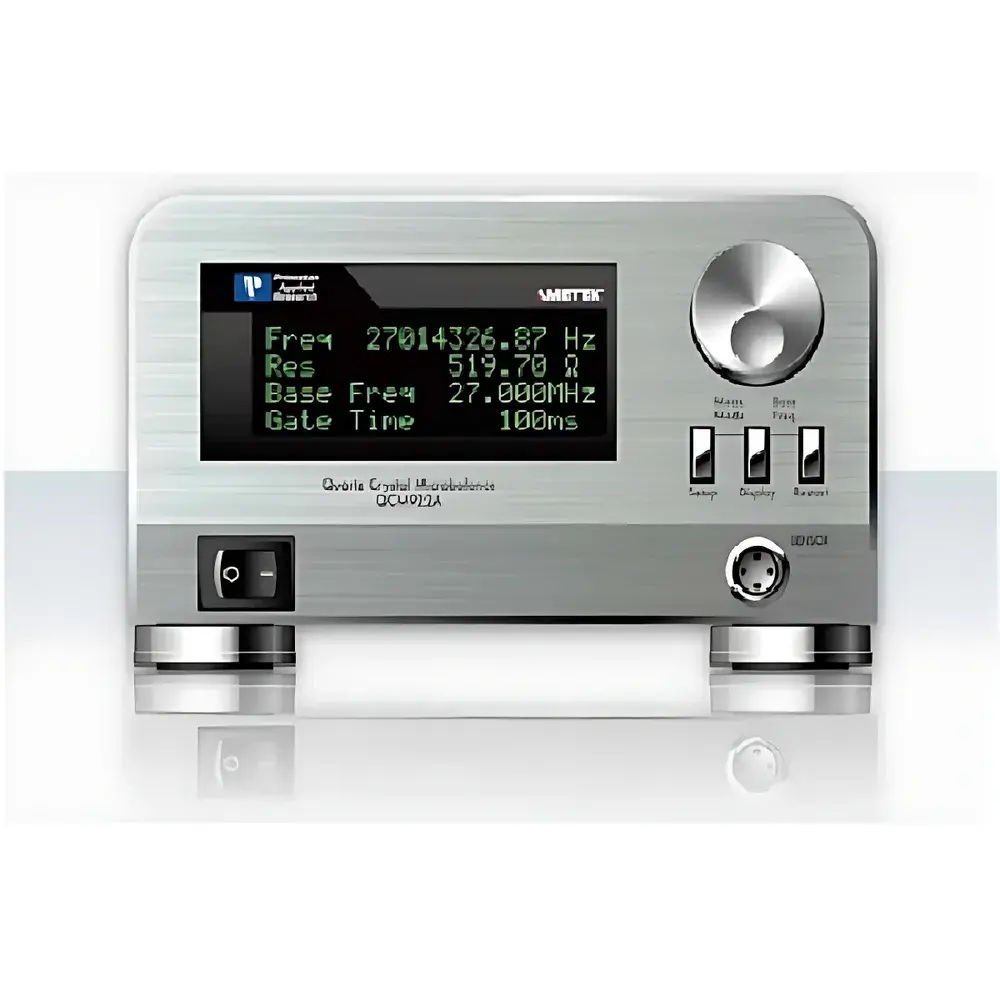
Princeton Applied Research QCM922A Quartz Crystal Microbalance
| Brand | Princeton Applied Research |
|---|---|
| Origin | USA |
| Manufacturer Type | Authorized Distributor |
| Product Origin | Imported |
| Model | QCM922A |
| Pricing | Available Upon Request |
| Frequency Range | 5–30 MHz |
| Frequency Resolution | 0.01 Hz |
| Resistance Range | 1 Ω – 10 kΩ |
| Resistance Resolution | 0.01 Ω |
| Conductance Frequency Characterization Range | 4–30 MHz |
| Δf Analog Output | ±10 V (14-bit), selectable ranges ±100 Hz to ±500 kHz |
| ΔR Analog Output | ±10 V (14-bit), selectable ranges ±10 Ω to ±10 kΩ |
| Analog Inputs | 2 channels, ±3/6/12 V (14-bit) |
| Minimum Time Resolution | 10 ms |
| Display | 20-character 4-line OLED |
| Interface | USB 2.0 |
| Power Supply | AC 100–240 V, 50/60 Hz |
| Dimensions (L×W×H) | 162 × 160 × 95 mm |
| Weight | 1.3 kg |
| Operating Temperature | 5–40 °C, non-condensing |
| Certification | CE |
| Compatible Crystals | 9 MHz AT-cut, 5 mm diameter, electrode materials include Au, Pt, Ag, Al, C, Cu, ITO, Mo, Ni, Si, SiO₂, SUS304, Ti |
Overview
The Princeton Applied Research QCM922A Quartz Crystal Microbalance is a high-precision electrochemical microgravimetric instrument engineered for real-time, in situ monitoring of nanogram-scale mass changes at solid–liquid or solid–gas interfaces. Based on the piezoelectric resonance principle of AT-cut quartz crystals, the QCM922A measures shifts in resonant frequency (Δf) and motional resistance (ΔR) — both governed by the Sauerbrey equation and Kanazawa–Gordon viscoelastic model — enabling quantitative differentiation between rigid mass loading and energy-dissipative (viscoelastic) processes. Unlike conventional single-parameter QCM systems, the QCM922A simultaneously acquires frequency and resistance data at up to 100 Hz sampling rate (10 ms time resolution), supporting dual-mode analysis critical for distinguishing adsorption kinetics from interfacial hydration or polymer swelling. Its extended 5–30 MHz operating range accommodates higher-order overtones for enhanced sensitivity and improved discrimination of surface-confined phenomena in complex electrochemical environments.
Key Features
- Simultaneous high-speed acquisition of crystal frequency (Δf) and motional resistance (ΔR) with independent 14-bit analog outputs for both parameters
- Extended frequency range up to 30 MHz with 0.01 Hz resolution — optimized for overtone analysis and improved signal-to-noise ratio
- Integrated conductance-frequency characterization (4–30 MHz) for probing structural relaxation, phase transitions, and interfacial conductivity changes
- Sub-millisecond temporal resolution (10 ms minimum control interval) enabling kinetic studies of fast electrochemical processes such as Li⁺ insertion/extraction or redox polymer switching
- Full backward compatibility with QCM922 transducers and expanded crystal portfolio including QA-A9M (multi-material electrodes: Au, Pt, ITO, Ti, SiO₂) and QA-A30M (100 nm Au/Ti bilayer, 5 mm diameter)
- Onboard 20-character 4-line OLED display with real-time parameter visualization; USB 2.0 interface for seamless integration with Windows-based acquisition and control software
Sample Compatibility & Compliance
The QCM922A supports a broad spectrum of sample configurations: liquid-phase electrochemical cells (three-electrode setups), gas-phase exposure chambers, and thin-film deposition reactors. Its modular crystal holder accepts standard 5 mm diameter AT-cut quartz sensors with customizable electrode metallizations — including biocompatible Au and Pt for protein binding assays, conductive ITO for transparent electrochemistry, and corrosion-resistant Ti or SUS304 for aggressive electrolytes. All measurements adhere to fundamental metrological traceability principles outlined in ISO/IEC 17025. The system complies with CE marking requirements for electromagnetic compatibility (EMC Directive 2014/30/EU) and low-voltage safety (LVD Directive 2014/35/EU). When operated within validated software environments supporting audit trails and electronic signatures, the QCM922A can be deployed in GLP- and GMP-regulated laboratories for method development and stability-indicating assays per USP and FDA 21 CFR Part 11 guidelines.
Software & Data Management
The QCM922A is controlled via Princeton Applied Research’s QCM Control Suite — a Windows-native application providing synchronized potentiostat/QCM operation, multi-channel time-series logging, and FFT-based spectral analysis of conductance dispersion. Raw Δf and ΔR datasets are stored in HDF5 format with embedded metadata (timestamp, temperature, applied potential, crystal ID), ensuring FAIR (Findable, Accessible, Interoperable, Reusable) data practices. Export options include CSV, MATLAB .mat, and ASCII-compatible formats compatible with third-party modeling tools (e.g., COMSOL Multiphysics® for viscoelastic inversion, Python SciPy for kinetic fitting). The software supports automated calibration routines using reference crystals and includes built-in Sauerbrey and Voigt-model fitting modules with uncertainty propagation for mass and viscosity calculations.
Applications
- Real-time monitoring of biomolecular interactions (e.g., antigen–antibody binding, DNA hybridization) under physiological buffer conditions
- In situ characterization of conducting polymer growth/dedoping and redox-switchable hydrogel swelling
- Electrochemical quartz crystal microgravimetry (EQCM) studies of lithium-ion battery electrode materials during cycling, quantifying SEI formation and reversible Li storage
- Gas-phase sensing of humidity, volatile organic compounds (VOCs), and odorants via functionalized sensor surfaces
- Quantitative assessment of surface cleanliness in semiconductor wafer processing using ultrathin hydrophobic/hydrophilic coatings
- Thickness and density profiling of atomic layer deposited (ALD) films and self-assembled monolayers (SAMs)
- Structural evolution analysis of soft matter interfaces through conductance-frequency dispersion mapping
FAQ
What is the minimum detectable mass change using the QCM922A?
The theoretical mass sensitivity depends on the fundamental resonance frequency and active area; for a standard 5 MHz, 5 mm diameter crystal, the Sauerbrey limit is ~1.4 ng/cm² per Hz. With 0.01 Hz resolution and optimal signal conditioning, the system reliably resolves sub-ng/cm² changes — typically 0.1–1 ng/cm² in controlled electrochemical environments.
Can the QCM922A operate in air or vacuum?
Yes — the instrument supports gas-phase measurements across ambient pressure to moderate vacuum (<10⁻² mbar) when used with appropriate sealed chambers and temperature-stabilized crystal mounts.
Is the QCM922A compatible with third-party potentiostats?
It features isolated analog inputs and outputs, enabling synchronization with external potentiostats (e.g., PARSTAT, BioLogic, Metrohm Autolab) via TTL triggers and analog voltage coupling for true hybrid EQCM experiments.
How is temperature stability managed during long-term QCM experiments?
While the QCM922A itself does not include active thermal control, it is designed for integration with commercial temperature-jacketed electrochemical cells and Peltier-stage accessories. Its low thermal drift (<±0.05 Hz/°C typical) ensures stable baselines over 24-hour acquisitions when ambient temperature is regulated to ±0.5 °C.
Does the system support harmonic (overtone) analysis?
Yes — the 5–30 MHz frequency range enables acquisition at the 3rd, 5th, 7th, and 9th overtones, facilitating viscoelastic modeling via the Kanazawa–Gordon equation and discrimination between surface-bound and bulk-dissipative processes.




