
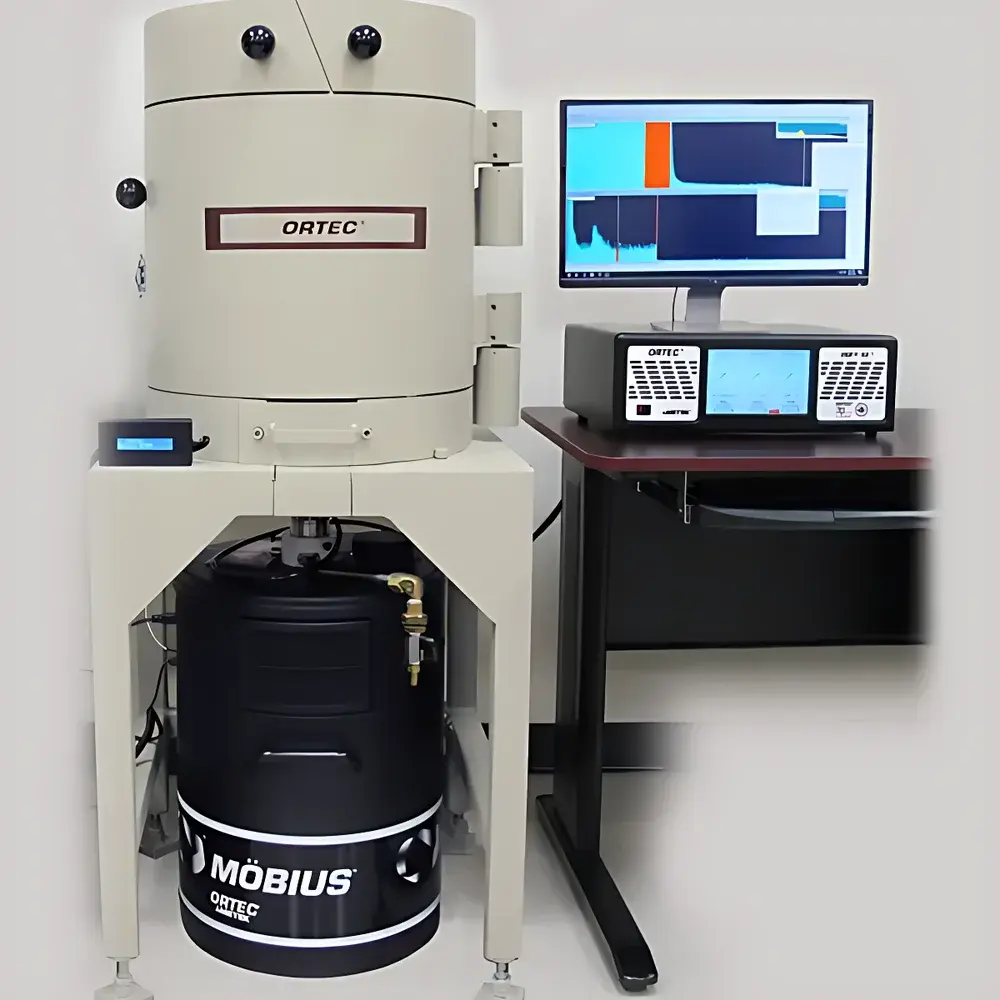
ORTEC GEM Series P-Type High-Purity Germanium (HPGe) Gamma-Ray Spectrometer
| Brand | ORTEC |
|---|---|
| Origin | USA |
| Manufacturer Type | Authorized Distributor |
| Origin Category | Imported |
| Model | GEM |
| Instrument Type | Laboratory Gamma Spectrometer |
| Detector Type | P-Type Coaxial High-Purity Germanium (HPGe) Detector |
| Radiation Type | Gamma Rays |
| Energy Range | 40 keV – 10 MeV |
| Energy Resolution | 1.75–2.3 keV FWHM at 1332 keV (dependent on relative efficiency) |
Overview
The ORTEC GEM Series is a family of P-type coaxial high-purity germanium (HPGe) gamma-ray spectrometers engineered for high-resolution, quantitative gamma-ray spectroscopy in laboratory environments. Operating on the principle of semiconductor charge collection, the GEM detector converts incident gamma photons into electron-hole pairs within the cryogenically cooled HPGe crystal; the resulting charge pulses are proportional to photon energy and digitized for spectral analysis. With an operational energy range spanning 40 keV to 10 MeV, the GEM system supports nuclide identification, activity quantification, and isotopic ratio determination across environmental monitoring, nuclear safeguards, health physics, and radiochemistry applications. Its P-type architecture provides superior performance for low-energy gamma rays and enhanced resistance to radiation damage compared to N-type counterparts—particularly advantageous in long-term deployment or high-flux environments.
Key Features
- P-type coaxial HPGe crystal with optimized geometry for high detection efficiency (up to 150% relative to 3″ × 3″ NaI(Tl) standard)
- Exceptional energy resolution: 1.75–2.3 keV FWHM at 1332 keV (⁶⁰Co), scalable with crystal size and cooling stability
- Peak symmetry optimized for accurate centroid determination and deconvolution of complex multiplets
- SMART-1 integrated bias supply (-SMP): eliminates need for external HV module; includes moisture-resistant ABS housing, molded strain relief, and embedded authorization tracking
- Integrated Cryogenic System (-ICS, -ICS-E, -ICS-LB): closed-cycle mechanical cooling with zero warm-up downtime; immediate re-cooling after interruption, eliminating the typical 72-hour recovery period associated with conventional dewar-based systems
- Low-background configuration options (-LB-C, -XLB-C, -ICS-LB): carbon-fiber endcaps, high-purity aluminum windows and inner cups, oxygen-free copper mounting base—reducing intrinsic background by up to two orders of magnitude in the 3–100 keV region
- High-count-rate capability via transistor-reset preamplifier (-PL): handles >1 Mcps at 1 MeV without pulse pile-up distortion or feedback resistor limitations
- Remote preamplifier/hv interface (-HJ): relocates all active electronics outside shielding to minimize background contributions from electronic components
- Ruggedized environmental option (-HE): sealed carbon-fiber endcap with desiccant indicator and replaceable moisture barrier—certified for operation in humid, dusty, or temperature-variable field-laboratory settings
Sample Compatibility & Compliance
The GEM spectrometer accommodates diverse sample geometries—including Marinelli beakers, petri dishes, filter papers, soil cores, and air filters—when used with appropriate shielding (e.g., 10 cm lead + 1 mm copper graded shielding). It complies with ISO/IEC 17025 requirements for testing laboratories when operated under documented procedures. Data acquisition and analysis workflows support audit trails compliant with FDA 21 CFR Part 11 (when paired with ORTEC’s GammaVision™ software with electronic signature and user access control modules). Measurement protocols align with ASTM E1452 (Standard Practice for Calibration of Germanium Spectrometers), ASTM E181 (Standard Test Methods for Radioactivity in Water), and IAEA Technical Reports Series No. 295 for environmental gamma spectrometry.
Software & Data Management
GEM systems integrate seamlessly with ORTEC’s GammaVision™ spectroscopy software (v7.0+), which provides automated peak search, nuclide library matching (including IAEA, LANL, and JEFF libraries), efficiency calibration using point, volume, and matrix-matched standards, and MDA calculation per ANSI N42.22. The software supports multi-detector synchronization, spectral summing, and uncertainty propagation per GUM (JCGM 100:2008). Raw data are stored in industry-standard CNF format; processed results export to CSV, XML, and PDF with full metadata embedding (detector ID, acquisition time, live time, temperature logs, HV status). Audit trail functionality records all parameter modifications, calibrations, and report generations with timestamped user attribution—essential for GLP/GMP-regulated laboratories.
Applications
- Environmental radioactivity monitoring: soil, sediment, water, biota, and airborne particulates per EPA Method 901.1 and ISO 18589
- Nuclear forensics and non-proliferation verification: isotopic fingerprinting of uranium/plutonium samples
- Decommissioning and waste characterization: alpha/beta/gamma emitters in legacy nuclear facilities
- Medical isotope production QC: ⁹⁹Mo/⁹⁹mTc generator assays, ¹⁷⁷Lu purity verification
- Geological exploration: K/U/Th mapping in rock and ore samples
- Food safety screening: detection of ¹³⁷Cs, ¹³⁴Cs, and ⁴⁰K in post-Fukushima agricultural products
FAQ
What cooling method does the GEM detector require?
The GEM series operates exclusively with liquid nitrogen or mechanical cryocoolers. Standard configurations use LN₂ dewars; optional Integrated Cryogenic Systems (-ICS) provide continuous closed-cycle cooling without manual refills.
Is the GEM detector suitable for low-energy X-ray measurements below 40 keV?
While the nominal lower limit is 40 keV, low-background variants with carbon-fiber endcaps (-RB, -XLB-C) and ultra-thin beryllium or aluminum windows enable reliable detection down to ~3 keV—subject to vacuum integrity and shielding configuration.
Can the GEM system meet regulatory requirements for accredited environmental labs?
Yes—when deployed with validated procedures, calibrated sources traceable to NIST, and GammaVision™ configured for 21 CFR Part 11 compliance, the system satisfies ISO/IEC 17025 accreditation criteria for gamma spectrometry.
How does the SMART-1 bias supply improve system reliability?
SMART-1 integrates high-voltage generation and monitoring directly at the detector endcap, eliminating exposed HV connectors vulnerable to moisture ingress; its sealed, strain-relieved design prevents catastrophic failure due to condensation or handling stress.
What is the typical minimum detectable activity (MDA) for ¹³⁷Cs in a 1-kg soil sample?
Under standard 24-hour counting in a 10-cm Pb shield with a 100% relative efficiency GEM detector, MDA for ¹³⁷Cs is typically 0.2–0.5 Bq/kg—improved to <0.1 Bq/kg using -ICS-LB configuration and optimized geometry.







