
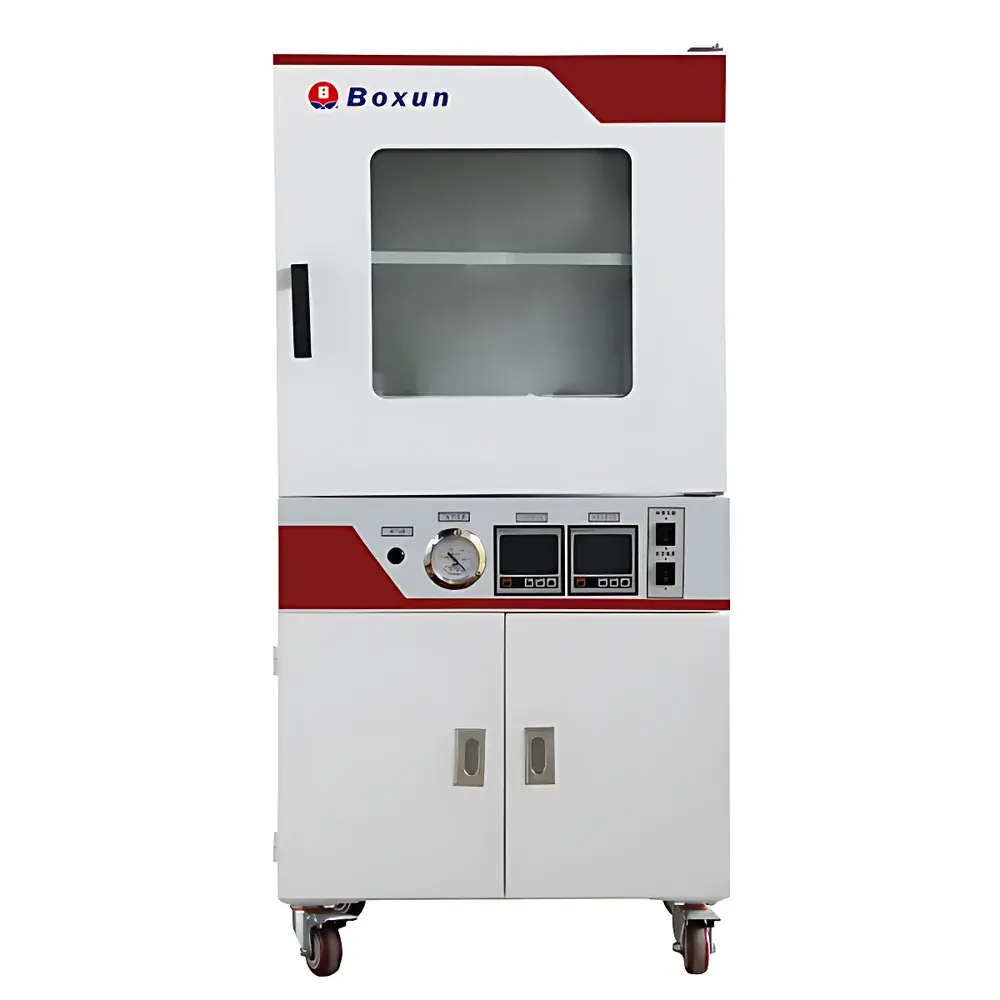
Boxun BXK-500 Vacuum Drying Oven
| Brand | Boxun |
|---|---|
| Origin | Shanghai, China |
| Manufacturer Type | Direct Manufacturer |
| Product Category | Domestic |
| Model | BXK-500 |
| Instrument Type | Vacuum Oven |
| Temperature Range | Ambient +2°C to 250°C |
| Temperature Uniformity | ±0.5°C |
| External Dimensions (W×D×H) | 800×990×1660 mm |
| Internal Chamber Dimensions (W×D×H) | 630×810×845 mm |
| Chamber Material | Stainless Steel (SUS304) |
| Heating Method | Heated Shelf System with Independent Zone Control |
| Vacuum Level | ≤133 Pa |
| Pump Flow Rate | 2 L/s |
| Chamber Volume | 500 L |
| Power Supply | 380 V ±10%, 50/60 Hz |
| Rated Power | 3900 W |
| Timer Range | 0–9999 min |
| Standard Shelves | 4 pcs (individually temperature-controlled) |
Overview
The Boxun BXK-500 Vacuum Drying Oven is an engineered solution for precise, low-temperature moisture removal in thermally sensitive, oxidation-prone, or structurally complex samples. Operating on the principle of reduced-pressure drying—where ambient pressure is lowered to depress the boiling point of volatile solvents—the BXK-500 enables effective dehydration without thermal degradation. Unlike convection ovens that rely on air circulation, this system maintains a stable vacuum environment (<133 Pa) throughout the chamber, eliminating oxidative risks and preventing displacement of fine powders or fragile specimens. Designed for compliance-critical environments, it supports routine drying, sterilization of glassware, residual solvent removal in pharmaceutical intermediates, and pre-conditioning of hygroscopic materials prior to analytical weighing or spectroscopic analysis.
Key Features
- Heated stainless steel shelves with independent PID temperature control per zone—ensuring uniform thermal distribution across all four adjustable trays (630 × 810 × 845 mm internal volume)
- Integrated vacuum pump housed within a sound-dampened cabinet—reducing operational noise by up to 40 dB(A) and optimizing laboratory floor space
- Microprocessor-based digital controller with LCD interface, supporting real-time monitoring of chamber temperature, vacuum level, elapsed time, and remaining timer duration
- Robust chamber construction: interior lined with electropolished SUS304 stainless steel; rounded corners for easy cleaning and contamination control; dual-pane tempered safety glass door with silicone gasket for leak-tight sealing
- Intelligent power recovery function—automatically resumes preset parameters after unexpected power interruption or system reset
- Over-temperature alarm with audible/visual alert and automatic heating cutoff to prevent sample damage or safety incidents
Sample Compatibility & Compliance
The BXK-500 accommodates diverse sample formats—including powders, granules, lyophilized matrices, ceramic substrates, polymer films, and multi-component assemblies—without mechanical disturbance or surface oxidation. Its inert vacuum environment eliminates combustion hazards associated with drying flammable solvents or reactive metal oxides. The system meets fundamental design requirements aligned with ISO 5725 (accuracy and precision of measurement methods), ASTM E145 (standard specification for gravity-convection and forced-ventilation ovens), and GLP-compliant workflows where traceable parameter logging and operator intervention records are essential. While not inherently 21 CFR Part 11-certified, its programmable timer, non-volatile memory, and event-triggered alarms support audit-ready documentation when integrated into validated laboratory information management systems (LIMS).
Software & Data Management
The embedded controller provides local data handling via non-volatile EEPROM storage, retaining up to 10 user-defined programs with temperature setpoints, ramp rates, hold durations, and vacuum activation sequences. All operational events—including start/stop timestamps, alarm triggers, and manual overrides—are timestamped and stored internally for post-run review. Optional RS485 communication port enables integration with SCADA platforms or centralized lab monitoring software for remote status polling and historical trend analysis. No proprietary cloud service or vendor-dependent firmware updates are required; configuration remains fully accessible through front-panel navigation.
Applications
- Drying heat-labile biological reagents (e.g., enzymes, antibodies, nucleic acid preparations) without denaturation
- Removing residual solvents from synthesized organic compounds under inert vacuum conditions
- Conditioning reference standards and calibration weights in metrology labs to stabilize mass readings
- Dehydrating soil, sediment, or plant tissue samples for gravimetric moisture content determination per ISO 11465
- Sterilizing glassware and stainless steel tools prior to aseptic processing in QC microbiology suites
- Pre-baking composite laminates and printed circuit board (PCB) substrates to eliminate trapped moisture before lamination or soldering
FAQ
What vacuum level can the BXK-500 achieve, and how is it maintained?
The system reaches and sustains ≤133 Pa using an integrated 2 L/s oil-lubricated rotary vane pump housed in an acoustically insulated enclosure.
Can multiple shelf zones operate at different temperatures simultaneously?
Yes—each of the four standard shelves features independent temperature sensors and heating elements, allowing differential setpoints within the overall range of ambient +2°C to 250°C.
Is the chamber suitable for use with corrosive vapors such as HCl or HF?
No—the standard SUS304 chamber is not resistant to halogen acids or strong oxidizers; optional Hastelloy C-276 lining or quartz chamber inserts must be specified for such applications.
Does the unit include validation documentation for IQ/OQ protocols?
Factory-supplied calibration certificates for temperature and vacuum sensors are provided; full qualification packages (IQ/OQ/PQ) require site-specific execution by qualified personnel using third-party metrology equipment.
How is thermal uniformity verified inside the working chamber?
Uniformity is validated per ASTM E2207 using nine calibrated thermocouples placed at standardized locations (center, corners, mid-walls) during commissioning; typical deviation across the load area is ≤±0.5°C at setpoint.
Related Products



