
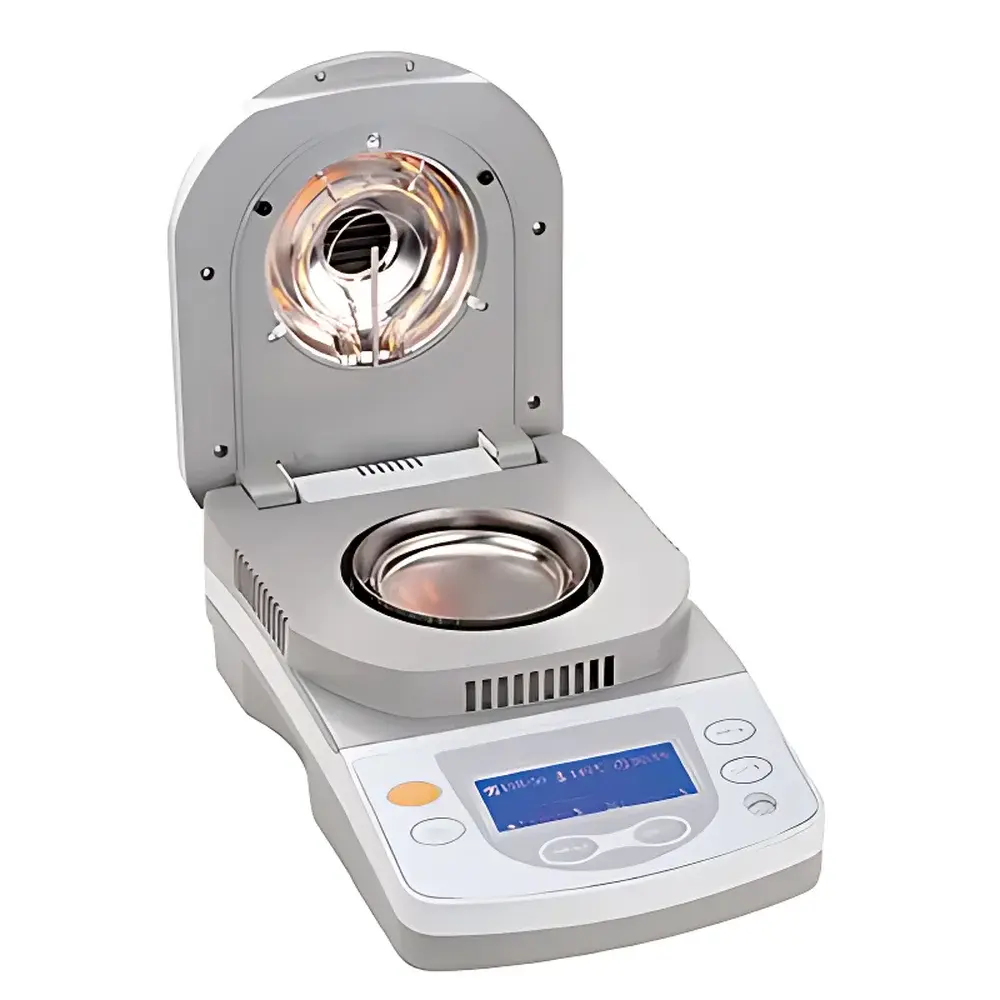
Yoke DSH-50A-1 Halogen Moisture Analyzer
| Max Capacity | 50 g |
|---|---|
| Readability | 1 mg |
| Repeatability (3 g sample) | ±0.2% |
| Minimum Sample Mass | 0.5 g |
| Recommended Sample Mass | 3–10 g |
| Heating Time Range | 1–99 min (1 min increments) |
| Temperature Range | 50–180 °C |
| Heating Source | Halogen Lamp |
| Pan Diameter | 100 mm |
| Dimensions (W×D×H) | 265 × 160 × 150 mm |
| Net Weight | 5 kg |
| Communication Interface | RS232 |
| End-Point Modes | Timer-Controlled & Automatic |
| Display Parameters | Moisture %, Solid %, Mass (g), Elapsed Time, Date |
Overview
The Yoke DSH-50A-1 Halogen Moisture Analyzer is a precision thermogravimetric instrument engineered for rapid, reliable quantification of moisture content in solid and semi-solid samples via loss-on-drying (LOD) methodology. It operates on the principle of controlled halogen lamp heating—delivering uniform radiant energy across the sample surface—followed by real-time mass monitoring using a high-stability, thermally isolated weighing sensor. Unlike conventional infrared or convection ovens, the halogen heating system achieves faster thermal response (<30 s to reach setpoint), minimizes thermal lag, and ensures consistent energy distribution—critical for reproducible LOD results across diverse matrices including pharmaceutical powders, food ingredients, polymers, minerals, and agricultural products. The instrument complies with fundamental method validation requirements outlined in ASTM E1447, USP <921>, and ISO 5530-1, supporting its use in quality control laboratories operating under GLP or GMP frameworks.
Key Features
- High-Resolution Backlit Dot-Matrix LCD Display: 128 × 64 pixel monochrome screen with adjustable contrast, optimized for low-ambient-light environments and ergonomic viewing angles during extended operation.
- Tactile Membrane Keypad: Dedicated function keys for start/stop, tare, menu navigation, and parameter entry—designed for glove-compatible operation and reduced input error in production or lab settings.
- Thermally Isolated Load Cell Architecture: Integrated thermal shielding and dual-compensation algorithms mitigate drift induced by ambient temperature fluctuations and heater-induced convection currents—ensuring stable baseline integrity throughout drying cycles.
- Adjustable Halogen Radiant Heater: Quartz-encapsulated 500 W halogen lamp with digitally regulated power output; provides precise, repeatable heating profiles without hot spots or convective air movement that could disturb fine particulates.
- Dual End-Point Detection Logic: Supports both fixed-duration drying (user-defined timer) and automatic termination based on mass change threshold (e.g., ≤0.1 mg/30 s), enabling method flexibility for volatile vs. bound-water applications.
Sample Compatibility & Compliance
The DSH-50A-1 accommodates heterogeneous, granular, fibrous, and hygroscopic samples within the 0.5–10 g recommended range. Its 100 mm stainless-steel sample pan facilitates even spreading and accommodates irregular geometries without spillover. The instrument meets mechanical and electrical safety standards per IEC 61010-1 and is CE-marked for laboratory use in the EU. While not inherently 21 CFR Part 11 compliant, its RS232 interface supports integration with validated LIMS or ELN systems that implement audit trail, electronic signature, and data integrity controls—enabling traceable compliance in regulated environments. Calibration verification procedures align with ISO/IEC 17025 metrological requirements when performed using certified reference weights and NIST-traceable moisture standards.
Software & Data Management
Data output is transmitted via RS232 serial protocol at 9600 baud, 8-N-1 configuration, compatible with standard terminal emulators or custom SCADA/LIMS interfaces. Each measurement record includes timestamp (date + time), initial/final mass, moisture %, solid %, drying duration, set temperature, and user-defined ID. No proprietary software is bundled; however, ASCII-formatted output enables direct import into Excel, MATLAB, or statistical process control (SPC) platforms. For laboratories requiring structured reporting, third-party middleware solutions can parse raw streams into CSV or XML formats with configurable metadata tagging—supporting trend analysis, SPC charting, and batch release documentation per FDA guidance on electronic records.
Applications
- Pharmaceutical: Quantification of residual solvents and hydrate water in APIs and excipients per USP <921>.
- Food & Agriculture: Routine moisture testing of grains, dairy powders, spices, and pet food to verify shelf-life stability and regulatory labeling compliance (e.g., FDA 21 CFR 101.9).
- Chemicals & Polymers: Monitoring moisture in catalysts, resins, and battery electrode materials where trace water impacts reactivity or electrochemical performance.
- Construction Materials: LOD analysis of cementitious admixtures, gypsum, and clay-based binders per ASTM C114 and EN 196-2.
- Academic Research: Method development for accelerated drying kinetics, comparative thermal stability studies, and validation of alternative moisture techniques (e.g., Karl Fischer titration).
FAQ
What calibration standards are recommended for routine verification?
Certified moisture reference materials (e.g., sodium tartrate dihydrate, ~15.66% H₂O) or NIST SRM 2890 (dried silica gel) should be used quarterly; daily zero and span checks with Class M2 weights are advised.
Can the instrument be used for volatile organic compound (VOC) loss determination?
No—the DSH-50A-1 measures total volatile loss under inert conditions only if explicitly validated; it does not discriminate between water and other volatiles without complementary GC or FTIR confirmation.
Is the halogen lamp replaceable by the user?
Yes—the lamp module is field-replaceable using standard Torx tools; replacement interval averages 5,000 hours under typical usage (10 cycles/day).
Does the analyzer support multi-step heating programs?
No—the DSH-50A-1 implements single-stage heating only; multi-ramp protocols require external programmable controllers or higher-tier models (e.g., DSH-50A-3 with gradient programming).
How is temperature uniformity verified across the pan surface?
Per ISO 5530-1 Annex B, users may perform a thermal mapping exercise using calibrated thermocouples placed at center, edge, and quarter points—typical deviation is ≤±2.5 °C at 105 °C steady state.




