
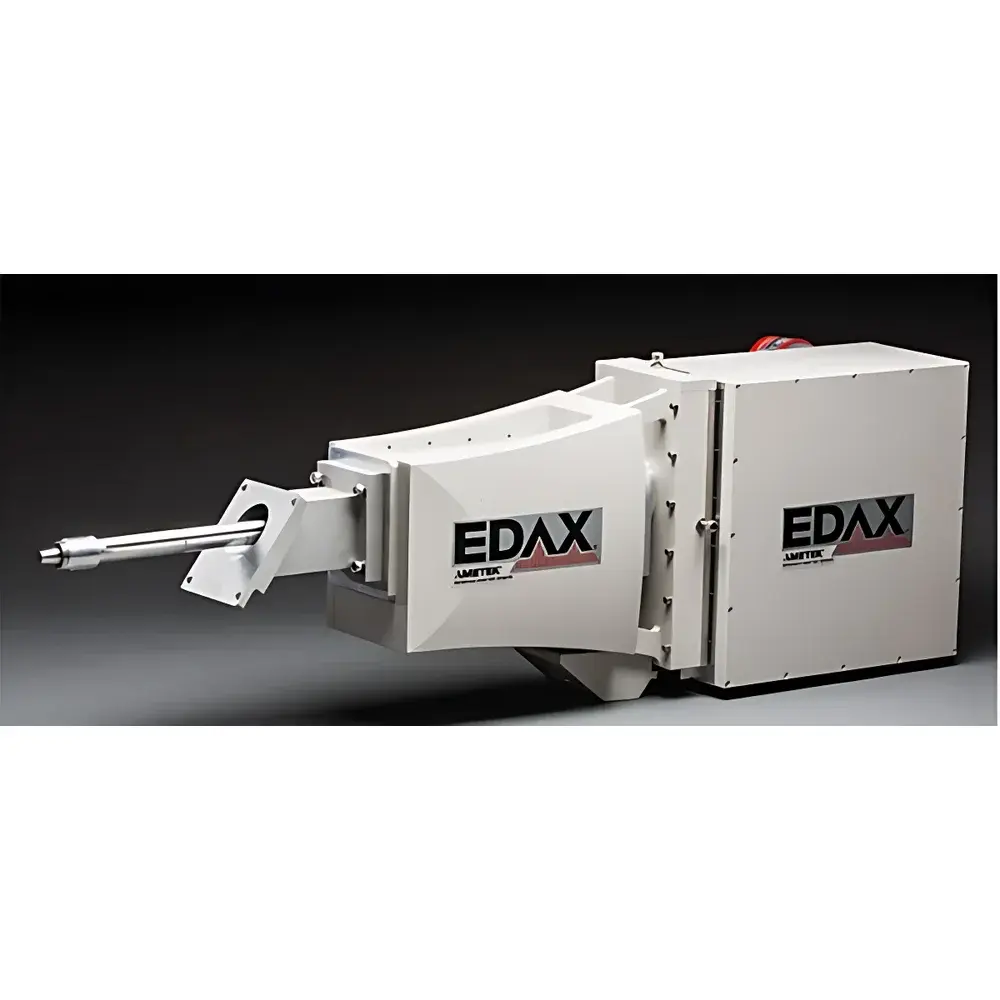
EDAX TEXS Transition X-ray Wavelength Dispersive Spectrometer
| Brand | EDAX |
|---|---|
| Origin | USA |
| Manufacturer Type | Authorized Distributor |
| Import Status | Imported |
| Model | TEXS |
| Quotation | Available Upon Request |
| Energy Resolution | Optimized for 150 eV – 10 keV Range |
| Peak-to-Background Ratio | High, typical of high-efficiency PBS architecture |
| Maximum Count Rate | Compatible with standard SEM/WDS-compatible electron column currents (e.g., 1–10 nA) |
| Detector Area | Integrated Bragg crystal diffraction system with five standard analyzing crystals |
| Optical Design | Capillary-based Parallel Beam Spectrometer (PBS) |
| Mass | 20.5 kg (45 lbs) |
Overview
The EDAX TEXS Transition X-ray Wavelength Dispersive Spectrometer is a high-performance WDS system engineered for precise elemental quantification and spectral deconvolution in scanning electron microscopes (SEM) and electron probe microanalyzers (EPMA). Unlike energy-dispersive spectrometers (EDS), the TEXS operates on the principle of Bragg diffraction—where characteristic X-rays emitted from the sample are collimated and dispersed by precisely oriented single-crystal analyzers according to their wavelength (λ), enabling resolution of closely spaced emission lines (e.g., Ti Kβ/Cr Kα, V Kβ/Mn Kα, Fe Lα/Co Lα). Its capillary-optic parallel beam architecture eliminates the need for mechanical focusing adjustments during routine analysis and delivers exceptional signal intensity across the critical low-energy (B Kα at 183 eV) to mid-energy (Cu Kα at 8.04 keV) range—making it especially suited for transition metal, light element (C, N, O, F), and rare-earth characterization in metallurgical, geological, and advanced materials research.
Key Features
- Capillary-optic parallel beam spectrometer (PBS) design ensures stable, high-intensity X-ray collection without alignment drift or focal-length recalibration.
- Five standard Bragg crystals included: LiF(200), PET, TAP, LDE1, and LDE2—each selected for optimal d-spacing coverage from 150 eV to 10 keV, supporting quantitative analysis of elements from boron (Z=5) through copper (Z=29) and beyond.
- Intelligent Auto-Focus algorithm dynamically adjusts stage Z-height based on WDS signal intensity feedback, maintaining optimal Bragg condition across variable sample topography and accelerating setup time.
- Compact modular footprint enables direct integration into standard EDS ports on most modern SEM platforms—no major chamber modification or vacuum revalidation required.
- Robust mechanical architecture with vibration-damped mounting and thermal stabilization minimizes spectral drift during extended mapping or time-resolved acquisition.
Sample Compatibility & Compliance
The TEXS is compatible with polished bulk specimens, thin foils, and coated particulates commonly prepared for EPMA and SEM-WDS workflows. It supports standard ASTM E1508 (Standard Practice for Quantitative Analysis by WDS) and ISO 22309 (Electron probe microanalysis — Quantitative analysis using wavelength dispersive spectrometry). When operated in conjunction with certified reference materials (CRMs) and matrix correction protocols (e.g., φ(ρz)), the system meets GLP-compliant reporting requirements for industrial QA/QC labs. Data acquisition and processing adhere to traceable instrument calibration logs, and optional audit-trail-enabled TEAM™ software modules support 21 CFR Part 11 compliance for regulated environments.
Software & Data Management
Controlled exclusively via EDAX’s TEAM™ software platform, the TEXS provides unified interface for WDS qualitative identification, peak search, background modeling, and ZAF/φ(ρz) quantitative correction. The software includes integrated spectral library matching (NIST SRM-based), automated line-scan and raster mapping with pixel-wise quantification, and export-ready reports in CSV, XML, and PDF formats. All acquisition parameters—including crystal selection, spectrometer take-off angle, dwell time, and beam current—are logged with timestamps and user metadata. Raw spectrum files (.eds/.wds) retain full binary fidelity for offline reprocessing and inter-laboratory comparison.
Applications
- Quantitative phase analysis in multi-component alloys (e.g., Ni-base superalloys, Ti-6Al-4V), where overlapping L- and K-lines demand high spectral resolution.
- Light element detection and stoichiometry determination in oxides, nitrides, and carbides—particularly for oxygen gradients in thermal barrier coatings or nitrogen distribution in nitrided steels.
- Trace element segregation studies at grain boundaries and interfacial layers, enabled by sub-100 ppm detection limits for transition metals under optimized counting conditions.
- Forensic metallurgy and failure analysis requiring unambiguous discrimination between chemically similar phases (e.g., FeCr vs. FeNi spinels, MnS vs. MnO inclusions).
- Geological petrology for precise cation site occupancy modeling in silicates and phosphates using combined WDS/EDS data fusion.
FAQ
What is the primary advantage of TEXS over conventional HCO-based WDS systems?
The capillary-optic PBS architecture eliminates angular sensitivity to sample height variation, reduces aberrations, and increases photon throughput—especially below 1 keV—without sacrificing spectral resolution.
Can TEXS be used simultaneously with an EDS detector?
Yes; its compact form factor allows co-installation with most silicon-drift detector (SDD) EDS systems on dual-port SEM columns, enabling hybrid EDS/WDS workflows for rapid survey + high-resolution verification.
Is calibration traceable to national standards?
All crystal d-spacings and spectrometer geometry parameters are factory-calibrated against NIST-traceable reference spectra (e.g., Cu, Co, Fe, Si), with certificate-of-conformance provided per unit.
Does TEXS support automated multi-element line scans?
Yes; TEAM™ software includes scriptable acquisition sequences for synchronized WDS line profiling across up to five elements with real-time background subtraction and peak integration.
What vacuum requirements does TEXS impose on the SEM chamber?
TEXS operates under standard SEM high-vacuum conditions (≤1×10⁻⁴ Pa); no additional pumping or differential pumping stages are required for installation or operation.




