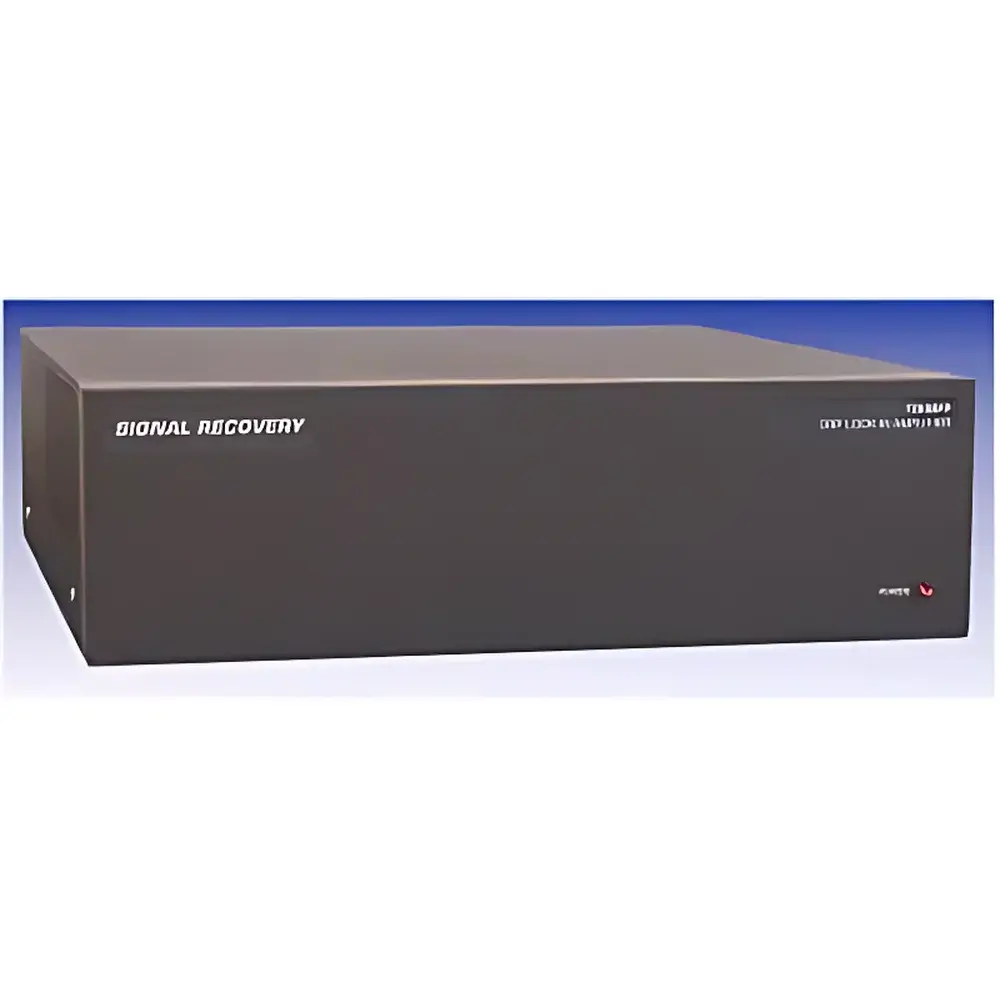
Signal Recovery 7280 Dual-Phase Wideband DSP Lock-in Amplifier
| Brand | Signal Recovery |
|---|---|
| Origin | USA |
| Model | 7280 |
| Frequency Range | 0.5 Hz to 2 MHz |
| ADC Sampling Rate | 7.5 MHz |
| Time Constant Range | 1 µs to 100 ks |
| Harmonic Detection | up to 32nd order (32F) |
| Reference Modes | Dual Reference, Dual Harmonic, Virtual Reference |
| Spectrum Display Mode | Enabled |
| Optional Frequency Extension | up to 2 MHz for dual-reference/dual-harmonic operation |
| Software Compatibility | Acquire software, LabVIEW drivers |
| Internal Oscillator | Quartz-stabilized |
Overview
The Signal Recovery 7280 Dual-Phase Wideband DSP Lock-in Amplifier is a high-performance, digitally implemented lock-in instrument engineered for precision measurement of weak, noise-contaminated signals in demanding research and industrial environments. Based on direct digital synthesis (DDS) and real-time digital signal processing (DSP), the 7280 performs synchronous demodulation using two independent phase-sensitive detectors—enabling simultaneous extraction of in-phase (X) and quadrature (Y) components, as well as magnitude (R) and phase (θ). Its operational bandwidth spans from 0.5 Hz to 2 MHz, making it suitable for applications ranging from low-frequency impedance spectroscopy and scanning probe microscopy to high-frequency optical modulation transfer analysis and plasma diagnostics. The instrument employs a quartz-stabilized internal oscillator with exceptional frequency stability (<2 ppm/°C), ensuring long-term measurement repeatability and minimizing drift-induced artifacts in time-series experiments.
Key Features
- Dual-phase detection architecture with fully independent X, Y, R, and θ outputs updated at user-selectable rates up to 50 kHz
- Direct digital demodulation—no analog multipliers or analog filters—eliminating gain drift, harmonic distortion, and temperature-dependent offsets
- 7.5 MHz main ADC sampling rate supports oversampling and high-fidelity signal reconstruction across the full 2 MHz bandwidth
- Configurable time constants from 1 µs to 100 ks, with 64 selectable filter slopes (6–48 dB/octave) for optimal noise rejection versus response speed trade-offs
- Advanced reference handling: dual physical reference inputs, dual-harmonic detection (up to 32F), virtual reference generation, and automatic harmonic sweep capability
- Integrated spectrum display mode enables real-time FFT-based spectral monitoring of demodulated outputs and reference harmonics
- Front-panel-free variant (7280BFP) available for OEM integration and rack-mounted systems without compromising specification integrity
Sample Compatibility & Compliance
The 7280 accommodates both voltage and current input configurations, with programmable gain (1 nV/V to 1 V/V for voltage; 1 fA/A to 1 mA/A for current) and auto-ranging functionality. Input impedance is configurable (1 MΩ || 25 pF or 100 MΩ || 15 pF) to match diverse sensor types—including photodiodes, piezoresistive cantilevers, Hall sensors, and electrochemical cells. All signal paths feature galvanic isolation and EMI-hardened shielding compliant with IEC 61326-1 (industrial EMC standards). The instrument meets CE marking requirements and supports audit-ready operation under GLP and GMP frameworks when used with Acquire software’s built-in data logging, timestamping, and metadata tagging—facilitating traceability in regulated laboratories.
Software & Data Management
The 7280 interfaces seamlessly with Signal Recovery’s Acquire software—a Windows-based application offering real-time waveform visualization, automated parameter sweeps, harmonic mapping, and export to HDF5, CSV, or MATLAB-compatible formats. Full remote control is supported via Ethernet (TCP/IP) or USB 2.0, with native LabVIEW drivers (NI-VISA compliant) enabling integration into custom test automation sequences. Acquire implements secure data handling features including user-access levels, electronic signatures, and optional 21 CFR Part 11 compliance modules (audit trail, electronic records retention, and operator authentication) for pharmaceutical and medical device development workflows.
Applications
- Low-noise characterization of nanoscale devices (e.g., graphene FET transconductance, quantum dot photocurrent)
- Dynamic mechanical analysis (DMA) of viscoelastic polymers using modulated force inputs
- Lock-in thermography for subsurface defect detection in composites and microelectronics
- Frequency-domain fluorescence lifetime imaging (FD-FLIM) and time-resolved spectroscopy
- High-resolution impedance spectroscopy in battery electrode studies and fuel cell catalyst evaluation
- Feedback control loops in atomic force microscopy (AFM) and scanning tunneling microscopy (STM)
FAQ
What is the difference between the 7280 and the 7280BFP?
The 7280BFP is functionally identical to the 7280 in all electrical specifications and firmware capabilities but omits the front-panel display and controls—designed specifically for embedded or rack-mount integration where remote operation is standard.
Can the 7280 perform harmonic analysis beyond the fundamental frequency?
Yes—it supports harmonic detection up to the 32nd harmonic (32F) with independent amplitude and phase readouts for each harmonic component, enabling nonlinear susceptibility mapping and parametric resonance studies.
Is external reference required, or does the unit include an internal oscillator?
The 7280 includes a high-stability quartz-crystal oscillator as the default reference source; however, it also accepts external TTL or sine-wave references synchronized to the internal clock for phase-coherent multi-instrument setups.
How is data integrity ensured during long-duration measurements?
Acquire software provides continuous timestamped logging with checksum validation, while hardware-level watchdog timers and memory-mapped register access prevent data loss during network interruptions or host reboots.