
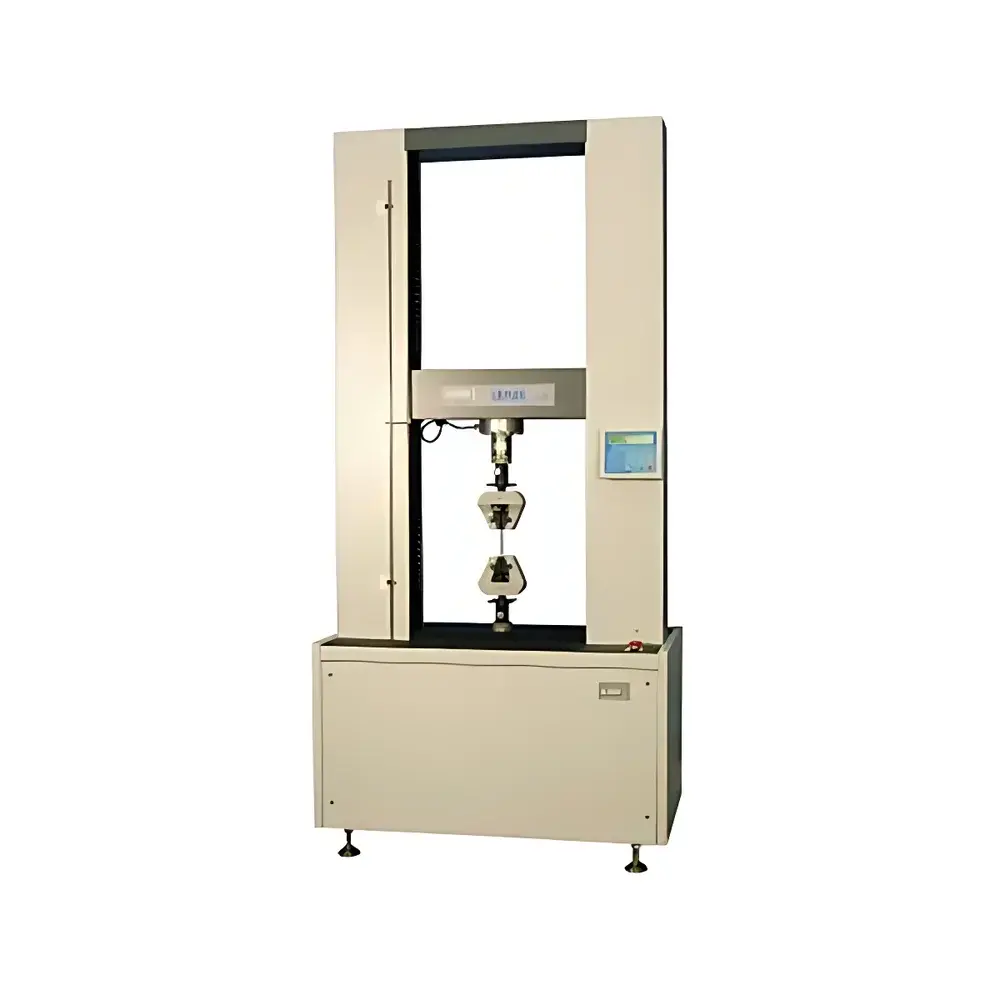
Lloyd LR150KPlus Dual-Column Floor-Standing Universal Testing Machine
| Brand | Lloyd |
|---|---|
| Origin | USA |
| Model | LR150KPlus |
| Load Capacity | 150 kN |
| Standard Crosshead Travel | 1150 mm |
| Extended Crosshead Travel | 1620 mm |
| Control System | Microprocessor-based 32-bit architecture |
| Display | Backlit 4-line LCD with multilingual & unit support |
| Onboard Memory | Up to 600 test results from 10 programmable test methods |
| Software Compatibility | NEXYGENPlus (Windows®-based) |
| Frame Stiffness Compensation | Yes |
| Drive System | Dual-ball-screw actuation with high-precision DC servo motor |
| Sensor Options | Interchangeable high-accuracy load cells |
| Fixture Support | Comprehensive range for tensile, compression, flexure, peel, shear and cyclic testing |
| Compliance | Designed for ASTM E4, ISO 7500-1, ISO 5893, USP <1041>, and GLP/GMP environments |
Overview
The Lloyd LR150KPlus is a dual-column, floor-standing universal testing machine engineered for precision mechanical characterization of materials across industrial, academic, and regulatory-compliant laboratory settings. Operating on the fundamental principle of controlled force application and displacement measurement, the system adheres to standardized quasi-static mechanical testing protocols defined in ASTM E4 (verification of force-measuring instruments), ISO 7500-1 (static calibration of testing machines), and ISO 5893 (tensile, compression, and flexural testing). With a maximum load capacity of 150 kN (33,722 lbf), it supports high-force applications including structural component validation, composite laminate evaluation, metal yield/tensile analysis, and medical device mechanical integrity assessment. Its rigid cast-iron frame—reinforced with precision-ground crosshead guidance and dual-ball-screw actuation—minimizes parasitic bending moments and ensures axial alignment fidelity throughout the full travel range (1150 mm standard; 1620 mm extended). The integrated stiffness compensation algorithm dynamically corrects for elastic deformation in the load train (frame, load cell, and grips) during compression tests, enabling traceable, repeatable measurements per ISO 7500-1 Class 0.5 accuracy requirements.
Key Features
- Microprocessor-controlled 32-bit architecture delivering high-resolution load measurement (typically ≤0.5% of reading) and real-time data acquisition at up to 100 Hz sampling rate
- Side-mounted control console with tactile membrane keypad and backlit 4-line LCD interface supporting English, Spanish, French, German, and Chinese languages, plus SI/imperial unit switching
- Onboard test method storage for up to 10 user-programmable configurations and local retention of 600 complete test records with timestamps, operator IDs, and metadata
- Dual-ball-screw drive system coupled with a high-torque DC servo motor, enabling precise crosshead speed control from 0.001 mm/min to 1000 mm/min (with optional high-speed upgrade)
- Automatic frame stiffness compensation for compression testing—calibrated against certified reference standards to maintain force linearity under high-load conditions
- Modular load cell architecture: interchangeable sensors covering 10 N to 150 kN ranges, each traceably calibrated to ISO/IEC 17025-accredited laboratories
- Integrated safety interlocks including emergency stop, overload cut-off, and position limit switches compliant with ISO 13857 and IEC 60204-1
Sample Compatibility & Compliance
The LR150KPlus accommodates specimens ranging from sub-millimeter polymer films to 300 mm-diameter concrete cylinders or 25 mm-thick steel plates, facilitated by its wide throat depth (≥500 mm) and adjustable grip spacing. It supports standardized specimen geometries per ASTM D638 (plastics tensile), ASTM D790 (flexural), ASTM D143 (wood), ISO 6892-1 (metal tensile), and ISO 178 (rigid plastics flexure). All hardware—including pneumatic, wedge-action, and hydraulic grips—is designed to minimize stress concentrations and ensure uniform clamping pressure. The system meets mechanical safety and electromagnetic compatibility (EMC) requirements per CE marking directives (2014/30/EU, 2006/42/EC) and is routinely deployed in FDA-regulated environments where audit trails, electronic signatures, and 21 CFR Part 11 compliance are enforced via NEXYGENPlus software configuration.
Software & Data Management
NEXYGENPlus serves as the primary software platform for advanced test definition, real-time visualization, statistical post-processing, and report generation. Built natively on Microsoft Windows®, it supports multi-channel synchronized acquisition (load, displacement, strain, temperature), automated pass/fail criteria, and batch processing of identical test sequences. The software includes built-in templates aligned with ASTM, ISO, and DIN standards, and enables export of raw ASCII data, PDF reports with embedded digital signatures, and XML datasets compatible with LIMS integration. Audit trail functionality logs all user actions—including parameter edits, result deletions, and calibration events—with immutable timestamps and operator authentication. Optional modules include fracture mechanics (KIc, J-integral), creep/stress relaxation modeling, and custom scripting via Python API for laboratory automation workflows.
Applications
- Quality assurance of aerospace fasteners, automotive suspension components, and orthopedic implant alloys under tensile, compressive, and shear loading
- Evaluation of packaging integrity—including seal strength (ASTM F88), peel resistance (ASTM D903), and puncture resistance (ASTM D5748)
- Mechanical property mapping of additive-manufactured metals and polymers across build orientations and heat treatment conditions
- Regulatory submission testing for ISO 10993-12 (biological evaluation of medical devices) and ASTM F2129 (corrosion testing of surgical implants)
- Teaching laboratories performing hands-on instruction in solid mechanics, material science, and experimental stress analysis
- Research into time-dependent behavior such as creep rupture (ISO 20623), stress relaxation (ISO 3344), and low-cycle fatigue (ASTM E606)
FAQ
What load cell options are available for the LR150KPlus?
Standard configurations include 10 N, 100 N, 500 N, 2.5 kN, 5 kN, 10 kN, 25 kN, 50 kN, and 150 kN load cells—all factory-calibrated and supplied with ISO/IEC 17025 certificates.
Is the system compatible with third-party extensometers?
Yes, the LR150KPlus features analog and digital input channels supporting LVDT, clip-on, and video extensometers meeting ASTM E83 Class B-1 or better accuracy specifications.
Can NEXYGENPlus generate 21 CFR Part 11-compliant reports?
When configured with electronic signature modules and audit trail logging enabled, NEXYGENPlus satisfies predicate rule requirements for electronic records and signatures in FDA-regulated environments.
What maintenance intervals are recommended?
Annual verification of force and displacement metrology is advised per ISO/IEC 17025 guidelines; routine lubrication of ball screws and inspection of grip jaws should occur every 500 operational hours.
Does the LR150KPlus support cyclic testing?
Yes—it performs fully programmable sinusoidal, triangular, and trapezoidal waveforms for tension-compression, load-controlled, or displacement-controlled fatigue testing up to 5 Hz with closed-loop feedback.



