
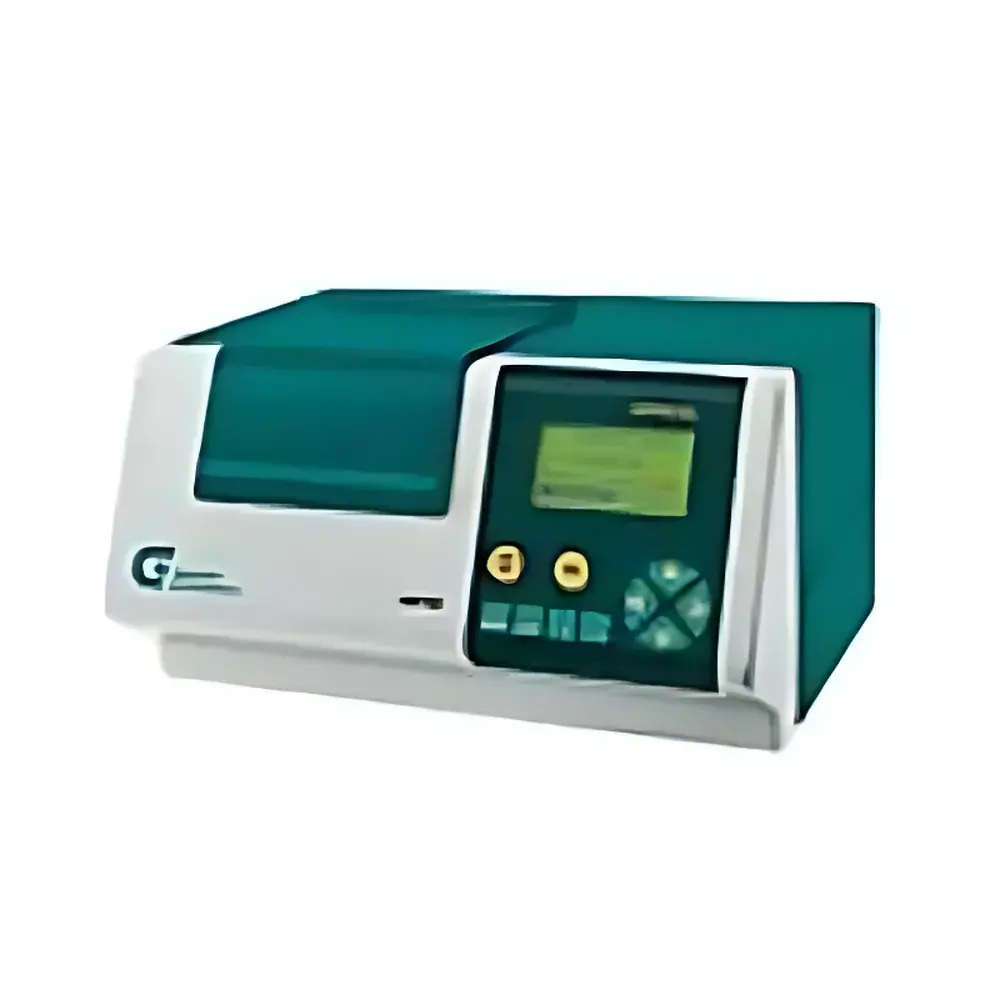
Grabner MiniCOL Intelligent Colorimeter
| Brand | Grabner |
|---|---|
| Origin | Austria |
| Model | MiniCOL |
| Measurement Principles | Filter-based photometric colorimetry per ASTM D1500, D156, D1209, D5386, D6045, and ISO 2049 |
| Color Scales | Saybolt (–16 to +30), ASTM (0–8), Pt-Co (0–30 or 0–500) |
| Repeatability | < 1.2 (Saybolt), < 0.48 (ASTM), < 0.9 / <5% (Pt-Co, ≤30 / >30) |
| Reproducibility | < 0.14 (Saybolt), < 0.1 (ASTM), < 2 / <10% (Pt-Co, ≤30 / >30) |
| Cycle Time | < 30 s |
| Throughput | 120 samples/h |
| Interfaces | RS-232, USB, PC keyboard port |
| Power | 90–260 V AC, 47–63 Hz, max. 110 W |
| Dimensions | 325 × 250 × 170 mm |
| Weight | 6.5 kg |
Overview
The Grabner MiniCOL Intelligent Colorimeter is a fully automated, filter-based photometric instrument engineered for high-precision color measurement of liquid hydrocarbon and refined petroleum products. It operates on standardized optical principles defined in ASTM D1500 (ASTM Color), ASTM D156/D6045 (Saybolt Color), and ASTM D1209/D5386/D1686 (Platinum-Cobalt or APHA Color), delivering traceable, repeatable results without reliance on physical reference standards. Unlike conventional colorimeters requiring manual calibration with glass or liquid standards, the MiniCOL employs an integrated three-channel excitation filter system coupled with a factory-calibrated internal spectral database. This architecture ensures each measurement is self-referenced against digitally encoded chromatic references—eliminating drift, minimizing operator dependency, and enabling true “one-touch” analysis. Designed specifically for refinery QC labs, lubricant testing facilities, and petrochemical R&D environments, the MiniCOL conforms to rigorous industrial workflows where speed, reproducibility, and regulatory alignment are non-negotiable.
Key Features
- Triple-band excitation filter system optimized for simultaneous spectral response matching across ASTM, Saybolt, and Pt-Co color scales
- Integrated Peltier-heated sample chamber (up to 60 °C), enabling accurate color assessment of waxy, high-viscosity, or semi-solid petroleum distillates without pre-melting
- Embedded microprocessor with firmware pre-loaded with ASTM D1500, D156, D1209, D5386, and ISO 2049 algorithms—no user calibration required
- Intuitive LCD interface with hierarchical menu navigation; all operations executable via single-button press after sample loading
- Full compliance with GLP data integrity requirements: timestamped result logging, user ID tracking, and audit-ready output formatting
- Compact benchtop footprint (325 × 250 × 170 mm) and low power consumption (<110 W) suitable for space-constrained analytical laboratories
Sample Compatibility & Compliance
The MiniCOL accommodates transparent to lightly hazy liquid samples in standard 10-mm or 20-mm pathlength cuvettes—including gasoline, diesel, jet fuel, lubricating oils, solvents, and white mineral oils. Its optical design mitigates interference from minor turbidity through fixed-wavelength photometry, avoiding scattering artifacts common in broadband spectrophotometers. All reported color values are traceable to NIST-traceable reference materials used during factory certification. The instrument meets essential regulatory expectations for routine QC testing under ISO/IEC 17025-accredited laboratories and supports documentation requirements aligned with FDA 21 CFR Part 11 when paired with compliant data management software. It is certified for use in accordance with ASTM D1500 (for lubricants and petroleum products), ASTM D156 (for light-colored petroleum products), and ASTM D1209 (for water-white liquids), and its measurement uncertainty profiles have been validated per ISO/IEC Guide 98-3 (GUM).
Software & Data Management
Data export is supported via RS-232 serial and USB interfaces, enabling seamless integration into LIMS environments or custom QA/QC reporting systems. The MiniCOL outputs ASCII-formatted result strings containing sample ID, measurement date/time, color scale identifier, numeric value, repeatability flag, and instrument serial number—structured for direct parsing by laboratory informatics platforms. Optional PC software (Grabner ColorLink™) provides enhanced functionality including trend charting, statistical process control (SPC) charts, batch report generation, and electronic signature support compliant with 21 CFR Part 11 Annex 11 requirements. All raw measurement logs are stored onboard with time-stamped metadata, supporting full audit trails required under GMP/GLP frameworks.
Applications
- Routine color grading of aviation turbine fuels (Jet A/A-1) per ASTM D1319 and D1655 specifications
- QC verification of naphtha, kerosene, and diesel fractions during fractional distillation
- Stability monitoring of transformer oils and insulating fluids per IEC 60296
- Quality release testing of pharmaceutical-grade white oils (USP/EP grade)
- Color consistency validation in solvent manufacturing (e.g., acetone, toluene, xylene)
- Research applications involving oxidation-induced color development in base stocks and additives
FAQ
Does the MiniCOL require recalibration before daily use?
No. The instrument is factory-calibrated using NIST-traceable standards and maintains calibration stability over time due to its solid-state optical architecture and internal reference database. Routine verification with a check standard is optional but not mandatory per ASTM guidelines.
Can the MiniCOL measure colored aqueous solutions such as wastewater or pharmaceutical intermediates?
It is optimized for hydrocarbon-based liquids per ASTM methods. While Pt-Co measurements can be performed on water-white aqueous samples meeting ASTM D1209 criteria, it is not designed for highly turbid, fluorescent, or strongly absorbing aqueous matrices outside specified scope.
Is thermal control available for temperature-sensitive samples?
Yes—the built-in Peltier heating module maintains sample temperature up to 60 °C with ±0.5 °C stability, critical for consistent color evaluation of waxy distillates and viscous feedstocks.
How does the MiniCOL ensure measurement traceability?
Each unit ships with a Certificate of Conformance detailing calibration against primary reference standards, uncertainty budgets per ISO/IEC 17025, and compliance statements referencing applicable ASTM and ISO standards.
What is the expected service life of the optical filters and light source?
The LED-based illumination system and interference filters are rated for ≥50,000 hours of operation under normal laboratory conditions, eliminating consumable replacement costs typical of tungsten-halogen or xenon lamp-based instruments.




