
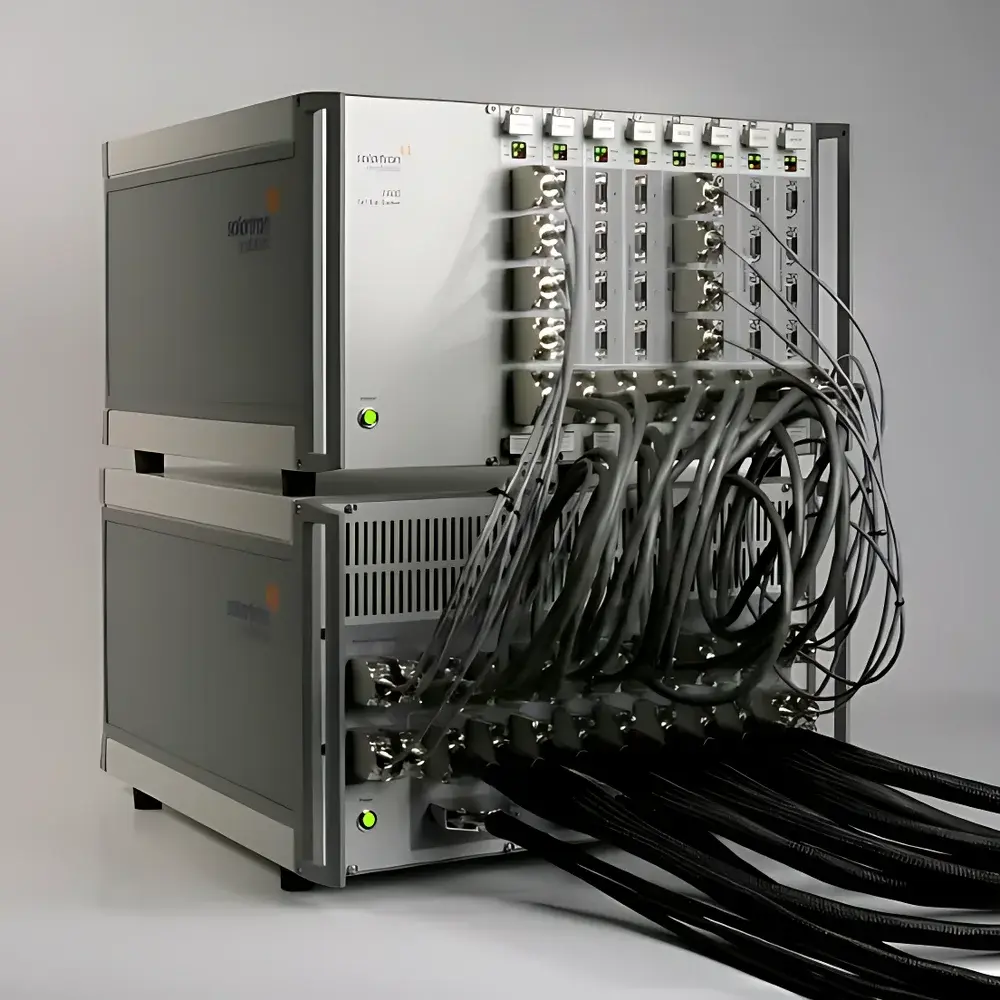
Solartron Analytical 1455/1451 Multi-Channel Frequency Response Analyzer (FRA) with Electrochemical Impedance Spectroscopy Capability
| Brand | Solartron Analytical |
|---|---|
| Origin | United Kingdom |
| Model | 1455 / 1451 |
| Channel Count | Multi-channel workstation |
| Current Range | ±4 A |
| Current Accuracy | ±0.2% |
| Potential Accuracy | ±0.2% |
| Potentiostatic Range | ±10 V |
| AC Impedance Frequency Range | 10 µHz to 1 MHz |
| DAC Sampling Rate | 40 MHz |
| Frequency Resolution | 1 in 65,000,000 |
| Signal Amplitude Range | 1 mV–50 V (rms) |
| Phase Resolution | 0.01° |
| Voltage Resolution | 1 µV |
| Waveform Options | Single-sine, multi-sine (FFT-based) |
| Auxiliary Input Channels | 4 (with optional 14702A/14703A modules) |
| Communication Interface | Ethernet |
Overview
The Solartron Analytical 1455/1451 Multi-Channel Frequency Response Analyzer (FRA) is a high-precision electrochemical workstation engineered for advanced impedance characterization across demanding research and industrial applications. It operates on dual-mode signal generation and detection architecture—combining lock-in amplifier–based single-sine correlation for ultra-high phase and magnitude fidelity with fast Fourier transform (FFT)-driven multi-sine analysis for rapid, broadband spectral acquisition. This hybrid approach enables rigorous electrochemical impedance spectroscopy (EIS) from ultra-low frequencies (10 µHz) up to 1 MHz, supporting time-domain stability studies, battery degradation modeling, fuel cell stack diagnostics, and corrosion mechanism elucidation. The system’s modular, template-based hardware design allows scalable deployment of up to eight independent FRA channels within a single chassis, each equipped with dedicated Ethernet interfaces for deterministic data streaming and synchronized multi-electrode or multi-cell measurements.
Key Features
- Dual-mode excitation: Single-sine correlation (for maximum accuracy at critical low frequencies) and multi-sine FFT analysis (for accelerated full-spectrum acquisition)
- Exceptional resolution: 26-bit frequency synthesis engine delivering 1-part-in-65-million frequency resolution and 0.01° phase resolution
- High-fidelity signal conditioning: 40 MHz DAC sampling rate with automatic digital filtering and adaptive integration time control to suppress environmental noise and improve SNR
- Multi-channel scalability: Each FRA module supports independent operation; up to eight modules can be integrated into one system via standardized backplane and Ethernet synchronization
- High-power EIS capability: Compatible with Solartron’s 1470E potentiostat/galvanostat platform and 1290 Power Amplifier for DC-biased AC measurements up to ±28 A (parallel DC channel configuration)
- Dedicated auxiliary voltage analyzer: Four auxiliary analog inputs (with optional 14702A/14703A modules) enable simultaneous anode/cathode impedance mapping—critical for electrode-level failure analysis in Li-ion batteries and PEM fuel cells
Sample Compatibility & Compliance
The 1455/1451 FRA system is compatible with standard three-electrode electrochemical cells, rotating disk electrodes (RDE), flow cells, and custom-built battery test fixtures. Its wide potential range (±10 V), current capacity (±4 A per channel), and sub-millivolt voltage resolution support aqueous and non-aqueous electrolytes, solid-state batteries, and high-impedance coatings. The instrument complies with ISO/IEC 17025 requirements for calibration traceability and meets key regulatory expectations for data integrity under GLP and GMP environments. All measurement sequences—including parameter sweeps, time-resolved EIS, and hybrid DC+AC protocols—support full audit trail logging in accordance with FDA 21 CFR Part 11 when used with compliant software configurations (e.g., CorrWare™/SMaRT™ with electronic signature and user access controls).
Software & Data Management
Control and analysis are performed using Solartron’s CorrWare™ and SMaRT™ software suite, which provides scriptable experiment sequencing, real-time Nyquist/Bode visualization, Kramers–Kronig validation, and equivalent circuit fitting (including distributed element models). Raw time-series and complex impedance datasets are stored in HDF5 format—ensuring metadata-rich, self-documenting files suitable for long-term archival and cross-platform interoperability. Ethernet-native communication enables remote monitoring, centralized fleet management, and integration into laboratory information management systems (LIMS) via TCP/IP APIs. All software modules support automated report generation compliant with ASTM E1461 (impedance spectroscopy), ISO 12944-6 (corrosion testing), and USP (analytical instrument qualification).
Applications
- Li-ion and solid-state battery R&D: State-of-charge–dependent EIS, SEI growth kinetics, interfacial resistance mapping
- Fuel cell stack health monitoring: Individual cell impedance profiling using auxiliary voltage inputs to isolate anode/cathode contributions
- Corrosion science: Coating delamination detection, inhibitor efficiency quantification, and electrochemical noise analysis
- Supercapacitor characterization: Frequency-dependent capacitance dispersion, leakage current modeling, and aging trajectory prediction
- Electrocatalyst screening: Charge-transfer resistance extraction under controlled mass transport conditions (e.g., with RDE coupling)
- Biomedical electrode development: Impedance biosensor calibration, tissue–electrode interface modeling, and biofilm formation tracking
FAQ
What distinguishes the 1455 from the 1451 model?
The 1455 supports full-frequency EIS from 10 µHz to 1 MHz, while the 1451 is optimized for lower-frequency applications with a range of 10 µHz to 100 kHz—offering enhanced low-noise performance and extended integration times for ultra-stable measurements.
Can the system perform simultaneous multi-electrode EIS on different cells?
Yes—each FRA channel operates independently with isolated analog front-ends and dedicated Ethernet interfaces, enabling true parallel impedance acquisition across multiple working electrodes without crosstalk.
Is the 1455/1451 compatible with third-party potentiostats?
It is designed for native integration with Solartron’s 1470E and 1472E potentiostat platforms; external potentiostat compatibility requires analog sync signal interfacing and is validated on a case-by-case basis.
How is data integrity ensured during long-duration low-frequency EIS scans?
The system employs adaptive integration, temperature-compensated reference circuits, and real-time Kramers–Kronig consistency checks—combined with timestamped HDF5 storage and optional 21 CFR Part 11 audit logging.
What auxiliary hardware is required for anode/cathode-resolved impedance in battery testing?
The 14702A (dual auxiliary voltage input) or 14703A (quad auxiliary input) option must be installed on the host 1470E unit to enable simultaneous four-terminal sensing of individual electrode potentials during AC perturbation.






