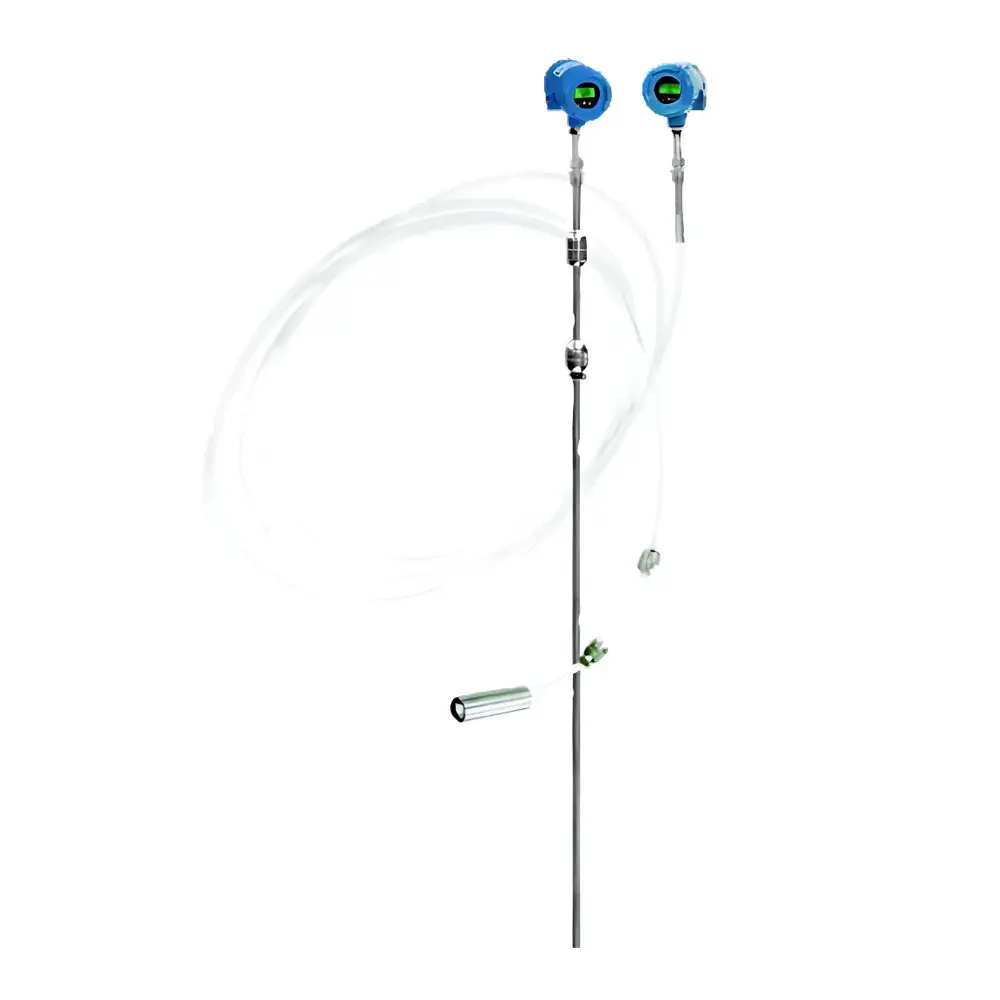
Drexelbrook TLS Series Magnetostrictive Level Transmitter
| Brand | Drexelbrook |
|---|---|
| Origin | Shanghai, China |
| Model | TLS Series Magnetostrictive Level Transmitter |
| Measurement Principle | Magnetostriction |
| Accuracy | ±0.01% of full scale |
| Output Signals | Dual 4–20 mA outputs (one with HART protocol or RS-485) |
| Temperature Points | 5 integrated Pt100 RTD sensors |
| Pressure Rating | Up to 6.9 MPa (rigid rod), up to 1.0 MPa (flexible cable) |
| Temperature Range | –40 °C to +100 °C (rod), –40 °C to +70 °C (cable) |
| Maximum Measurement Length | 9 m (rigid rod), 18 m (flexible cable) |
| Compliance | Designed for SIL-2 capable systems per IEC 61508 |
| Enclosure Options | Aluminum or stainless steel (IP66/IP67 rated) |
| Process Connection | Threaded (NPT, G, or BSP), flanged, or sanitary clamp |
Overview
The Drexelbrook TLS Series Magnetostrictive Level Transmitter is an industrial-grade continuous level and interface measurement instrument engineered for high-reliability operation in demanding process environments. It operates on the magnetostrictive principle—where a torsional strain pulse is generated at the position of a magnetized float moving along a waveguide—and precisely determines liquid level or liquid-liquid interface position by measuring the time-of-flight between an interrogation current pulse and the returned mechanical torsion wave. This physics-based method delivers exceptional repeatability and long-term stability without mechanical wear, making it suitable for critical applications in chemical, petrochemical, pharmaceutical, and food & beverage industries where regulatory compliance and process safety are paramount.
Key Features
- High-accuracy level and interface measurement with ±0.01% FS typical accuracy, traceable to NIST-calibrated reference standards.
- Dual independent 4–20 mA analog outputs—one configurable with HART 7 protocol for diagnostics and configuration, the other optionally supporting RS-485 Modbus RTU for integration into distributed control systems (DCS) or SCADA networks.
- Integrated temperature profiling: five calibrated Pt100 RTD elements distributed along the sensing element enable simultaneous multi-point temperature monitoring, supporting density compensation and thermal expansion correction in custody transfer or quality-critical batching operations.
- Robust mechanical design: rigid rod variants rated for pressures up to 6.9 MPa and temperatures from –40 °C to +100 °C; flexible cable versions support extended ranges up to 18 meters while maintaining pressure ratings up to 1.0 MPa and operating temperatures from –40 °C to +70 °C.
- Configurable hardware options including explosion-proof aluminum or 316 stainless steel housings (certified to ATEX, IECEx, and UL/cUL Class I Div 1/Zone 1), multiple process connection types (NPT, G, BSP threads; ANSI/EN/DIN flanges; tri-clamp sanitary fittings), and custom float materials (e.g., SS316L, Hastelloy C-276, PTFE-coated) for aggressive media compatibility.
Sample Compatibility & Compliance
The TLS Series is designed for continuous, non-contact level and interface measurement in liquids—including hydrocarbons, solvents, acids, caustics, and food-grade fluids—provided the float density is appropriately matched to the process medium. It complies with international functional safety requirements for SIL-2 capable systems per IEC 61508 and supports audit-ready documentation for GLP/GMP environments. Electromagnetic compatibility meets IEC 61326-1 (industrial environment), and ingress protection is rated IP66/IP67 as standard. Optional certifications include FDA-compliant wetted materials (3A-sanitary), PED 2014/68/EU for pressure equipment, and marine classification (DNV-GL, ABS) upon request.
Software & Data Management
Configuration and diagnostics are performed via Drexelbrook’s TLS Configuration Utility—a Windows-based PC application supporting HART communication, real-time signal simulation, sensor calibration verification, and firmware updates. All configuration changes, calibration events, and diagnostic logs are timestamped and stored locally; optional data logging enables export of historical level, temperature, and diagnostic parameters in CSV format. For enterprise integration, the device supports OPC UA server functionality through compatible gateways, enabling secure, structured data exchange aligned with ISA-95 and Industry 4.0 architecture principles. Audit trails comply with FDA 21 CFR Part 11 requirements when deployed with validated system software and electronic signature controls.
Applications
- Custody transfer tanks requiring high-accuracy volume reconciliation and API MPMS Chapter 3.2-compliant measurements.
- Interface detection in separator vessels (e.g., oil/water, solvent/aqueous phases) with automatic setpoint triggering for phase draw-off control.
- Batch reactors and storage silos where multi-point temperature compensation improves volumetric accuracy under thermal cycling conditions.
- Pharmaceutical clean utilities (PW, WFI) and bioreactor feed tanks where sanitary design, material traceability, and validation support are mandatory.
- Offshore and subsea production modules where vibration resistance, pressure integrity, and long-term drift stability are essential for unattended operation.
FAQ
What is the maximum allowable specific gravity range for float selection?
Float density must be selected such that it remains buoyant in the lightest phase and submerged in the heaviest phase—typically spanning 0.5–2.0 g/cm³ depending on application. Custom floats are available for extreme densities.
Can the TLS Series measure emulsions or foaming interfaces?
While not optimized for highly unstable emulsions or persistent foam layers, the TLS provides reliable interface detection in well-defined, stable phase boundaries. Signal processing includes adaptive damping to suppress transient noise from agitation or entrained gas.
Is third-party calibration certification available?
Yes—factory calibration reports with uncertainty budgets (k=2) are provided. Accredited ISO/IEC 17025 calibration services are available through authorized Drexelbrook calibration centers.
How is the device validated for GxP environments?
The TLS Series supports IQ/OQ documentation packages, including test protocols for installation verification, operational boundary testing, and performance qualification against defined acceptance criteria per ASTM E2500 and Annex 11 guidelines.
What maintenance intervals are recommended?
No scheduled recalibration is required under normal operating conditions. Annual visual inspection and functional check (via HART loop test or simulated float movement) are recommended per manufacturer’s maintenance schedule.
Related Products