
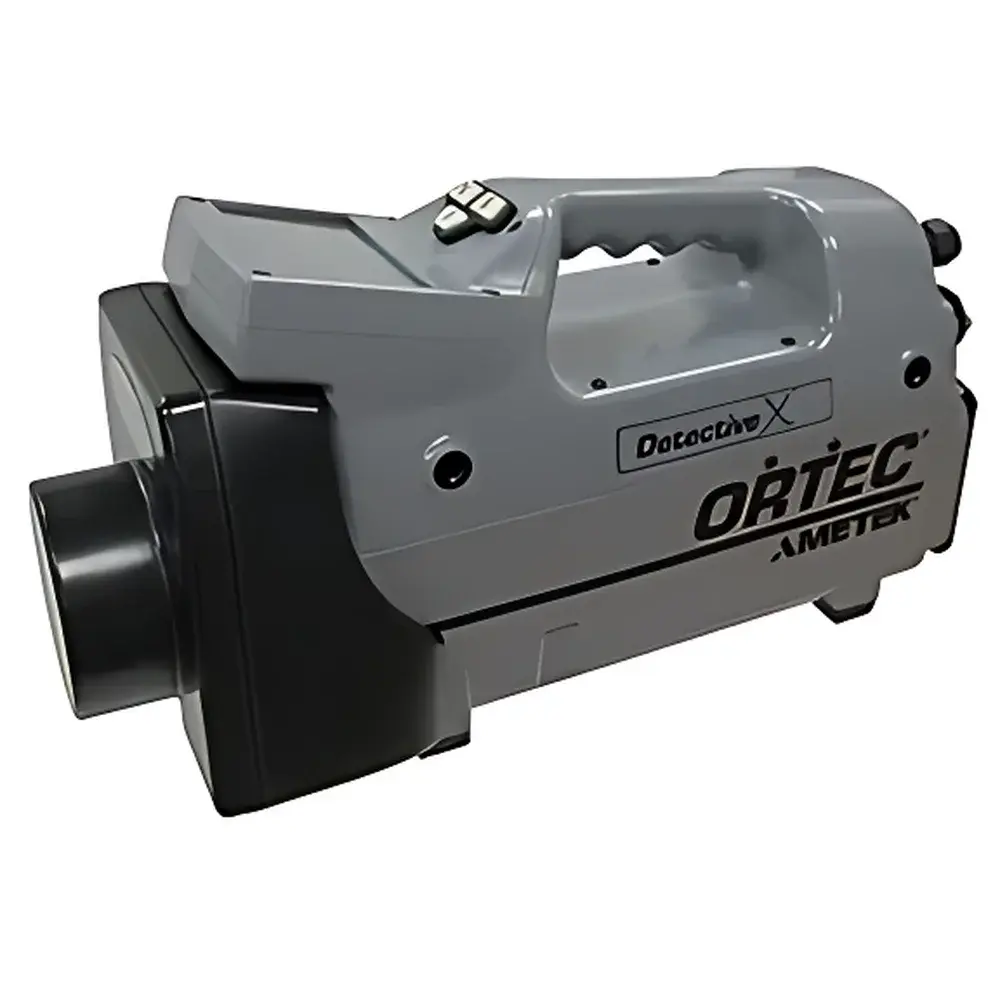
ORTEC Detective X Portable High-Purity Germanium (HPGe) Gamma Spectrometer
| Brand | ORTEC |
|---|---|
| Origin | USA |
| Manufacturer Type | Authorized Distributor |
| Origin Category | Imported |
| Model | Detective X |
| Pricing | Upon Request |
Overview
The ORTEC Detective X is a field-deployable, battery-powered portable high-purity germanium (HPGe) gamma spectrometer engineered for rapid, laboratory-grade radionuclide identification in real-world operational environments. Unlike scintillation-based handheld instruments—such as NaI(Tl) or LaBr3(Ce)—the Detective X leverages the intrinsic energy resolution advantage of cryogenically cooled HPGe detectors to deliver sub-keV full-width-at-half-maximum (FWHM) performance at 1332 keV (e.g., <1.8 keV), enabling unambiguous discrimination of closely spaced gamma-ray lines. This capability forms the physical foundation for definitive isotopic identification under low-activity, mixed-source, or shielded conditions—critical for nuclear security, border control, emergency response, and environmental monitoring. The system integrates an electrically cooled P-type coaxial HPGe detector (65 mm diameter × 50 mm thickness), eliminating reliance on liquid nitrogen while maintaining spectral fidelity across temperature ranges from –10 °C to +40 °C.
Key Features
- Electrically cooled P-type coaxial HPGe detector with 65 mm Ø × 50 mm active volume—no LN2 required
- Energy resolution ≤1.8 keV FWHM at 1332 keV (typical), enabling separation of complex gamma spectra (e.g., 133Ba, 60Co, 239Pu)
- Integrated He-3 thermal neutron detection option for dual gamma–neutron threat assessment
- Self-contained operation: internal rechargeable Li-ion battery, onboard storage (microSD card support), and embedded ARM-based processing unit
- Multi-mode acquisition: search mode (real-time gross count rate alerting), nuclide identification mode (library-matched peak analysis), special nuclear material (SNM) mode (Pu/U fission signature screening), and spectroscopic data logging
- Wireless connectivity via IEEE 802.11 a/b/g; USB 2.0 host/device interface for data export and firmware updates
Sample Compatibility & Compliance
The Detective X is designed for direct measurement of solid, liquid, or particulate radioactive samples in situ—no sample preparation required. Its ruggedized aluminum housing meets MIL-STD-810G for shock, vibration, and ingress protection (IP54). The system supports compliance workflows aligned with international nuclear security frameworks, including IAEA Nuclear Security Series No. 11-T, ANSI N42.34 (Performance Criteria for Handheld Instruments for Detection and Identification of Radionuclides), and ASTM E2782 (Standard Guide for Use of Radiation Detection Instrumentation for Homeland Security Applications). While not certified for GLP/GMP-regulated pharmaceutical or clinical use, its spectral traceability and audit-ready metadata logging (including timestamp, GPS coordinates, operator ID, and calibration history) support chain-of-custody documentation required by customs authorities, radiation protection agencies, and first responders.
Software & Data Management
The instrument runs ORTEC’s proprietary embedded software suite, featuring automated peak search, library-assisted nuclide identification (using the ORTEC GammaVision-compatible nuclide library with >800 isotopes), and false-positive suppression algorithms based on peak shape, interference correction, and background subtraction. All spectral data—including raw counts, calibrated energy spectra, and identification reports—are stored locally in standard ORTEC MCA (.cnf/.spc) format. Data export is supported via Wi-Fi or USB to PCs running GammaVision, Genie 2000, or third-party analysis tools compliant with the IAEA’s Intercomparison Data Format (IDF). Audit trails include operator logins, configuration changes, and calibration events—fully compatible with 21 CFR Part 11–aligned data integrity requirements when deployed in regulated environments.
Applications
- Nuclear security screening at ports of entry, border checkpoints, and critical infrastructure perimeters
- Radiological dispersal device (RDD) and “dirty bomb” threat assessment during large-scale public events
- Verification of declared nuclear materials and detection of undeclared SNM (e.g., 239Pu, 235U) in scrap metal, cargo, or waste streams
- Environmental radiological surveys following accidental releases or legacy site characterization
- Emergency response triage by HAZMAT teams requiring immediate isotopic attribution without lab backhaul
- Regulatory compliance verification for radioactive source accountability under national radiation protection ordinances
FAQ
Does the Detective X require liquid nitrogen cooling?
No. It uses a compact, low-power Stirling-cycle cryocooler to maintain the HPGe crystal at ~77 K, enabling continuous operation for up to 8 hours on a single charge.
Can it identify shielded or masked isotopes?
Yes. Its superior energy resolution allows deconvolution of overlapping peaks and detection of weak gamma signatures obscured by matrix attenuation or intentional shielding—particularly critical for identifying plutonium isotopes in mixed-fuel scenarios.
Is GPS and location tagging supported?
Yes. Integrated GPS module geotags all spectra and reports, supporting spatial mapping of contamination or threat locations in incident command systems.
What nuclide libraries are included?
Standard library covers over 800 radioisotopes, including medical, industrial, naturally occurring, and special nuclear materials. Custom libraries can be loaded via USB or Wi-Fi.
How is calibration maintained in the field?
Automatic daily energy calibration using internal 241Am reference source; user-initiated efficiency calibration via standard point sources (e.g., 133Ba, 60Co) with traceable NIST-traceable certificates.







