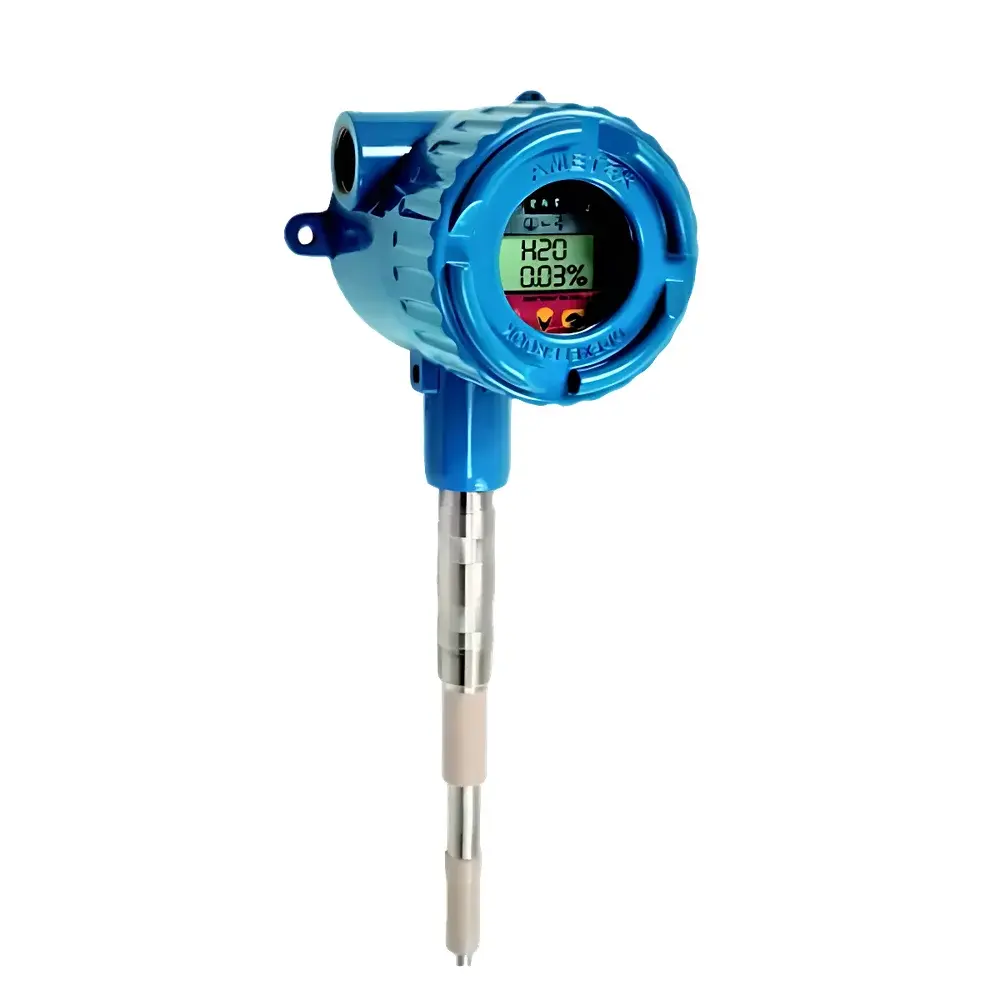
Drexelbrook UC Series Insertion-Type Water-in-Oil Analyzer
| Brand | Drexelbrook |
|---|---|
| Origin | Shanghai, China |
| Manufacturer Type | Authorized Distributor |
| Product Category | Level Meter |
| Model | UC Series Insertion-Type Water-in-Oil Analyzer |
| Measurement Principle | RF Admittance |
| Water-in-Oil Range | 0–50% for Light Oils, 0–80% for Heavy Oils |
| Max. Operating Temperature | 232°C |
| Max. Operating Pressure | 10 MPa |
| Output Signal | 4–20 mA with HART Protocol |
| Installation Type | Insertion |
| Certifications | ATEX, IECEx, CSA (Class I Div 1/Zone 1), FM |
| Sensor Maintenance | Field-cleanable, wax-resistant, flow-insensitive |
| Configuration Options | Integral or Remote Electronics, Multiple Probe Lengths & Process Connections |
Overview
The Drexelbrook UC Series Insertion-Type Water-in-Oil Analyzer is an industrial-grade, real-time process analyzer engineered for continuous, non-intrusive measurement of water concentration in hydrocarbon-based liquids. It operates on the principle of RF admittance—a robust dielectric sensing technique that distinguishes between oil and free/emulsified water based on their distinct permittivity and conductivity signatures. Unlike optical or capacitance-only methods, RF admittance compensates for coating effects (e.g., wax, sludge, or asphaltenes) and is inherently insensitive to changes in flow velocity, density, or viscosity—making it uniquely suited for demanding upstream, midstream, and refining applications where process stability and sensor reliability are critical.
Key Features
- Insertion-style probe design enables rapid field installation without process shutdown or vessel modification—ideal for retrofitting into existing pipelines, separators, or storage tanks.
- Wide dynamic range: 0–50% water-in-light-oil (e.g., crude, naphtha, diesel) and 0–80% water-in-heavy-oil (e.g., bitumen, vacuum residue, tar), calibrated per API RP 14E and ASTM D4006 guidelines.
- High-temperature, high-pressure rated construction: stainless steel 316L probe with ceramic insulation; validated for continuous operation up to 232°C and 10 MPa (1450 psi).
- Field-serviceable sensor geometry with smooth, non-stick surface finish minimizes fouling; compatible with CIP/SIP protocols and mechanical cleaning tools.
- Integrated electronics support HART 7 protocol over standard 4–20 mA loop—enabling remote configuration, diagnostics, and calibration verification without physical access to the transmitter.
- Comprehensive hazardous area certification suite: ATEX II 1/2 G Ex d ia IIC T4 Ga, IECEx Ex d ia IIC T4 Ga, FM Class I Div 1 Groups B, C, D, T4, and CSA Class I Div 1 Groups B, C, D, T4.
Sample Compatibility & Compliance
The UC Series analyzer is validated for use with a broad spectrum of petroleum streams—including crude oil (API 10–45°), synthetic crudes, refinery slops, lube oils, fuel oils, and heavy tars—where water exists as free, dispersed, or emulsified phases. Its RF admittance architecture eliminates false readings caused by conductive contaminants, entrained solids, or interfacial turbulence. The instrument complies with IEC 61508 SIL 2 functional safety requirements when integrated into safety instrumented systems (SIS). Data integrity meets FDA 21 CFR Part 11 and EU Annex 11 expectations via optional audit-trail-enabled firmware, supporting GLP/GMP environments in lubricant manufacturing and custody transfer operations.
Software & Data Management
Configuration and diagnostics are performed using Drexelbrook’s UC ConfigTool—a Windows-based PC application supporting device parameterization, zero/span calibration, linearization curve editing, and diagnostic log export. All configuration changes are timestamped and user-logged. When deployed with DCS or SCADA systems, the 4–20 mA + HART output delivers primary measurement value alongside secondary variables (e.g., temperature-compensated admittance, signal quality index, sensor health status). Optional Modbus TCP or Profibus DP gateways enable integration into enterprise MES platforms for trend analysis, predictive maintenance scheduling, and batch reconciliation reporting.
Applications
- Automatic water-cut monitoring at wellhead manifolds and multi-phase separator outlets.
- Real-time control of electrostatic desalters and dehydration units in refineries.
- Custody transfer verification for crude oil loading/unloading terminals per ISO 3966 and API MPMS Ch. 10.8.
- Quality assurance in lube oil blending plants detecting moisture ingress during storage or transfer.
- Process optimization in coker fractionators and visbreaker feed lines where water content affects coke drum cycle time.
- Environmental compliance monitoring in produced water treatment skids prior to reinjection or discharge.
FAQ
How does RF admittance differ from conventional capacitance measurement?
RF admittance employs a high-frequency AC excitation signal (typically 1–10 MHz) combined with phase-sensitive detection to resolve both capacitive and conductive components of the dielectric response—effectively rejecting stray capacitance and coating-induced drift.
Can the UC Series be used in multiphase flow with gas entrainment?
Yes—its measurement is largely unaffected by intermittent gas bubbles or slug flow, provided the probe remains fully wetted; however, sustained dry-out conditions require level supervision or probe immersion verification.
Is field calibration possible without removing the probe?
Yes—zero calibration can be performed with dry oil (verified water-free), and span calibration uses certified reference standards traceable to NIST; HART-enabled tools allow full two-point calibration remotely.
What materials are available for probe wetted parts in highly corrosive service?
Standard probes use 316L SS; optional variants include Hastelloy C-276, Inconel 600, and PFA-lined bodies for H₂S, organic acids, or chlorinated solvents.
Does the analyzer support SIL-certified control loops?
When configured with dual-redundant UC probes and certified logic solvers, the system achieves SIL 2 per IEC 61511 for water-cut trip functions in separation trains.
Related Products