
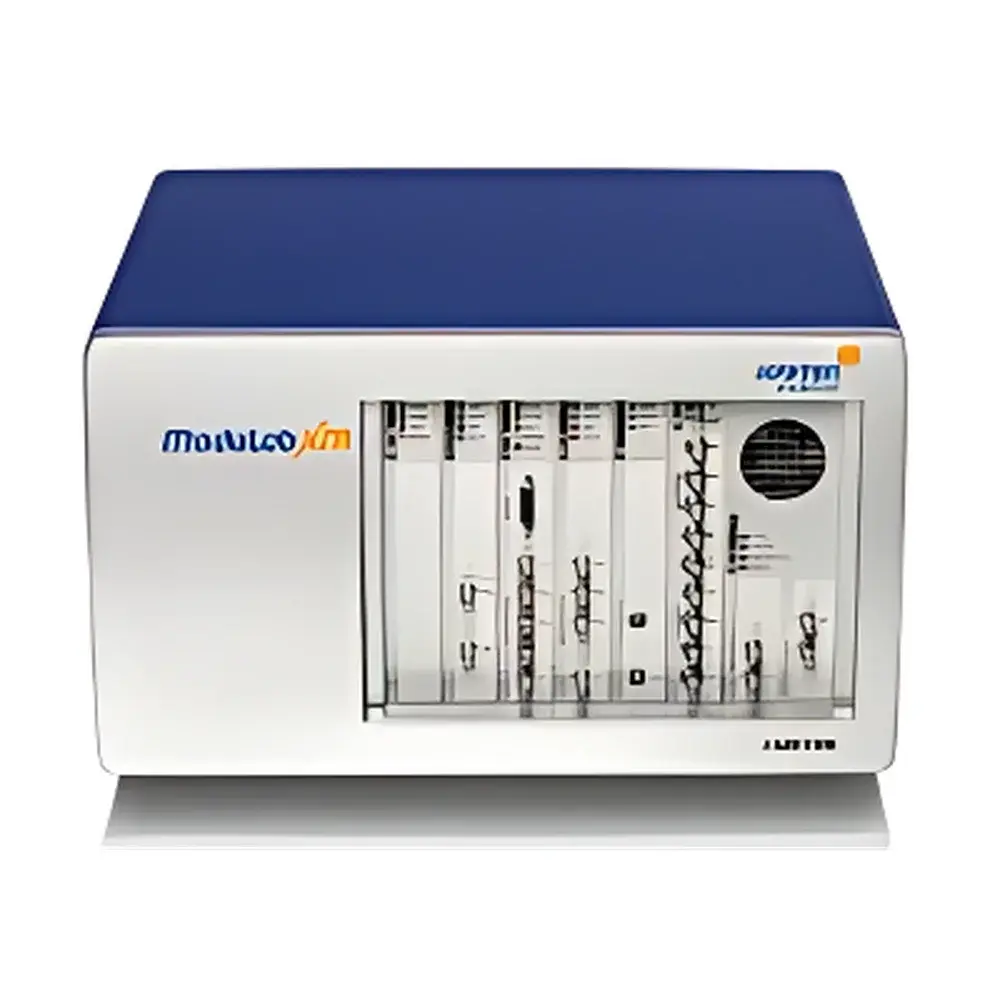
Solartron Analytical Modulab XM DSSC Photoelectrochemical Testing System
| Brand | Solartron Analytical |
|---|---|
| Origin | United Kingdom |
| Model | Modulab XM DSSC |
| Instrument Type | Electrochemical Workstation |
| Channel Count | Single-Channel |
| Current Range | ±2 A |
| Current Accuracy | ±0.2% of reading |
| Potential Accuracy | ±0.2% of reading |
| Potentiostatic Range | ±10 V |
| EIS Frequency Range | 10 µHz – 1 MHz |
| Light Source | NIST-traceable, thermally stabilized LED-based optical platform with selectable high-brightness monochromatic LEDs |
| Software | ModuLab XM Suite with integrated FRA, CV, CP, EIS, IMPS/IMVS, Voc decay, charge extraction, and J-V analysis modules |
| Compliance | Fully compatible with GLP/GMP data integrity requirements |
Overview
The Solartron Analytical Modulab XM DSSC Photoelectrochemical Testing System is a purpose-engineered, single-channel electrochemical workstation optimized for quantitative characterization of dye-sensitized solar cells (DSSCs), photoelectrodes, and light-driven catalytic systems such as Fe₂O₃-based photoanodes for water splitting. Built upon the industry-proven Modulab XM architecture, it integrates high-fidelity potentiostat/galvanostat electronics with a thermally stabilized, NIST-traceable optical excitation platform—enabling synchronized electrochemical and photonic stimulation under controlled spectral, temporal, and intensity conditions. The system operates on principles of transient photocurrent/photovoltage spectroscopy, intensity-modulated photocurrent spectroscopy (IMPS), intensity-modulated photovoltage spectroscopy (IMVS), and electrochemical impedance spectroscopy (EIS) across six decades of frequency (10 µHz–1 MHz). Its design emphasizes experimental reproducibility, traceable irradiance calibration, and seamless correlation between optical input and electrochemical response—critical for mechanistic studies of charge generation, recombination kinetics, and interfacial transport in semiconductor–electrolyte junctions.
Key Features
- Single-channel potentiostat/galvanostat with ±2 A current range, ±10 V compliance voltage, and metrological-grade accuracy (±0.2% for both potential and current)
- Integrated optical platform featuring NIST-traceable, thermally managed high-brightness monochromatic LEDs (selectable wavelengths from 365 nm to 940 nm) with real-time irradiance monitoring and recalibration capability
- Advanced frequency response analysis (FRA) engine supporting single-sine, multi-sine, and swept-frequency EIS, alongside dedicated IMPS/IMVS acquisition protocols
- Automated time-domain analysis suite for Voc decay, charge extraction, and J–V curve generation—including built-in calculation of electron lifetime (τₙ), effective diffusion coefficient (Dₑff), and recombination resistance (Rrec)
- Dual-potential monitoring capability via auxiliary voltage divider, enabling simultaneous measurement of anode- and cathode-specific potentials and impedances during illumination
- Fully modular hardware architecture: existing Modulab or Modulab XM systems can be upgraded to DSSC configuration via optical stage integration and firmware licensing
Sample Compatibility & Compliance
The Modulab XM DSSC accommodates standard three-electrode photoelectrochemical cells (e.g., quartz-cuvette, custom flow cells, or thin-film deposition substrates) and supports liquid, gel, and solid-state electrolytes. It complies with ISO 17025–aligned calibration practices through its factory-supplied NIST-traceable irradiance certificate and user-accessible in-situ light source verification routine. For regulated environments, the ModuLab XM software suite supports 21 CFR Part 11 compliance when deployed with appropriate IT infrastructure—including role-based access control, electronic signature workflows, and immutable audit trails for all method definitions, raw data acquisition, and post-processing steps. All electrochemical protocols adhere to ASTM E1461 (for photoelectrochemical performance reporting) and IEC 61215–derived test sequences applicable to emerging photovoltaic materials.
Software & Data Management
Controlled by the ModuLab XM software platform, the system delivers unified experiment design, execution, and analysis without requiring third-party scripting. The graphical method editor allows users to construct complex multi-step sequences combining potentiostatic holds, light-on/off triggers, EIS sweeps, and transient waveform capture—all time-synchronized to optical pulses. Raw data are stored in vendor-neutral binary format (.mxd) with embedded metadata (timestamp, instrument ID, calibration status, environmental logs). Integrated analysis modules provide automated fitting of equivalent circuit models to EIS spectra, derivative-based determination of carrier lifetimes from Voc decay transients, and statistical reporting of parameter distributions across replicate samples. Export options include CSV, MATLAB .mat, and HDF5 formats—ensuring compatibility with institutional data repositories and FAIR (Findable, Accessible, Interoperable, Reusable) data management policies.
Applications
- Quantitative evaluation of charge injection efficiency, electron transport length, and surface recombination velocity in mesoporous TiO₂–dye–electrolyte interfaces
- Time-resolved investigation of photoinduced charge accumulation and back-reaction kinetics in hematite (α-Fe₂O₃), BiVO₄, and perovskite-based photoanodes
- Stability assessment of DSSCs under accelerated illumination–bias stress protocols (e.g., MPPT tracking, open-circuit voltage hold under AM1.5G-equivalent irradiance)
- Development and validation of novel redox mediators and solid-state hole-transport materials via in situ impedance monitoring during photoelectrolysis
- Correlative study of optoelectronic properties and morphological evolution using synchronized EIS and in situ UV-Vis spectroelectrochemistry (with optional fiber-optic coupling)
FAQ
Is the Modulab XM DSSC compatible with non-Solartron optical accessories?
Yes—its optical stage uses standardized mechanical and electrical interfaces (e.g., SMA905 fiber ports, TTL trigger lines, and 0–10 V analog intensity control), enabling integration with external monochromators, xenon lamps, or pulsed laser sources.
Can the system perform dark EIS measurements alongside illuminated tests?
Absolutely—the software supports automatic dark/light cycling within a single experiment sequence, with configurable delay times and bias conditions before and after illumination onset.
What level of technical support is provided for method development?
Solartron Analytical offers application-specific protocol templates, remote expert consultation, and on-site training packages covering DSSC characterization best practices, uncertainty quantification, and GLP-compliant reporting workflows.
Does the system meet requirements for publication-grade data reporting?
Yes—raw data files include full experimental metadata, calibration history, and instrument configuration snapshots, satisfying journal requirements for transparency and reproducibility (e.g., ACS Energy Letters, Journal of Physical Chemistry C, and Nature Energy).





