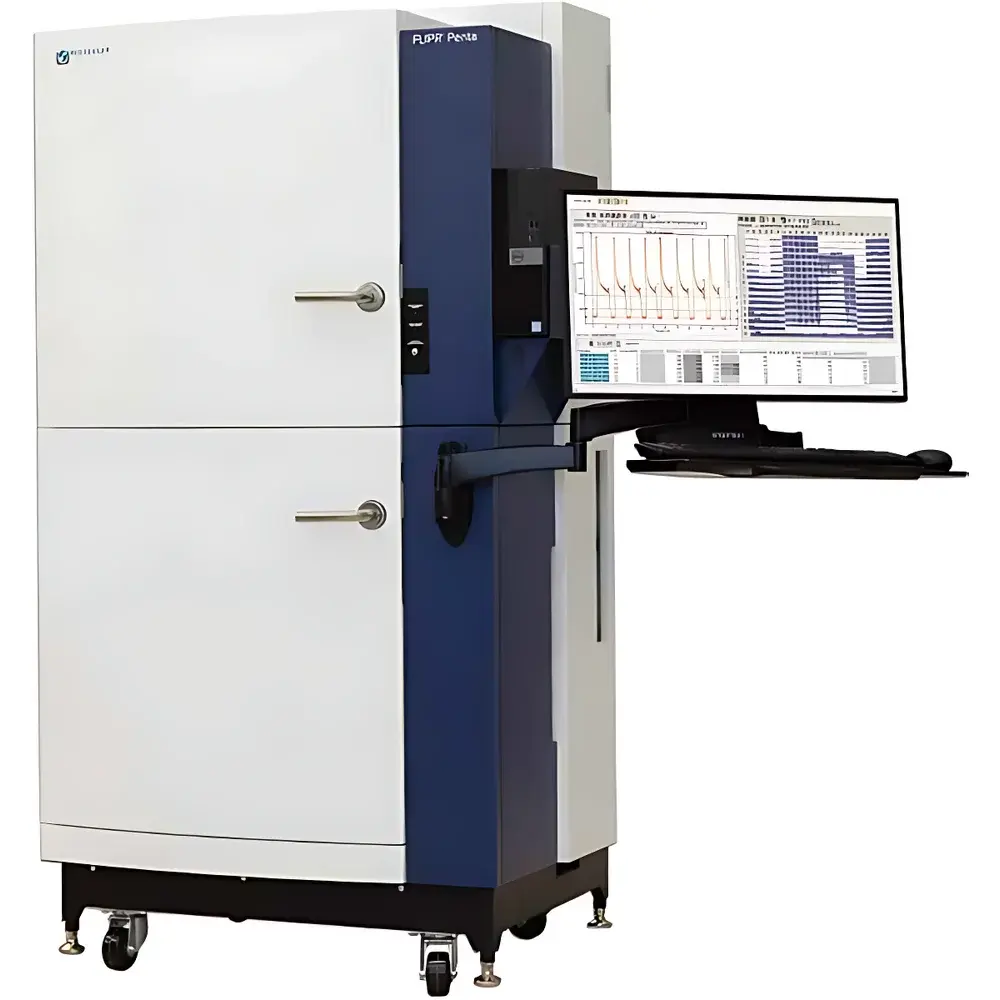
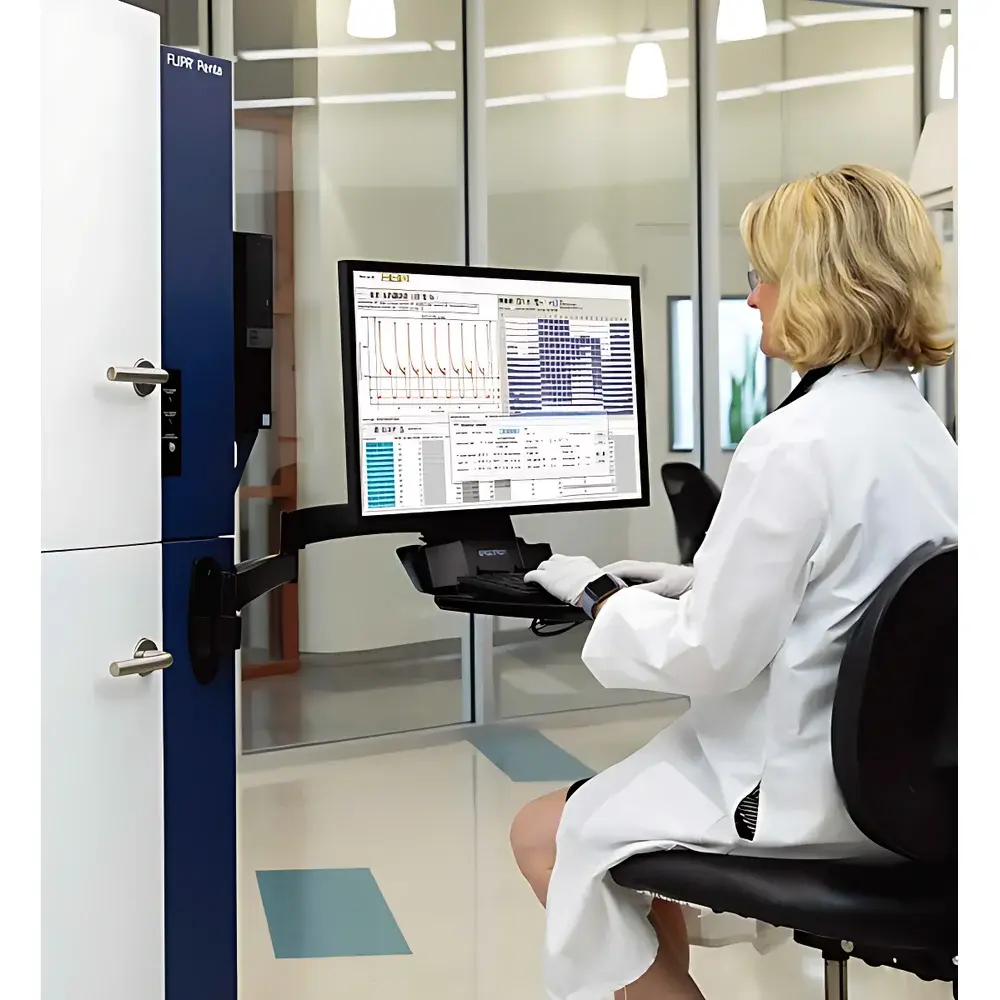
Molecular Devices FLIPR Penta High-Throughput Real-Time Fluorescence Detection System
| Brand | Molecular Devices |
|---|---|
| Origin | USA |
| Manufacturer Type | Original Equipment Manufacturer (OEM) |
| Product Category | Imported Instrument |
| Model | FLIPR Penta |
| Pricing | Upon Request |
Overview
The Molecular Devices FLIPR Penta High-Throughput Real-Time Fluorescence Detection System is a purpose-built, plate-based functional assay platform engineered for kinetic, cell-based measurements in drug discovery and translational physiology research. It operates on the principle of real-time fluorescence intensity or ratiometric detection—primarily leveraging calcium-sensitive dyes (e.g., Fluo-4, Fura-2), membrane potential dyes (e.g., DiBAC₄(3)), pH indicators, or thallium-sensitive probes—to quantify dynamic intracellular signaling events with millisecond temporal resolution. The system integrates synchronized liquid handling, high-speed imaging, and precise environmental control to enable quantitative measurement of G protein-coupled receptor (GPCR) activation, ion channel modulation, cardiomyocyte electrophysiological phenotyping, and early cardiac safety assessment—fully aligned with CiPA (Comprehensive in vitro Proarrhythmia Assay) and ICH S7B/S7B/E14 regulatory frameworks.
Key Features
- HS-EMCCD imaging sensor capable of up to 100 frames per second (fps), enabling high-fidelity capture of rapid calcium transients, oscillatory activity in iPSC-derived cardiomyocytes and neurons, and transient membrane depolarization events.
- Modular optical architecture featuring user-replaceable LED excitation sources and filter sets—supporting single-wavelength, dual-wavelength ratiometric, and chemiluminescence detection modes without hardware recalibration.
- Interchangeable pipetting heads for 96-, 384-, and 1536-well microplates—installed tool-free in under 2 minutes—with automatic head identification and gravimetric calibration to ensure volumetric accuracy across all formats (CV < 3% at 10 µL).
- Integrated FLIPR Cycler option: an internal multi-plate handler compatible with third-party stackers, enabling unattended sequential plate processing—up to 20 plates per hour including compound addition, signal acquisition (2 min/plate), and tip exchange.
- Temperature- and CO₂-controlled chamber (ambient to 40 °C; 0–10% CO₂) with humidity regulation, supporting long-term kinetic assays using primary cells, co-cultures, and stem-cell-derived models.
Sample Compatibility & Compliance
The FLIPR Penta accommodates adherent and suspension cell types—including HEK293, CHO, U2OS, iPSC-derived cardiomyocytes and cortical neurons—as well as yeast and bacterial systems. It supports standard ANSI/SLAS-compliant microplates (SBS format), opaque black or clear-bottom plates, and custom substrates for impedance or optogenetic integration. All hardware and software components comply with ISO 13485:2016 (for medical device quality management), FDA 21 CFR Part 11 (electronic records/signatures), and GLP/GMP-aligned audit trail functionality within ScreenWorks software. Data integrity is maintained through role-based access control, immutable experiment logs, and timestamped metadata capture—including pipette calibration history, optical configuration, and environmental parameters.
Software & Data Management
ScreenWorks software provides a drag-and-drop protocol builder with context-aware parameter selection—automatically restricting options based on installed hardware (e.g., available LEDs, head type, detector mode). Protocols support complex fluidic workflows: multi-step compound addition, fractional transfers, repeated sampling, automated tip washing (up to two solvents), and suspended-cell delivery with integrated cleaning cycles. Real-time data visualization includes well-level kinetic traces, heatmaps, peak amplitude/duration metrics, and oscillation frequency analysis via the optional PeakPro 2 module. Export options include CSV, Excel, and HDF5; all plots and tables are copy-paste enabled for direct integration into regulatory submissions (e.g., IND-enabling reports). Audit trails record every user action, instrument state change, and calibration event—fully traceable for FDA or EMA inspection readiness.
Applications
- Functional GPCR screening via calcium flux or cAMP biosensors across diverse ligand classes (agonists, antagonists, biased modulators).
- Ion channel pharmacology: hERG, Nav1.5, Cav1.2, and TRP channel profiling using Tl⁺ flux, voltage-sensitive dyes, or genetically encoded indicators.
- Cardiac safety assessment: detection of proarrhythmic signatures—including delayed afterdepolarizations (DADs), beat-to-beat variability, and conduction abnormalities—in human iPSC-cardiomyocyte monolayers.
- pH dynamics in lysosomal trafficking, metabolic stress response, or receptor internalization studies.
- Neuronal network activity mapping: synchronous calcium bursting, synaptic plasticity assays, and neurotoxicity endpoints in 2D/3D neuronal cultures.
FAQ
What cell types are validated for use with the FLIPR Penta system?
Primary cells, immortalized lines, and stem-cell-derived models—including iPSC-cardiomyocytes, iPSC-neurons, HEK293, CHO-K1, and Jurkat—are routinely supported. Suspension and adherent formats are both compatible with appropriate plate coatings and fluidics protocols.
Does the system support GLP-compliant data acquisition and reporting?
Yes. ScreenWorks includes full 21 CFR Part 11 compliance features: electronic signatures, audit trails, user authentication, and locked data archives—validated for use in regulated environments supporting IND/NDA submissions.
Can the FLIPR Penta perform simultaneous multi-parameter detection (e.g., Ca²⁺ + membrane potential)?
No. The system performs sequential, not concurrent, multi-dye detection due to optical path constraints. However, wavelength-switching protocols (e.g., alternating 480/520 nm excitation) enable ratiometric quantification within a single assay run.
Is remote monitoring or unattended operation supported?
Yes. With FLIPR Cycler integration and network-enabled ScreenWorks, users can initiate runs, receive email alerts upon completion, and monitor real-time kinetics remotely via secure HTTPS connection.
What validation documentation is provided with the instrument?
Each system ships with IQ/OQ documentation templates, factory calibration certificates for pipetting accuracy, optical throughput, and temperature/CO₂ stability—aligned with ASTM E2500 and USP analytical instrument qualification guidelines.