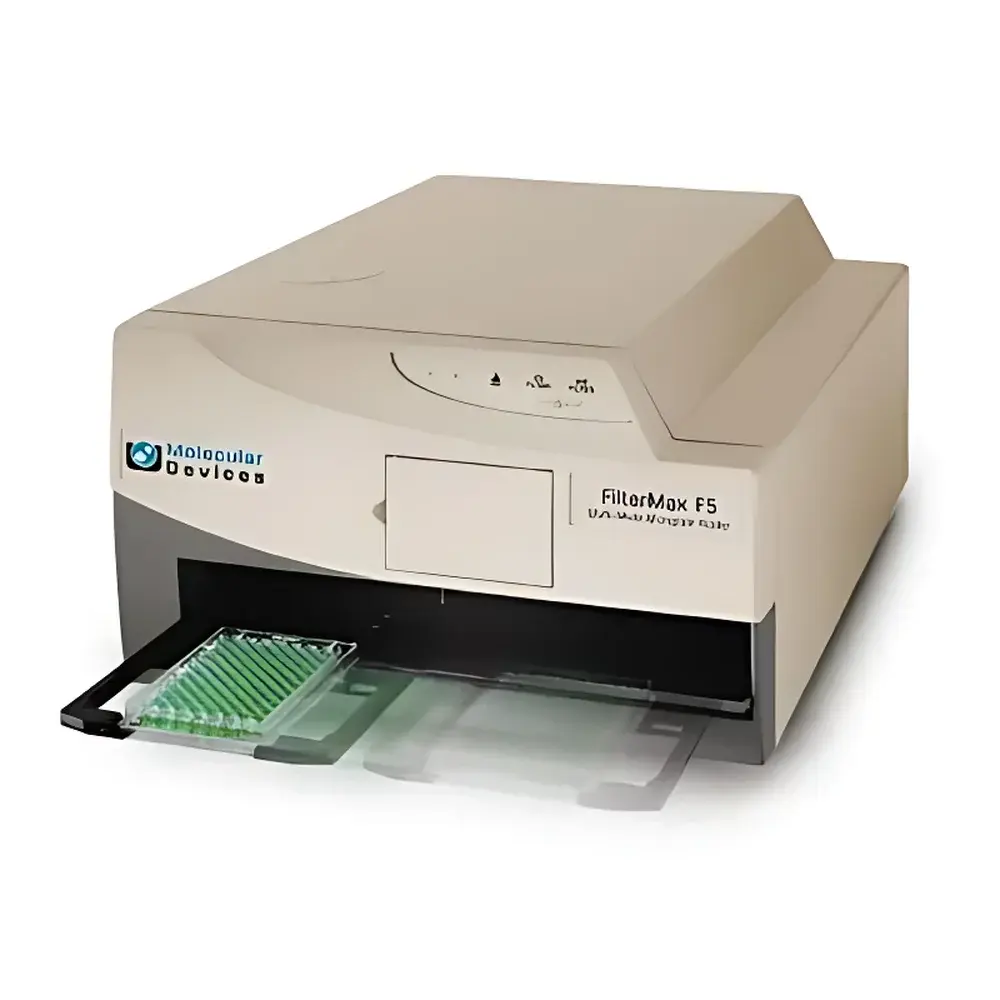
Molecular Devices FilterMax F3/F5 Filter-Based Multimode Microplate Reader
| Brand | Molecular Devices |
|---|---|
| Origin | Austria |
| Manufacturer Type | Original Equipment Manufacturer (OEM) |
| Import Category | Imported Instrument |
| Model | FilterMax F3/F5 |
| Detection Methods | Absorbance, Fluorescence Intensity (FI), Time-Resolved Fluorescence (TRF), Fluorescence Polarization (FP), Luminescence |
| Automation Level | Fully Automated Microplate Reader |
| Assay Modes | Endpoint, Kinetic, Spectral Scan, Linear Scan, Well Scan |
| Curve Fitting Options | >18 Built-in Algorithms (e.g., 4PL, 5PL, Linear, Log-Log, Sigmoidal) |
| Detector | Dual-Mode — Silicon Photodiode (Absorbance) + Photon-Counting PMT (Fluorescence/Luminescence) |
| Wavelength Range | 230–750 nm (Absorbance & Excitation) |
| Absorbance Dynamic Range | 0–3 OD |
| Absorbance Linearity | ±0.5% or ±0.005 OD (whichever is greater) |
| Wavelength Switching Speed | <100 ms per filter pair |
| Precision (CV) | <0.5% for absorbance (0–2 OD), <1.0% for fluorescence (high-signal range) |
Overview
The Molecular Devices FilterMax F3/F5 is a high-performance, filter-based multimode microplate reader engineered for precision, reproducibility, and operational flexibility in academic, pharmaceutical, and clinical research laboratories. Unlike monochromator-based systems, the FilterMax platform employs discrete optical filters—combined with high-intensity LEDs (260–750 nm) and a dedicated deuterium lamp for deep-UV excitation (<340 nm)—to deliver superior signal-to-noise ratios and wavelength-specific photon flux. Its dual-detector architecture integrates a low-noise silicon photodiode for absorbance measurements (230–750 nm) and a photon-counting photomultiplier tube (PMT) optimized for fluorescence intensity, time-resolved fluorescence (TRF), fluorescence polarization (FP), and luminescence detection. This design enables stable, maintenance-light operation while supporting quantitative assays across nucleic acid analysis, protein biochemistry, cell-based functional screening, and ADME/Tox profiling—all within a single instrument platform compliant with GLP/GMP data integrity requirements.
Key Features
- Filter-based optical path with interchangeable excitation/emission slide carousels—ensuring high transmission efficiency and minimal spectral crosstalk
- Dual light sources: High-output LEDs (360–750 nm) for routine fluorescence; deuterium lamp (230–340 nm) for UV-sensitive dyes (e.g., Hoechst 33342, DAPI)
- Photon-counting PMT with 6-decade linear dynamic range—enhancing sensitivity for red-shifted fluorophores (e.g., Cy5, Alexa Fluor 647) and low-light luminescence assays
- Integrated TRF capability with delay-gated detection—achieving sub-picomolar detection limits for lanthanide chelates (e.g., Europium, Terbium)
- Fully automated plate handling with programmable incubation (optional), shaking, and reagent injection (via external peripherals)
- Real-time kinetic monitoring with on-the-fly parameter adjustment—including zoom-to-well functionality during acquisition
Sample Compatibility & Compliance
The FilterMax F3/F5 supports standard microplate formats (6–384-well), including clear-bottom, black, white, and UV-transparent plates. It accommodates opaque, translucent, and bottom-read configurations without hardware modification. All optical components meet ISO 15197:2013 calibration traceability standards, and absorbance linearity adheres to ASTM E275-22 specifications. The system complies with FDA 21 CFR Part 11 requirements when used with SoftMax Pro 7 software configured for audit-trail-enabled workflows, electronic signatures, and role-based access control—making it suitable for regulated environments requiring GxP documentation.
Software & Data Management
SoftMax Pro 7 software provides instrument control, protocol automation, and integrated data analysis in a single interface. Key capabilities include: automatic instrument recognition; over 140 pre-validated assay templates (e.g., BCA, Bradford, ELISA, luciferase reporter); Plate Cloning for parallel computation across datasets; conditional formula scripting with Syntax Helper; real-time miniature chart generation; and cross-plate interpolation using unified standard curves. Data transformations—including EC50, IC50, Z’-factor, signal-to-background (S/B), and coefficient of variation (CV)—are computed natively without export. Audit trails log all user actions, parameter changes, and data modifications—supporting full ALCOA+ principles (Attributable, Legible, Contemporaneous, Original, Accurate, Complete, Consistent, Enduring, Available).
Applications
- Nucleic Acid Quantification: Fluorescent dye-based (e.g., PicoGreen, RiboGreen) and UV-absorbance (260/280 nm) methods on F5; dual-mode validation improves accuracy across sample purity ranges
- Protein Analysis: ELISA (absorbance at 405/450/620 nm), kinase activity (TRF-based peptide phosphorylation), receptor-ligand binding (FP), and enzymatic kinetics (NADH/NADPH, protease cleavage)
- Cell-Based Assays: Homogeneous luminescent viability (CellTiter-Glo), intracellular Ca2+ flux (Fluo-4, Fura-2), GPCR signaling (cAMP, IP1), and Caco-2/P450 metabolic stability assays
- High-Content Screening Support: Linear and well-scanning modes enable spatial profiling of heterogeneous cell populations or gradient-based dose responses
FAQ
What distinguishes the FilterMax F3 from the F5 model?
The F5 adds TRF, FP, and deep-UV absorbance (260 nm) capabilities—enabling nucleic acid quantification by A260/A280 ratio and advanced homogeneous immunoassays—while the F3 focuses on absorbance, fluorescence intensity, and luminescence.
Is the system compatible with third-party microplates and reagents?
Yes—no proprietary consumables are required. It supports ANSI/SLAS-standard plates from Corning, Greiner, Thermo Fisher, and others, with auto-plate recognition and height calibration.
How does the photon-counting PMT improve detection sensitivity?
By operating in single-photon counting mode, the PMT achieves lower dark current and higher signal discrimination—particularly critical for red-emitting dyes and low-abundance luminescent reporters.
Can SoftMax Pro 7 generate regulatory-compliant reports?
Yes—when deployed with validated installation qualification (IQ), operational qualification (OQ), and configured for 21 CFR Part 11 compliance, it produces auditable PDF reports with embedded metadata, timestamps, and electronic signatures.
What maintenance is required for long-term performance stability?
LED sources require no alignment or replacement over typical instrument lifetime (>50,000 hours). Annual verification of absorbance linearity and PMT gain calibration—per ASTM E275 and ISO 15197—is recommended for GLP labs.