
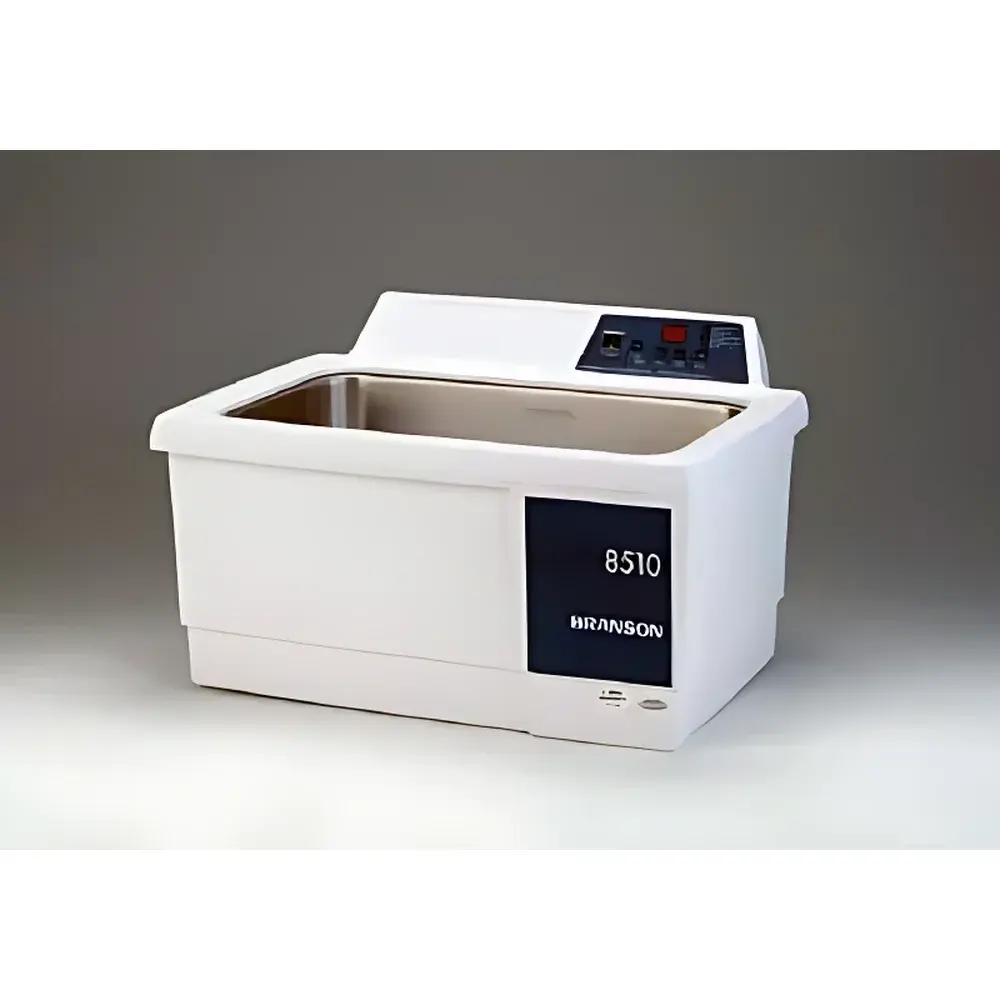
Brookfield B8510E-DTH Ultrasonic Cleaner
| Origin | USA |
|---|---|
| Manufacturer Type | Authorized Distributor |
| Origin Category | Imported |
| Model | B8510E-DTH |
| Quotation | Available Upon Request |
| Tank Volume | 20.81 L |
| Chamber Dimensions | 492 × 292 × 152 mm |
| Ultrasonic Frequency | 40 kHz |
| Heating Range | 0–69 °C |
| Timer Range | 0–59 min (ultrasonic), 1–99 min (extended ultrasonic mode) |
| Heating Power | 500 W |
| Ultrasonic Power Output | 380 W |
| Total Power Consumption | 880 W |
| Input Voltage/Frequency | 220 V, 50/60 Hz |
| Construction Material | Polypropylene (PP) Body |
| Transducer Type | Langevin-type Metal/Ceramic Stack |
| Mounting Method | Adhesive-bonded Vertical Transducers |
| Control Interface | Digital LED Display with Dual-Temperature Readout (Current Bath Temp & Setpoint) |
| Lid Function | Hinged Sound-Dampening Lid with Integrated Drip Tray and Drain Valve |
| Safety Features | IPX1-rated Electronics, Molded Rubberized Power Switch, Optimized Water-Level Calibration Mark |
Overview
The Brookfield B8510E-DTH Ultrasonic Cleaner is a precision-engineered laboratory-grade cleaning system designed for reproducible, residue-free decontamination of delicate instruments, glassware, microfluidic components, and analytical hardware. It operates on the principle of acoustic cavitation—where high-frequency (40 kHz) ultrasonic energy induces controlled microbubble formation and collapse in aqueous or mild solvent media, generating localized shear forces that dislodge particulate, organic, and biofilm contaminants without mechanical abrasion. Engineered for stability in regulated environments, the unit complies with general safety requirements per IEC 61010-1 and supports GLP-aligned workflows through deterministic timing, calibrated thermal control, and consistent energy delivery across its 20.81 L stainless steel tank.
Key Features
- Polypropylene (PP) housing provides broad chemical resistance to acids, bases, and common solvents—critical for labs handling corrosive cleaning agents or post-digestion residues.
- Langevin-type metal/ceramic transducer stack delivers high electromechanical coupling efficiency and long-term output stability, minimizing frequency drift over extended duty cycles.
- Adhesive-bonded vertical mounting ensures uniform acoustic coupling to the tank bottom and eliminates mechanical fastener-induced node interference or delamination risk.
- Dual-mode digital timer supports both standard (0–59 min) and extended (1–99 min) ultrasonic operation, enabling protocol-specific dwell times for stubborn deposits or low-energy-sensitive samples.
- Integrated heating system (0–69 °C, ±0.5 °C accuracy) enables temperature-assisted cleaning—particularly effective for lipid removal, wax dissolution, or enzymatic activity enhancement during pre-analytical preparation.
- Sound-dampening hinged lid doubles as a drip tray and incorporates a quick-release drain valve, facilitating rapid fluid exchange and reducing cross-contamination between batches.
- Vertically oriented internal PCB architecture enhances moisture resistance and extends service life in high-humidity lab environments; all critical electronics are conformally coated and IPX1-rated.
- Front-panel LED display shows real-time bath temperature and setpoint simultaneously—eliminating guesswork in thermal validation and supporting ISO/IEC 17025-compliant documentation practices.
Sample Compatibility & Compliance
The B8510E-DTH accommodates a wide range of sample formats including volumetric flasks, chromatography vials, pipette tips, surgical tools, optical lenses, and semiconductor wafers (with appropriate rack fixtures). Its 492 × 292 × 152 mm chamber allows full submersion of large-format labware while maintaining optimal acoustic field uniformity. The unit meets general electrical safety standards (IEC 61010-1) and is compatible with ASTM D2603 (Standard Test Method for Sonic Shear Stability of Polymer Solutions) and ISO 13406-2 (for optical component cleaning verification). While not FDA-cleared as a medical device sterilizer, it satisfies preparatory cleaning steps outlined in USP and AAMI ST79 for reusable instrument reprocessing prior to terminal sterilization.
Software & Data Management
This model operates via embedded firmware without external software dependency—ensuring reliability in air-gapped or IT-restricted laboratories. All operational parameters (time, temperature, power-on state) are retained across power cycles. Though no PC interface is provided, the digital timer and temperature display support manual audit trail generation per GLP Annex 11 principles. For facilities requiring electronic record retention, integration with third-party environmental monitoring systems (e.g., DeltaTrak, DicksonOne) is achievable via optional 4–20 mA analog output modules (sold separately).
Applications
- Pre-ICP-MS sample introduction system cleaning to minimize polyatomic interferences from residual salts.
- Removal of protein adhesion from HPLC autosampler needles and column frits without compromising surface integrity.
- Decontamination of electron microscopy grids and TEM specimen holders prior to carbon coating.
- Routine cleaning of calibration standards, reference materials, and certified reference glasses in metrology labs.
- Supporting ASTM E1720 validation protocols for pharmaceutical equipment cleaning verification.
- Restoration of quartz cuvettes and fused-silica optics used in UV-Vis and FTIR spectroscopy.
FAQ
Is the B8510E-DTH suitable for cleaning aluminum or soft metals?
Yes—when operated within recommended temperature and time limits and using non-etching aqueous solutions (e.g., pH-neutral detergents), it safely cleans aluminum, titanium, and brass without pitting or oxidation.
Can this unit be used with organic solvents like acetone or isopropanol?
No—only water-based or water-miscible cleaning solutions are approved. Flammable or volatile organics pose explosion risks and may degrade PP components or transducer adhesives.
Does the unit include a degassing function?
Yes—the “De-gas” mode initiates a brief high-power burst followed by reduced amplitude cycling to evacuate dissolved gases from the bath, improving cavitation onset and consistency for critical applications.
What is the expected transducer lifetime under continuous use?
Under normal operating conditions (≤8 hrs/day, ≤69 °C, proper solution maintenance), the Langevin stack demonstrates ≥5 years of functional service life with no measurable output decay.
Is calibration documentation available for quality assurance purposes?
Factory calibration certificates for temperature sensor and timer accuracy are provided with each unit and traceable to NIST standards upon request.



