
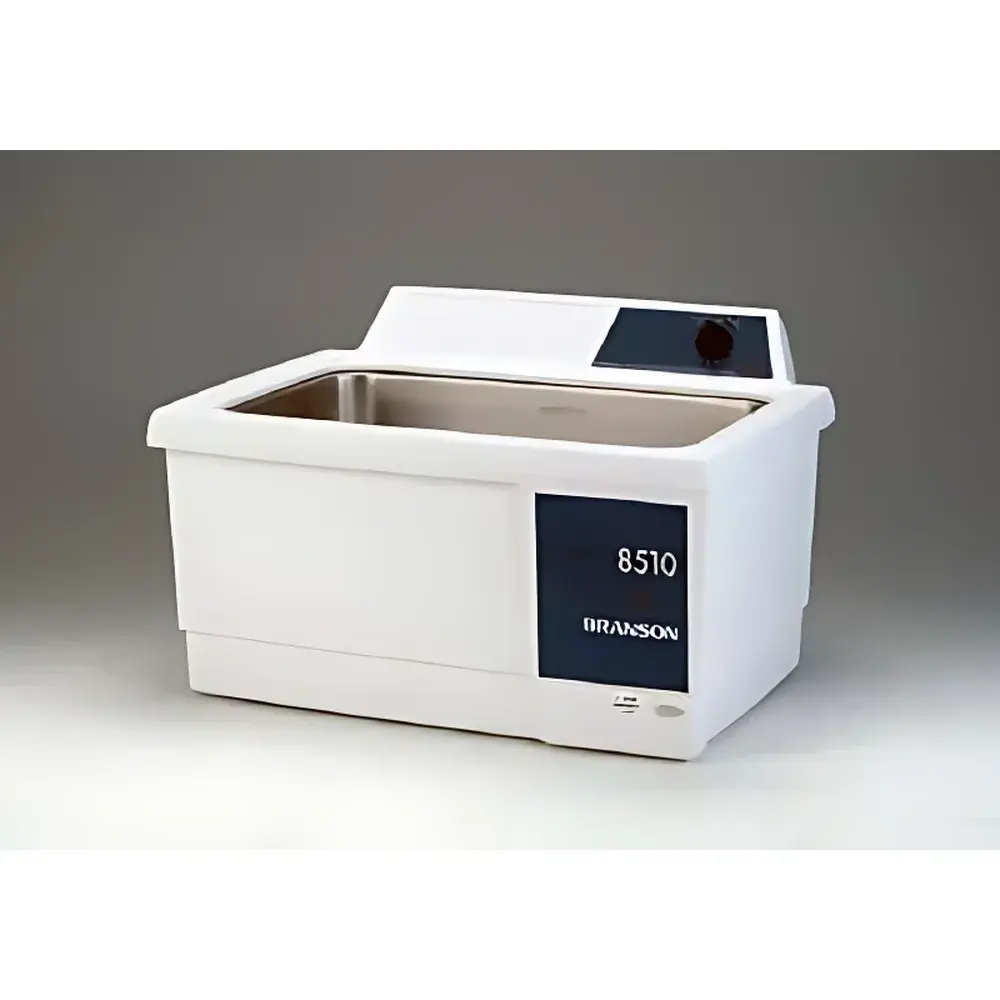
Branson B8510E-MT Ultrasonic Cleaner
| Brand | Branson |
|---|---|
| Origin | USA |
| Model | B8510E-MT |
| Tank Volume | 20.81 L |
| Chamber Dimensions | 492 × 292 × 152 mm |
| Ultrasonic Frequency | 40 kHz |
| Timer Range | 0–60 min |
| Ultrasonic Power Output | 320 W |
| Input Voltage | 220 V, 50/60 Hz |
| Construction Material | Polypropylene (PP) Tank & Housing |
| Heating Function | Yes (Digital Temperature Display & Control) |
| Lid Design | Hinged Sound-Dampening Cover with Drain Valve & Drip Tray Function |
| Transducer Type | Langevin-type Metal/Ceramic Stack |
| Mounting Method | Adhesive-Bonded Transducers |
| Circuit Board Orientation | Vertical Installation for Moisture Resistance |
| Control Interface | Top-Mounted Digital Panel with Water Level Indicator |
Overview
The Branson B8510E-MT is a benchtop ultrasonic cleaner engineered for precision cleaning of laboratory glassware, surgical instruments, optical components, electronic assemblies, and small mechanical parts. It operates on the principle of acoustic cavitation—where high-frequency sound waves (40 kHz) generate microscopic vacuum bubbles in the cleaning solution that rapidly collapse, producing localized shockwaves and micro-jets capable of dislodging particulate contaminants, organic residues, and biofilms from complex surface geometries. Designed and manufactured in the United States by Branson—the pioneer and longstanding industry leader in ultrasonic technology—the B8510E-MT integrates decades of transducer engineering expertise with robust industrial design to deliver consistent, repeatable cleaning performance across demanding R&D, quality control, and clinical laboratory environments.
Key Features
- 320 W ultrasonic power output delivered via proprietary Langevin-type metal/ceramic transducers, optimized for uniform energy distribution across the entire tank volume
- Polypropylene (PP) construction for both tank and housing—providing exceptional resistance to acids, alkalis, and common solvents used in laboratory cleaning protocols
- Adhesive-bonded transducer mounting system ensures long-term mechanical integrity and eliminates risk of delamination under continuous operation
- Vertical orientation of internal PCBs minimizes condensation ingress and enhances reliability in humid or splash-prone settings
- Top-mounted digital control panel with intuitive interface, real-time water temperature display, and programmable heating setpoint for temperature-sensitive applications
- Hinged, sound-dampening lid with integrated drain valve and reversible drip-tray functionality—enabling rapid fluid evacuation and minimizing operator exposure to aerosols
- Intelligent sweep-frequency circuitry maintains stable cavitation intensity over time, compensating for load variation and solution aging
- Precision-engineered standard water level indicator ensures optimal acoustic coupling and maximizes cleaning efficiency without requiring manual calibration
- IP-rated plastic-overmolded power switch for enhanced safety, durability, and resistance to accidental liquid ingress
Sample Compatibility & Compliance
The B8510E-MT accommodates a broad range of sample types—including borosilicate glassware (vials, pipettes, cuvettes), stainless-steel tools, silicone tubing, ceramic substrates, and printed circuit boards—without risk of surface pitting or etching when operated within recommended parameters. Its PP tank complies with USP Class VI biocompatibility standards for material contact. While the unit itself is not certified as medical device sterilization equipment, it supports pre-sterilization cleaning workflows aligned with ISO 15883-1 (washer-disinfectors) and AAMI ST33 (ultrasonic cleaning validation guidelines). Routine use adheres to GLP and GMP documentation requirements when paired with validated cleaning SOPs and temperature logging.
Software & Data Management
This model features embedded firmware with non-volatile timer and temperature memory, supporting traceable operation logs when integrated with external data acquisition systems via RS-232 or optional analog output modules. Although it does not include onboard data storage or network connectivity, its digital interface provides stable, noise-immune signal output suitable for integration into centralized lab management platforms compliant with FDA 21 CFR Part 11 (when paired with appropriate audit-trail software). All parameter settings—including timer duration, target temperature, and power activation—are retained after power cycling, ensuring procedural consistency across shifts.
Applications
- Pre-analytical sample preparation: removal of residual proteins, lipids, and cellular debris from HPLC vials and autosampler components
- Microelectronics: cleaning of MEMS devices, wafer carriers, and solder paste stencils prior to inspection or coating
- Pharmaceutical manufacturing: decontamination of filling line components, stopper trays, and lyophilization shelves
- Dental and orthopedic reprocessing: adjunctive cleaning of implant fixtures, burrs, and handpieces before autoclaving
- Materials science labs: solvent-based degreasing of metal coupons prior to SEM imaging or corrosion testing
- Environmental testing: preparation of filter housings and sampling probes used in EPA Method 1664 or ASTM D4052 workflows
FAQ
What is the maximum operating temperature of the B8510E-MT?
The unit supports heating up to 80 °C, with ±1 °C accuracy maintained via PID-controlled thermistor feedback.
Can this cleaner be used with flammable solvents?
No—only aqueous or water-miscible, non-flammable solutions are permitted; the device lacks explosion-proof certification.
Is the tank depth sufficient for immersing tall volumetric flasks?
With an internal height of 152 mm, the tank accommodates standard 100 mL and 250 mL volumetric flasks when placed upright; larger vessels may require angled placement.
Does the B8510E-MT meet CE or UL safety standards?
Yes—it carries UL 61010-1 certification for laboratory electrical equipment and conforms to IEC 61000-6-3 EMC emission limits.
How often should transducer performance be verified?
Annual verification using calibrated hydrophone mapping or aluminum foil test (per ASTM E1739) is recommended for critical applications.



