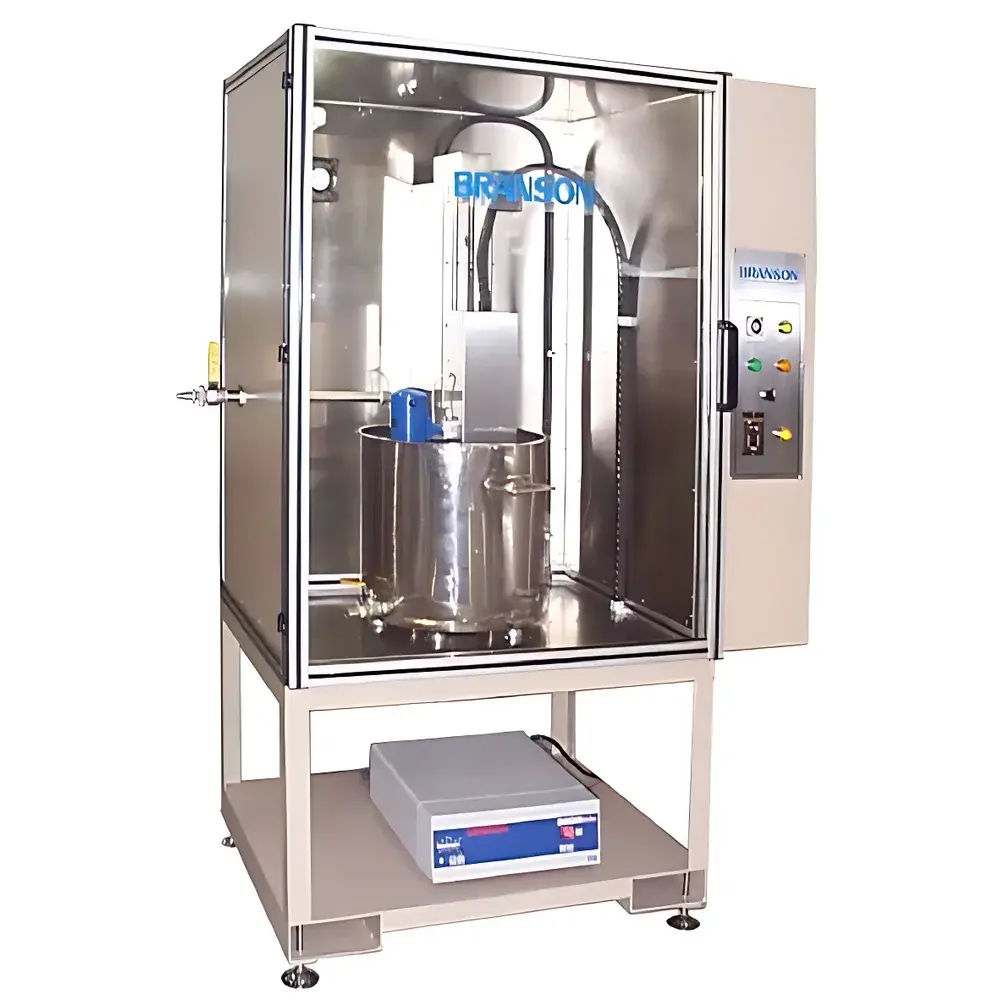
Branson LLP-DCX Series Large-Batch Ultrasonic Cell Disruptor
| Brand | Branson |
|---|---|
| Origin | USA |
| Model | LLP-DCX |
| Instrument Type | Ultrasonic Cell Disruptor |
| Output Power | 1250 W / 2500 W / 4000 W (max) |
| Frequency | 20 kHz |
| Voltage | 230 V AC, 50/60 Hz |
| Processing Volume | 5–20 L |
| Amplitude Control | 10–100% (closed-loop, patented) |
| Temperature Management | Integrated jacketed cooling system |
| Control System | PLC-based touchscreen interface with real-time diagnostics |
| Dimensions (W×D×H) | 1270 × 840 × 1930 mm |
| Probe Drive Motor | 120 W, variable-speed vertical lift |
| Rotation Motor | Bidirectional tank rotation |
| Safety Protections | 6-point generator protection (overcurrent, frequency drift, overheating, impedance mismatch, arc detection, duty cycle limit) |
| Remote Diagnostics | Branson SecureLink™ service port enabled |
Overview
The Branson LLP-DCX Series Large-Batch Ultrasonic Cell Disruptor is an industrial-grade, bench-to-pilot-scale ultrasonic processing system engineered for high-integrity cell lysis, macromolecular extraction, and dispersion applications in biopharmaceutical manufacturing, academic research, and natural product development. Operating on the principle of high-intensity acoustic cavitation at a fixed fundamental frequency of 20 kHz, the system delivers controlled mechanical energy to liquid-phase samples via titanium alloy probes coupled to a precisely tuned transducer stack. Unlike batch sonicators with fixed amplitude or open-loop power delivery, the LLP-DCX integrates a proprietary closed-loop amplitude control circuit that continuously monitors and compensates for load-dependent impedance shifts—ensuring consistent cavitation intensity across variable sample viscosities, volumes, and temperatures. This architecture enables reproducible disruption efficiency (e.g., >95% lysis yield for E. coli BL21(DE3) at 15 L scale, per internal validation protocols), critical for process transfer from lab to GMP-compliant production environments.
Key Features
- Patented closed-loop amplitude regulation: Maintains setpoint amplitude ±1.5% across full 10–100% range, independent of probe wear, temperature drift, or suspension density changes.
- Modular high-power generator architecture: Three configurations (LLP-DCX 1.25, 2.5, 4.0) deliver up to 4000 W RMS output with >90% electroacoustic conversion efficiency and integrated harmonic filtering to minimize non-fundamental mode excitation.
- Intelligent thermal management: Double-walled stainless-steel processing tank with glycol-cooled jacket (−5 to +40 °C operational range); real-time PT100 sensor feedback to PLC ensures sample temperature deviation ≤ ±0.8 °C during continuous 4-hour operation.
- Multi-axis sample agitation: Programmable bidirectional tank rotation (0.5–10 rpm) combined with motorized probe vertical translation (0–150 mm stroke, 0.1 mm resolution) eliminates dead zones and enhances homogeneity in viscous or particulate-laden suspensions.
- Comprehensive system diagnostics: On-boot self-test verifies transducer resonance tracking, impedance matching, coolant flow integrity, and safety interlock continuity; online remote diagnostics via Branson SecureLink™ support ISO/IEC 17025 traceable calibration logs and fault-code mapping.
- Regulatory-ready control layer: PLC-driven HMI with audit-trail-enabled parameter logging (per FDA 21 CFR Part 11 Annex 11 requirements), user-level access control (3-tier), and electronic signature capability for SOP execution.
Sample Compatibility & Compliance
The LLP-DCX accommodates aqueous, organic, and biphasic systems—including bacterial/fungal cultures, mammalian cell pellets, plant tissue homogenates, liposomal dispersions, and polymer emulsions—with no requirement for chemical lysis reagents. Its stainless-steel wetted parts (ASTM A240 316L) meet USP Class VI biocompatibility standards, while the sealed transducer housing complies with IP65 ingress protection. The system supports validation under ICH Q5A (viral clearance), USP (cell lysis), and ASTM E2810-11 (ultrasonic processor performance verification). Process documentation packages include IQ/OQ templates aligned with EU GMP Annex 15 and WHO TRS 986 guidelines.
Software & Data Management
The embedded Siemens S7-1200 PLC interfaces with a 10.1″ capacitive touchscreen running TIA Portal v18 firmware. All operational parameters—including amplitude, duration, pulse ratio (1–99% duty cycle), rotation speed, lift profile, and coolant setpoint—are stored in encrypted CSV files with timestamped metadata. Data export supports direct integration into LIMS platforms via OPC UA (IEC 62541) or Modbus TCP. Audit trails record operator ID, parameter changes, alarm events, and calibration interventions with immutable SHA-256 hashing. Optional Branson Cloud Connect enables secure TLS 1.3–encrypted remote monitoring and predictive maintenance alerts based on transducer impedance trend analysis.
Applications
- Biopharmaceutical upstream processing: Scalable lysis of CHO, HEK293, and microbial expression hosts for monoclonal antibody and recombinant protein recovery.
- Natural product extraction: Enhanced mass transfer in botanical matrix disruption (e.g., ginsenoside release from Panax ginseng root at 72% yield vs. 41% with Soxhlet).
- Vaccine development: Controlled envelope disruption of enveloped viruses (e.g., influenza A) without antigen denaturation, validated by ELISA and TEM.
- Nanomaterial synthesis: Uniform size distribution in lipid nanoparticle (LNP) formulation (PDI <0.12, measured by DLS) and graphene oxide exfoliation.
- Industrial enzymology: Activation of immobilized enzymes in packed-bed reactors via in-situ ultrasonic micro-mixing.
FAQ
What is the maximum allowable viscosity for consistent cavitation in the LLP-DCX system?
Viscosity limits depend on probe geometry and amplitude setting; for standard 25-mm diameter tapered probes, continuous operation is validated up to 1500 cP at 60% amplitude and 5 L volume. Higher viscosities require custom horn designs and reduced duty cycles.
Does the system comply with FDA 21 CFR Part 11 for electronic records?
Yes—the PLC firmware includes role-based authentication, electronic signatures, and immutable audit trails meeting all technical and procedural requirements outlined in Part 11 Subpart B.
Can the cooling system interface with external chillers?
The jacketed tank uses standard 1/2″ NPT ports compatible with commercial recirculating chillers (−10 to +30 °C range, ≥10 L/min flow rate recommended).
Is third-party calibration certification available?
Branson-certified calibration services include NIST-traceable acoustic power measurement (via calorimetric method per ASTM E2810), amplitude verification (laser vibrometer), and temperature uniformity mapping—delivered with ISO/IEC 17025 accredited reports.
What maintenance intervals are recommended for sustained GMP operation?
Transducer impedance baseline verification every 500 operating hours; probe tip inspection and torque recalibration every 1000 hours; full generator capacitor bank testing annually or after 10,000 cycles—documented in the included Maintenance Logbook template.