
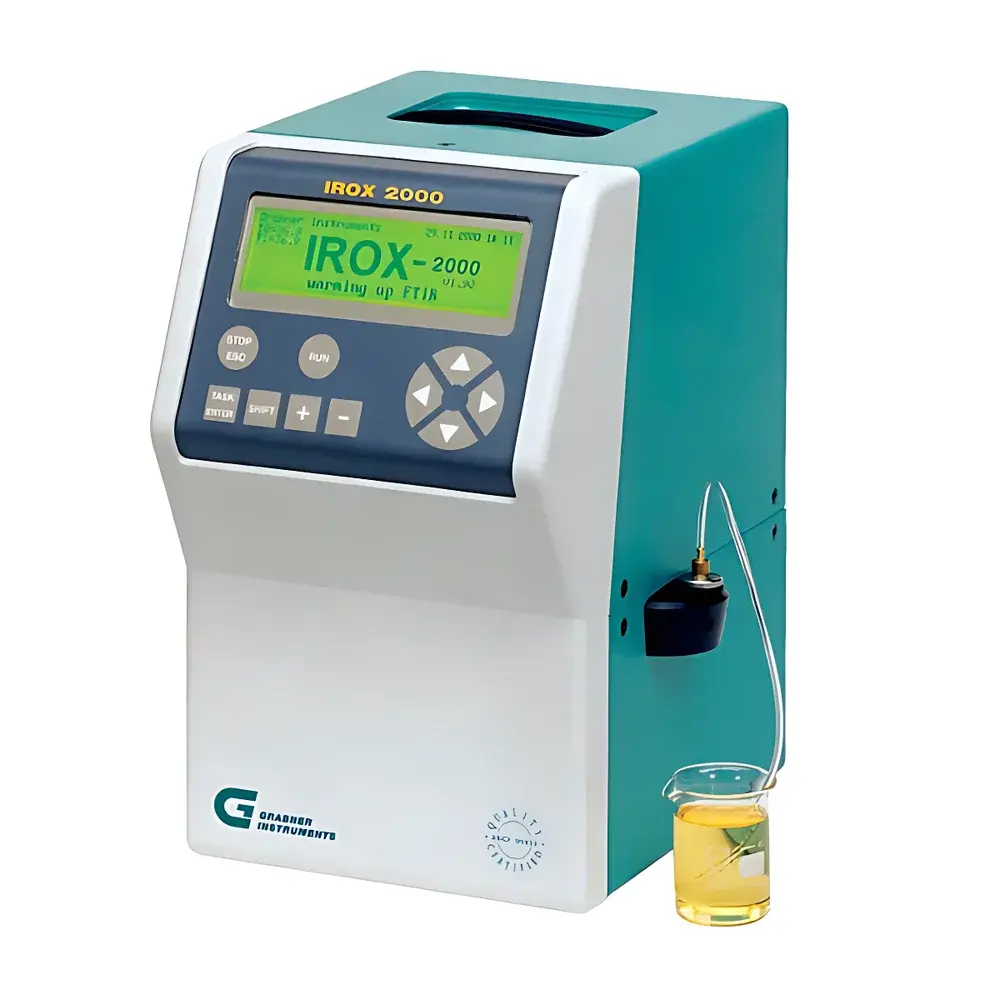
GRABNER IROX DIESEL Fourier Transform Infrared (FT-IR) Diesel Analyzer
| Brand | GRABNER |
|---|---|
| Origin | Austria |
| Model | IROX DIESEL |
| Portability | Portable |
| Measurement Parameter | Cetane Number (CN) |
| Measurement Range | 20–80 CN |
| Accuracy | ±0.5 CN |
| Analysis Time | < 80 s |
| Sample Volume | 6 mL |
| Spectral Resolution | 4 cm⁻¹ |
| Preheating Time | 10 min |
| Power Supply | 100/120/230 V AC, 50/60 Hz, 65 W |
| DC Operation | 12 V / 4 A (vehicle battery compatible) |
| Dimensions (W×H×D) | 200 × 320 × 220 mm |
| Weight | 11 kg |
| Data Interface | RS-232 |
| Compliance | ASTM D613, ASTM D976, ASTM D5186, ASTM D86 |
| FAME Quantification Ranges | 0.2–7.0 vol% (1745 cm⁻¹), 7.0–30.0 vol% (1195 cm⁻¹) |
| Repeatability (Cetane Number) | ±0.8 CN |
| Standard Deviation (Cetane Number) | 0.6–0.9 CN |
Overview
The GRABNER IROX DIESEL is a purpose-built, portable Fourier Transform Infrared (FT-IR) spectrometer engineered for rapid, field-deployable analysis of diesel fuel properties. Operating in the mid-infrared region (4000–600 cm⁻¹) with a fixed spectral resolution of 4 cm⁻¹, it employs chemometric modeling—specifically Cluster Analysis (CA) and Multilinear Regression (MLR)—to quantify critical fuel parameters directly from raw absorbance spectra. Unlike conventional wet-chemistry or combustion-based methods, the IROX DIESEL delivers results without sample derivatization, dilution, or solvent extraction. Its optical architecture features a thermally stabilized interferometer and a dedicated sample compartment optimized for liquid hydrocarbon transmission measurements. The system is calibrated against reference materials traceable to NIST and ISO-certified standards, ensuring metrological integrity across global regulatory frameworks including ASTM D613 (cetane number), ASTM D976 (cetane index), ASTM D5186 (aromatics and polycyclic aromatic hydrocarbons), and ASTM D86 (distillation characteristics T85/T90/T95). Designed for refinery QC labs, fuel distribution terminals, and mobile inspection units, the instrument supports real-time decision-making during blending, custody transfer, and compliance verification.
Key Features
- Portable FT-IR platform with integrated temperature-controlled sample cell and automatic syringe-driven aspiration (6 mL sample volume)
- Onboard chemometric engine supporting simultaneous quantification of cetane number, cetane index, FAME content, total aromatics, polycyclic aromatic hydrocarbons (PNA), and distillation endpoints (T85, T90, T95)
- Dual-band FAME quantification: second-derivative analysis at 1745 cm⁻¹ (0.2–7.0 vol%) and 1195 cm⁻¹ (7.0–30.0 vol%), enabling accurate biodiesel blend determination across EN 14214 and ASTM D7467 specifications
- Pre-calibrated using >1,200 certified reference diesel samples; field recalibration supported via user-imported standards with automated coefficient derivation
- Full automation: one-button operation, self-aligning optics, auto-zero referencing, and real-time spectral quality monitoring
- Integrated Anton Paar density module enables seamless conversion between volume % and mass % for FAME and additive reporting per ISO 12937 and EN ISO 12185
- Robust mechanical design (IP54-rated enclosure), 12 V DC operation for vehicle-mounted deployment, and 10-minute thermal stabilization time
Sample Compatibility & Compliance
The IROX DIESEL is validated for undiluted middle-distillate fuels including ultra-low-sulfur diesel (ULSD), biodiesel blends (B5–B30), synthetic diesel (F-T, HVO), and hydrotreated vegetable oil (HVO). It complies with international test method equivalencies required by regulatory bodies: ASTM D613 (cetane number), ASTM D976 (cetane index), ASTM D5186 (aromatics and PNA), ASTM D86 (distillation), and EN 14078 (FAME in diesel). All calibration models are developed and verified under GLP-compliant conditions, with full audit trails available in MINIWIN IROX-PC software. The system meets electromagnetic compatibility (EMC) requirements per EN 61326-1 and safety standards per EN 61010-1. No hazardous reagents, high-pressure gases, or open flames are required—eliminating laboratory safety liabilities associated with traditional cetane engines or GC-based methods.
Software & Data Management
MINIWIN IROX-PC is a Windows-based desktop application that provides comprehensive data governance, spectral archiving, and method management. It supports 21 CFR Part 11-compliant user authentication, electronic signatures, and immutable audit logs for all measurement events, calibration updates, and report generation. Spectra are stored in standardized JCAMP-DX format, enabling interoperability with LIMS platforms and third-party chemometric tools. The software includes batch processing, outlier detection via Mahalanobis distance metrics, and customizable reporting templates aligned with ISO/IEC 17025 documentation requirements. Remote firmware updates, spectral library expansion, and method validation packages (including precision, linearity, and robustness assessments) are delivered via secure GRABNER portal access. All raw interferograms and processed spectra are timestamped, geotagged (when GPS-enabled), and cryptographically hashed to ensure data integrity.
Applications
- Real-time quality assurance during diesel blending operations at refineries and terminals
- Field verification of biodiesel content in retail fuel to enforce EN 590 and ASTM D975 specifications
- Monitoring cetane improver dosing efficacy and stability over storage time
- Assessing aromatic saturation levels post-hydrotreating to predict ignition delay and NOx emissions
- Supporting regulatory audits for fuel sulfur, oxygenate, and renewable content mandates (e.g., EU RED II, US RFS2)
- Rapid screening of fuel adulteration or contamination (e.g., kerosene, heating oil, used cooking oil derivatives)
- Research applications in alternative fuel development, including co-processing pathways and catalytic upgrading studies
FAQ
Does the IROX DIESEL require daily calibration with reference standards?
No. Factory calibration remains stable for ≥6 months under routine use. Field verification is performed using a single certified reference diesel (e.g., CRM 852a); full recalibration is only necessary after major hardware service or when introducing new fuel types outside the original model domain.
Can the instrument measure FAME concentration in B100 (neat biodiesel)?
No. The IROX DIESEL is validated exclusively for FAME quantification in petroleum diesel matrices (i.e., B0–B30). Neat FAME exhibits strong baseline curvature and water vapor interference that invalidate the dual-band chemometric model.
Is temperature control active during measurement?
Yes. The sample cell maintains 40 °C ± 0.2 °C via Peltier regulation, compensating for viscosity-induced pathlength variation and ensuring reproducible transmittance across seasonal ambient conditions.
What is the minimum detectable FAME level?
The limit of quantitation (LOQ) is 0.2 vol% (1745 cm⁻¹ band) with a standard deviation of ≤0.04 vol% at 2 vol%, verified per ISO 11843-2.
How does the system handle water-contaminated diesel samples?
Samples with free water phase must be separated prior to analysis. Emulsified water (<500 ppm) has negligible impact on FAME or cetane prediction due to algorithmic robustness built into the MLR training set.
Are spectral libraries upgradeable for emerging biofuel components (e.g., fatty acid methyl esters beyond C16–C18)?
Yes. GRABNER provides annual spectral library updates, including newly characterized feedstocks (e.g., camelina, algae-derived FAME) and synthetic hydrocarbon fuels, subject to customer-specific validation protocols.






