
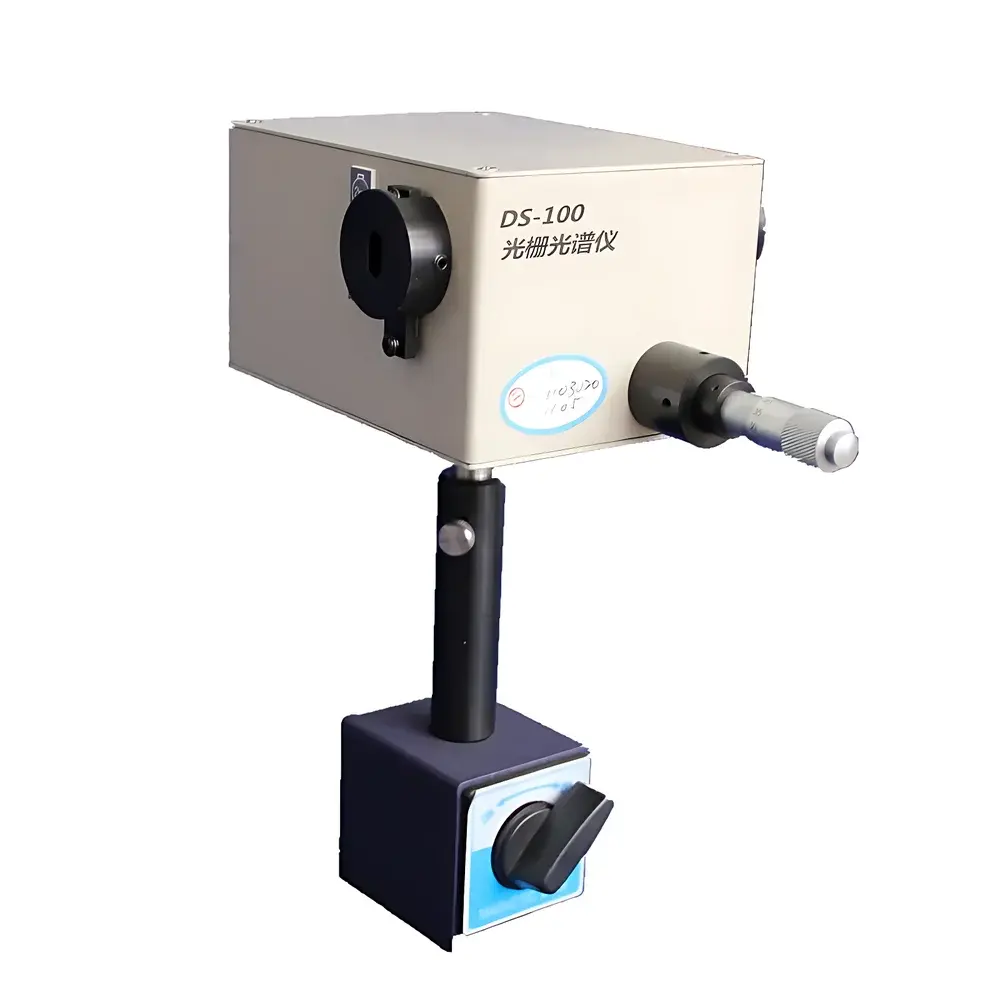
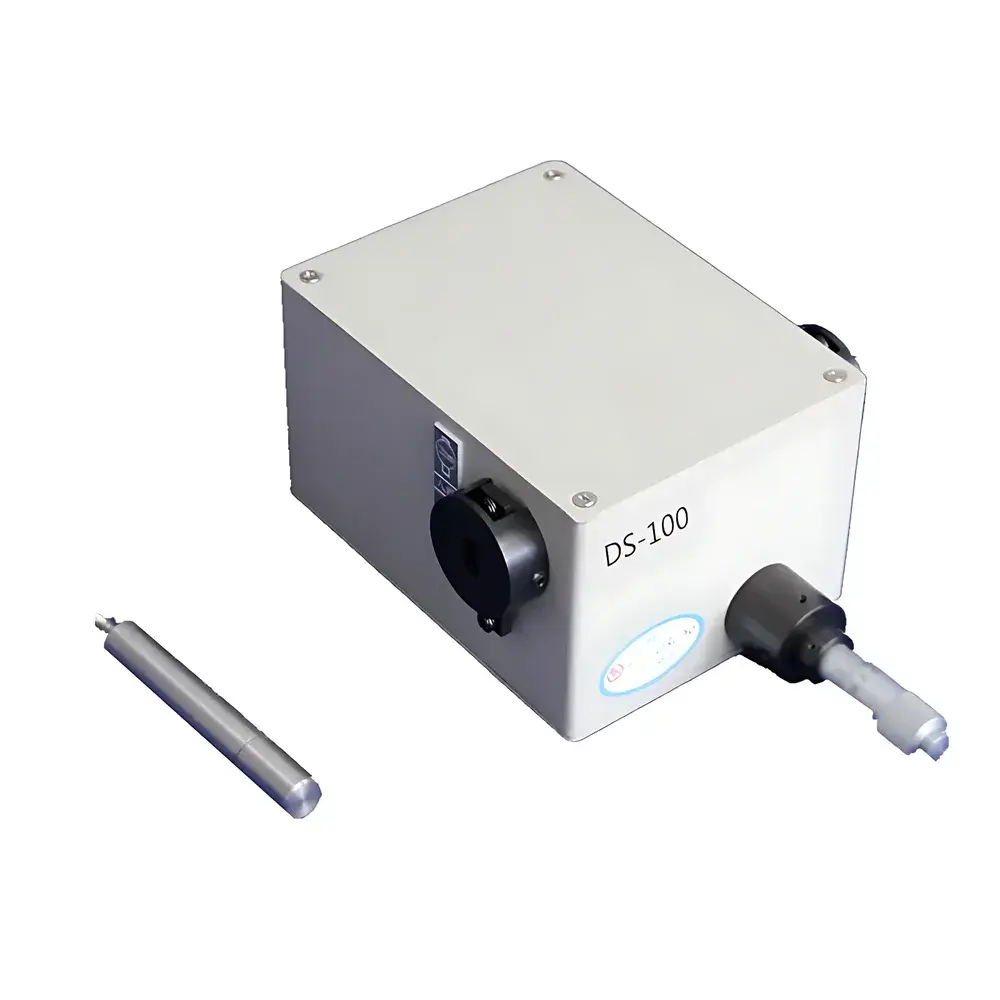
Topo DS-100 Compact Grating Monochromator
| Brand | Topo (TP) |
|---|---|
| Origin | Tianjin, China |
| Manufacturer Type | Direct Manufacturer |
| Model | DS-100 Compact |
| Application Systems | Transmission & Reflection Spectroscopy |
| Grating Mount | Rotatable Grating Stage |
| Spectral Resolution | ≤0.12 nm |
| Groove Density | 1200 grooves/mm |
| Wavelength Range | 200–800 nm |
| F-number | F/5 |
| Wavelength Accuracy | ±1 nm |
| Stray Light | ≤0.3% T |
| Slit Widths | Fixed at 0.15 mm and 0.3 mm |
| Wavelength Repeatability | ±0.5 nm |
| Dimensions | 120 × 90 × 65 mm |
| Weight | 0.8 kg |
Overview
The Topo DS-100 Compact Grating Monochromator is a benchtop optical instrument engineered for precise spectral isolation in laboratory-scale spectroscopic applications. Based on Czerny–Turner optical architecture, it employs a high-efficiency 1200 grooves/mm diffraction grating mounted on a precision rotary stage to enable wavelength selection across the deep ultraviolet to near-infrared range (200–800 nm). Its compact form factor (120 × 90 × 65 mm), low mass (0.8 kg), and modular mechanical interface—compatible with standard optical rails and magnetic base mounts—make it suitable for integration into custom optical setups, teaching laboratories, and portable spectrometer prototypes. The monochromator operates on the principle of angular dispersion: incident polychromatic light is collimated, diffracted by the grating, and refocused through an exit slit, delivering quasi-monochromatic output with ≤0.12 nm spectral resolution under optimal slit and alignment conditions. Designed for stability and reproducibility, it achieves ±1 nm absolute wavelength accuracy and ±0.5 nm repeatability over repeated scans, supporting both transmission and reflection measurement geometries.
Key Features
- Compact Czerny–Turner optical layout with F/5 beam geometry, optimized for throughput and aberration control
- Rotatable grating stage accommodating interchangeable gratings (standard configuration: 1200 g/mm, 200–800 nm coverage)
- Dual fixed-width entrance/exit slits (0.15 mm and 0.3 mm) ensuring consistent bandpass definition without manual adjustment
- High stray light suppression (≤0.3% T), achieved via internal blackened baffles and optimized optical path shielding
- Mechanically robust aluminum alloy housing with precision-machined kinematic mounts for long-term alignment retention
- Direct coupling capability with common detectors—including photomultiplier tubes (PMT), silicon photodiodes, and CCD arrays—via standardized SMA or FC fiber ports (adapters optional)
Sample Compatibility & Compliance
The DS-100 supports a broad class of optical sample configurations, including cuvette-based absorption cells (e.g., WDSF-1), fluorescence sample holders (WDSF-2), and reflective substrates mounted on translation stages. It is compatible with low-pressure spectral calibration sources such as Hg (GY-4), Na (GY-5), H (GY-7), Hg–Ne (GY-8), and D₂ (GY-9) lamps, enabling traceable wavelength validation per ISO/IEC 17025 requirements. While not certified for regulated GMP environments, its mechanical stability, repeatable wavelength positioning, and documented optical performance metrics align with GLP-compliant setup verification protocols. No electrical safety or EMC certification is included; users must verify compliance with local IEC 61010-1 and FCC Part 15 regulations when integrating into larger systems.
Software & Data Management
The DS-100 operates as a manually tuned or motorized (optional upgrade) optical component and does not include embedded firmware or proprietary control software. Wavelength selection is executed via calibrated micrometer-driven grating rotation, with scale markings referenced to NIST-traceable Hg and D₂ emission lines. For automated scanning, it integrates seamlessly with third-party motion controllers (e.g., Thorlabs KDC101, Newport ESP300) and data acquisition platforms (LabVIEW, Python with PyVISA, MATLAB Instrument Control Toolbox). Output spectra are recorded using external detectors and digitizers; no onboard storage or audit trail functionality is provided. Users implementing 21 CFR Part 11–compliant workflows must implement external electronic lab notebook (ELN) systems for metadata logging, version control, and operator authentication.
Applications
- Educational optics labs: Demonstration of dispersion, grating equation, and spectral line identification
- Custom UV-Vis spectrophotometer development: As core wavelength selector in OEM or research-grade instruments
- Fluorescence excitation profiling: Isolation of narrowband pump wavelengths for quantum dot or organic dye studies
- Reflectance spectroscopy of thin films and coatings: Paired with integrating spheres or goniometric stages
- Calibration source characterization: Line profile analysis of low-pressure lamps for wavelength standard verification
- Laser line cleanup and broadband source filtering in interferometry and ellipsometry setups
FAQ
What is the maximum optical throughput achievable with the DS-100 at 500 nm?
Throughput depends on slit width, grating efficiency, and detector quantum efficiency. With 0.3 mm slits and a 1200 g/mm blazed grating, typical system throughput (source-to-detector) exceeds 15% at 500 nm under F/5 illumination.
Can the DS-100 be upgraded with motorized wavelength scanning?
Yes—Topo offers optional stepper motor retrofit kits with encoder feedback, compatible with standard RS-232 or USB-to-serial interfaces for external control.
Is the grating removable for replacement or exchange?
The grating is secured via kinematic mounts and can be exchanged by qualified personnel using supplied alignment tools; recalibration against reference lines is required post-installation.
Does the DS-100 include wavelength calibration certificates?
No factory-issued calibration certificate is included; however, calibration procedures using Hg and D₂ lamp lines are documented in the user manual per ISO 6944 guidelines.
What materials are used for optical coatings and internal baffling?
All reflective surfaces use protected aluminum coatings; internal baffles and housing interior are treated with Acktar Magic Black™ or equivalent low-reflectance matte black finish to minimize stray light.






