
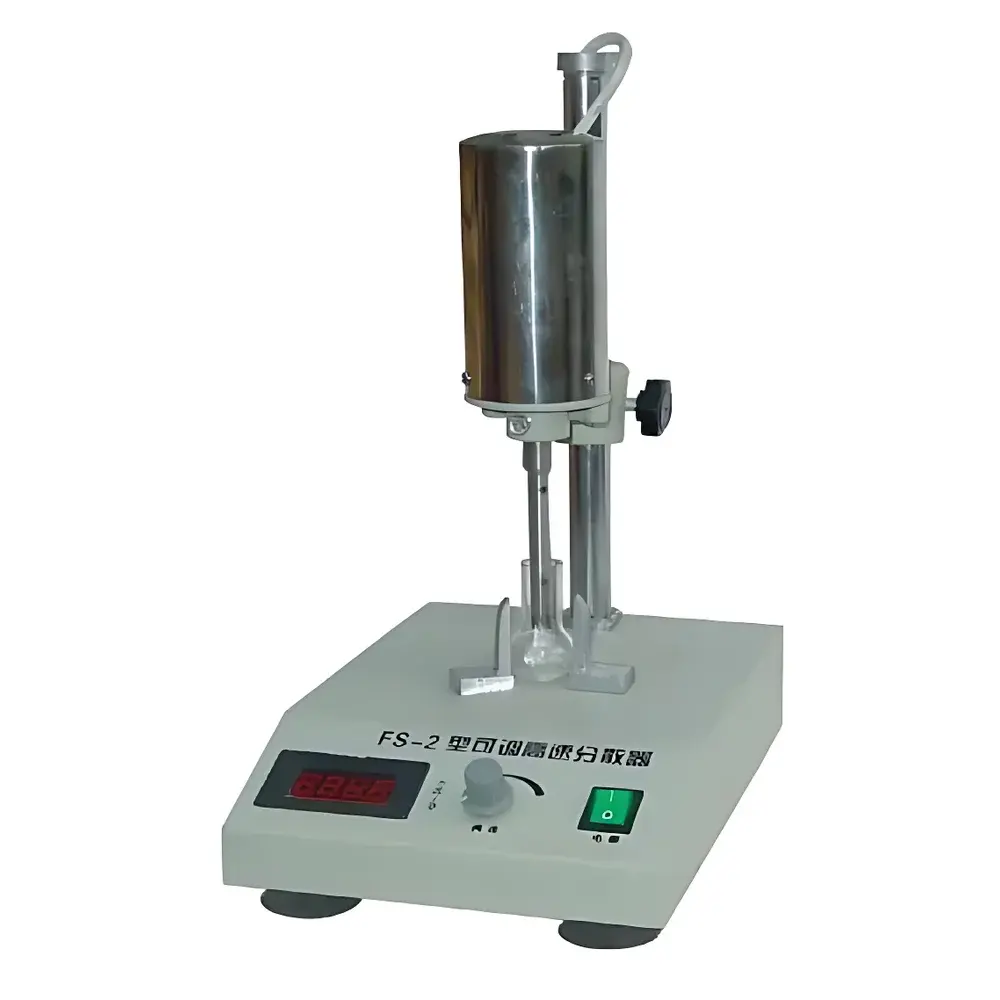
FS-2 Adjustable High-Speed Disperser
| Origin | Jiangsu, China |
|---|---|
| Manufacturer Type | Distributor |
| Origin Category | Domestic |
| Model | FS-2 |
| Price | USD 390 (FOB Jiangsu) |
| Speed Range | 0–20,000 rpm |
| Power Consumption | ~180 W |
| Dimensions (W×D×H) | 280 × 200 × 480 mm |
Overview
The FS-2 Adjustable High-Speed Disperser is an entry-level benchtop dispersion system engineered for rapid, reproducible homogenization and deagglomeration of liquid-phase suspensions, pastes, and viscous formulations in research laboratories and quality control environments. It operates on the principle of high-shear rotor-stator hydrodynamics: a precision-machined rotating shaft (rotor) rotates at variable speeds within a fixed concentric sleeve (stator), generating intense localized shear gradients, turbulent flow, and cavitation effects that break down particle aggregates and promote uniform distribution. Unlike ultrasonic or high-pressure homogenizers, the FS-2 delivers mechanical energy directly via impeller-driven fluid motion—making it particularly suitable for heat-sensitive, non-aqueous, or moderately viscous systems where thermal degradation or solvent volatility must be minimized.
Key Features
- Digitally adjustable speed control from 0 to 20,000 rpm with ±50 rpm repeatability across the full range, enabling method optimization for diverse sample rheologies.
- Compact, space-efficient footprint (280 × 200 × 480 mm) designed for standard laboratory benches; integrated non-slip rubber feet ensure stability during operation at maximum speed.
- Brushed DC motor delivering consistent torque output up to 180 W nominal power, with thermal protection circuitry to prevent coil overheating during extended duty cycles.
- Interchangeable dispersing elements—including standard 12 mm and optional 19 mm stainless steel dispersing discs—allow adaptation to vessel volumes from 50 mL to 2 L.
- Robust aluminum alloy housing with IP20-rated enclosure for dust resistance and operator safety compliance under IEC 61000-6-2/6-3 electromagnetic compatibility standards.
Sample Compatibility & Compliance
The FS-2 is validated for use with aqueous, organic, and semi-polar media including polymer solutions, pigment dispersions, ceramic slurries, pharmaceutical suspensions, and food emulsions. It supports batch processing in standard cylindrical glass or stainless-steel containers (e.g., DIN 12779 format beakers). While not certified for sterile or GMP-grade manufacturing, the device meets general laboratory safety requirements per EN 61010-1:2010 for electrical equipment used in measurement, control, and laboratory applications. All wetted parts are constructed from AISI 304 stainless steel, ensuring chemical resistance to common solvents (e.g., ethanol, acetone, toluene) and compatibility with mild alkaline or acidic cleaning agents. For regulated workflows, users may document operating parameters manually or integrate the unit into GLP-compliant SOPs with external logging tools.
Software & Data Management
The FS-2 operates as a stand-alone analog/digital hybrid instrument without embedded firmware or network connectivity. Speed settings are controlled via front-panel rotary encoder with LED digital display; no software installation, drivers, or cloud services are required. However, for traceability in regulated environments, users may pair the disperser with external data acquisition systems (e.g., USB-connected multimeters or programmable logic controllers) to record time-stamped speed profiles. While the device does not support FDA 21 CFR Part 11 electronic signatures or audit trails natively, its mechanical simplicity and deterministic speed response make it well-suited for inclusion in validated methods where manual parameter recording is acceptable per ISO/IEC 17025 Clause 7.7.
Applications
- Rapid formulation screening of nanomaterial dispersions (e.g., graphene oxide, TiO₂, SiO₂ colloids) prior to DLS or TEM analysis.
- Preparation of stable pigment concentrates for inkjet ink development and coating viscosity assessment (ASTM D1200).
- Homogenization of active pharmaceutical ingredient (API) suspensions in pre-formulation studies under non-sterile conditions.
- Disruption of soft biological aggregates (e.g., yeast cell clusters, protein precipitates) where enzymatic or thermal lysis is undesirable.
- Quality assurance testing of industrial lubricants and greases to assess consistency after storage-induced phase separation.
FAQ
What is the minimum recommended sample volume for optimal dispersion efficiency?
For the standard 12 mm dispersing disc, a minimum working volume of 50 mL in a 100 mL beaker is advised to ensure adequate submersion and vortex control.
Can the FS-2 be used with corrosive solvents such as concentrated HCl or NaOH solutions?
AISI 304 stainless steel components resist mild concentrations (<10% w/w); prolonged exposure to strong acids or alkalis is not recommended—consult material compatibility charts before use.
Is speed calibration traceable to national standards?
The unit ships with factory-set speed calibration verified against a calibrated tachometer; NIST-traceable recalibration services are available through authorized service centers upon request.
Does the FS-2 include overload or stall protection?
Yes—the motor drive incorporates current-limiting circuitry that automatically reduces output torque if rotational resistance exceeds design thresholds, preventing mechanical seizure or winding damage.
Can custom dispersing tools be fabricated for specialized geometries?
Third-party machining of compatible rotor-stator sets is feasible; dimensional drawings and torque interface specifications are available under NDA for qualified engineering partners.



