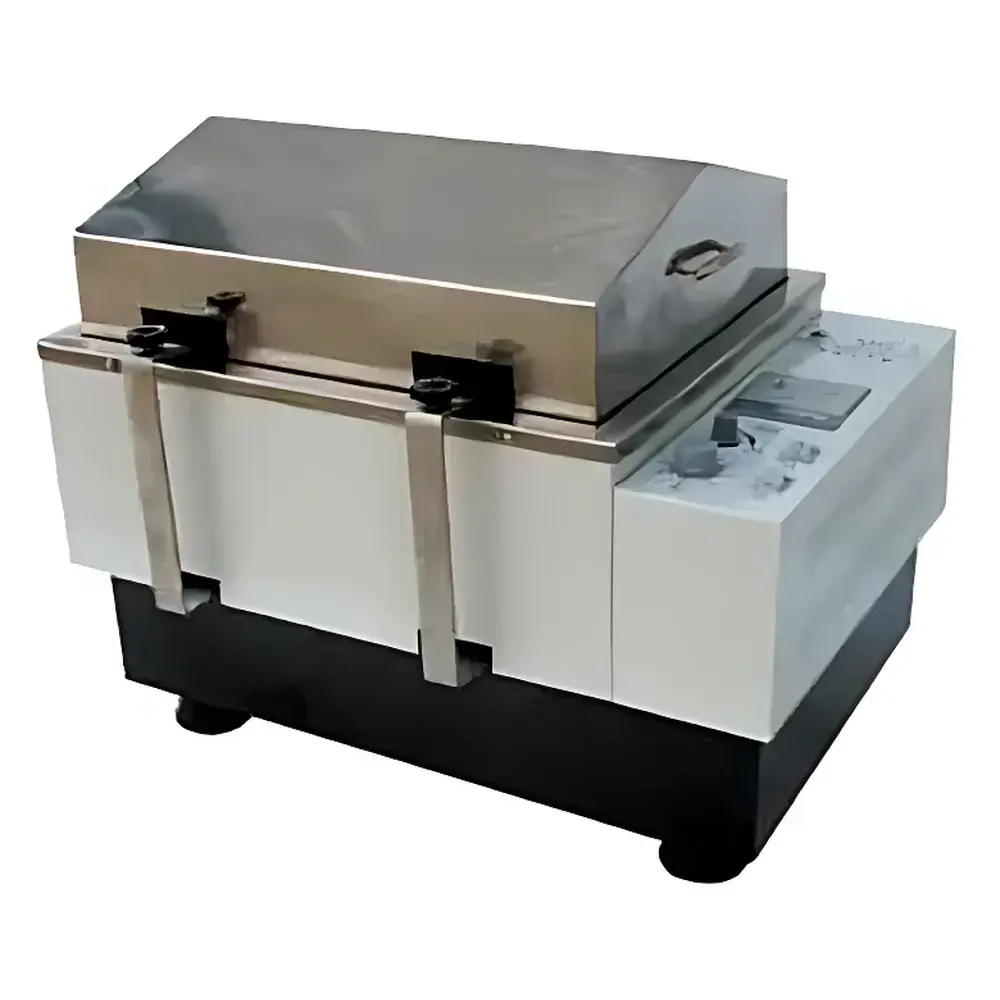
Shaking Water Bath with Digital Temperature Control – SHA-C
| Origin | Jiangsu, China |
|---|---|
| Manufacturer Type | Authorized Distributor |
| Country of Origin | PRC |
| Model | SHA-C |
| Price | USD 680 (FOB Jiangsu) |
| Temperature Range | Ambient +5°C to 100°C |
| Oscillation Frequency | 0–300 rpm |
| Stroke | 20 mm (Reciprocating) |
| Heating Power | 1800 W |
| Timer | 0–120 min or Continuous Operation |
| Capacity | 12 × 250 mL, 8 × 500 mL, or 4 × 1000 mL Erlenmeyer Flasks |
| Temperature Accuracy | ≤ ±1°C |
Overview
The SHA-C Shaking Water Bath with Digital Temperature Control is an integrated laboratory instrument engineered for simultaneous temperature regulation and orbital or reciprocating agitation in aqueous environments. It operates on the principle of convective heat transfer within a thermostatically controlled water bath, combined with mechanically driven horizontal reciprocating motion—ideal for applications requiring uniform thermal exposure and gentle-to-moderate mixing of biological, microbiological, or biochemical samples. Unlike air-jacketed incubators or dry-block shakers, this unit ensures superior temperature homogeneity (±0.5°C typical spatial uniformity across working chamber) and enhanced thermal coupling to vessel contents via direct liquid-phase contact. Its design conforms to standard benchtop life science workflows, supporting protocols aligned with ISO 15190:2020 (laboratory safety), ASTM E2500-13 (verification of equipment), and GLP-compliant sample handling where temperature stability and agitation repeatability are critical.
Key Features
- Digital PID temperature controller with real-time display and adjustable setpoint resolution of 0.1°C, enabling precise thermal management across the full operating range (ambient +5°C to 100°C)
- Stepless speed control (0–300 rpm) via digital interface, ensuring consistent oscillation without mechanical gear shifting or torque fluctuation
- Fixed 20 mm reciprocating stroke optimized for efficient mixing of culture media, enzyme reactions, solubility studies, and cell suspension protocols
- High-capacity stainless-steel water chamber (≥22 L usable volume) with anti-corrosion coating and over-temperature cut-off protection
- Independent mechanical timer (0–120 min) with audible end-of-cycle alert; optional continuous operation mode for extended incubation
- Reinforced platform with universal clamping system accommodating standard Erlenmeyer flasks—configurable for 12 × 250 mL, 8 × 500 mL, or 4 × 1000 mL vessels
- 1800 W heating element with rapid thermal recovery (<15 min from 25°C to 60°C at half-load), minimizing protocol downtime
Sample Compatibility & Compliance
The SHA-C accommodates common borosilicate glass and polypropylene labware used in microbial cultivation, protein expression, and immunoassay preparation. Its water-based thermal medium eliminates hot-spot formation and supports long-duration experiments involving heat-sensitive reagents (e.g., restriction enzymes, fluorescent dyes, or antibody conjugates). The unit meets IEC 61010-1:2010 safety requirements for laboratory electrical equipment and includes dual-level thermal protection: primary solid-state relay control and secondary bimetallic high-limit switch. While not certified for use in classified cleanrooms or explosion-proof environments, it is routinely deployed in ISO/IEC 17025-accredited testing laboratories for method validation under documented SOPs.
Software & Data Management
The SHA-C operates as a standalone analog-digital hybrid instrument with no embedded firmware or network connectivity. All operational parameters—including set temperature, actual bath temperature, speed, and remaining time—are displayed on a backlit LCD panel with non-volatile memory retention during brief power interruptions. For audit-trail compliance in regulated environments (e.g., pharmaceutical QC labs following FDA 21 CFR Part 11), users may integrate external data loggers (e.g., Omega OM-DAQPRO-5300 series) via analog output (0–5 V) for continuous temperature and RPM recording. Calibration certificates traceable to NIM (China National Institute of Metrology) are available upon request for IQ/OQ documentation packages.
Applications
- Microbial growth kinetics and antibiotic susceptibility testing (AST) using broth dilution methods per CLSI M07-A10
- Enzyme activity assays requiring strict thermal control and homogeneous substrate dispersion
- Solubility profiling of APIs and excipients in aqueous buffers per USP <1058>
- Cell detachment and resuspension in mammalian and insect cell culture workflows
- Extraction efficiency optimization for natural products (e.g., polysaccharides, alkaloids) in heated aqueous matrices
- Standardization of ELISA plate coating steps involving antigen or antibody incubation in solution phase
FAQ
What is the maximum recommended water level for optimal thermal performance?
Fill to the “MAX” line indicated inside the chamber—typically 20–22 L—to ensure full submersion of heater elements and uniform convection. Overfilling may impair circulation; underfilling risks dry-heating and sensor drift.
Can the SHA-C be used with non-aqueous solvents?
No. The bath is designed exclusively for deionized or distilled water. Organic solvents, acids, or saline solutions will corrode internal components and void warranty.
Is external temperature calibration supported?
Yes. The unit features a PT100-compatible reference port for third-party probe insertion. Users may perform offset adjustment using the calibration mode per manufacturer’s technical bulletin TB-SHA-C-Rev.3.
Does the device support remote monitoring or Ethernet connectivity?
No. The SHA-C has no built-in communication interface. Integration with LIMS or SCADA systems requires external analog-to-digital conversion hardware.
What maintenance intervals are recommended for sustained accuracy?
Clean the water chamber weekly with 10% acetic acid solution to prevent scale buildup; inspect gasket integrity and drain valve function every 90 days; recalibrate temperature sensor annually against a NIST-traceable reference thermometer.
Related Products