
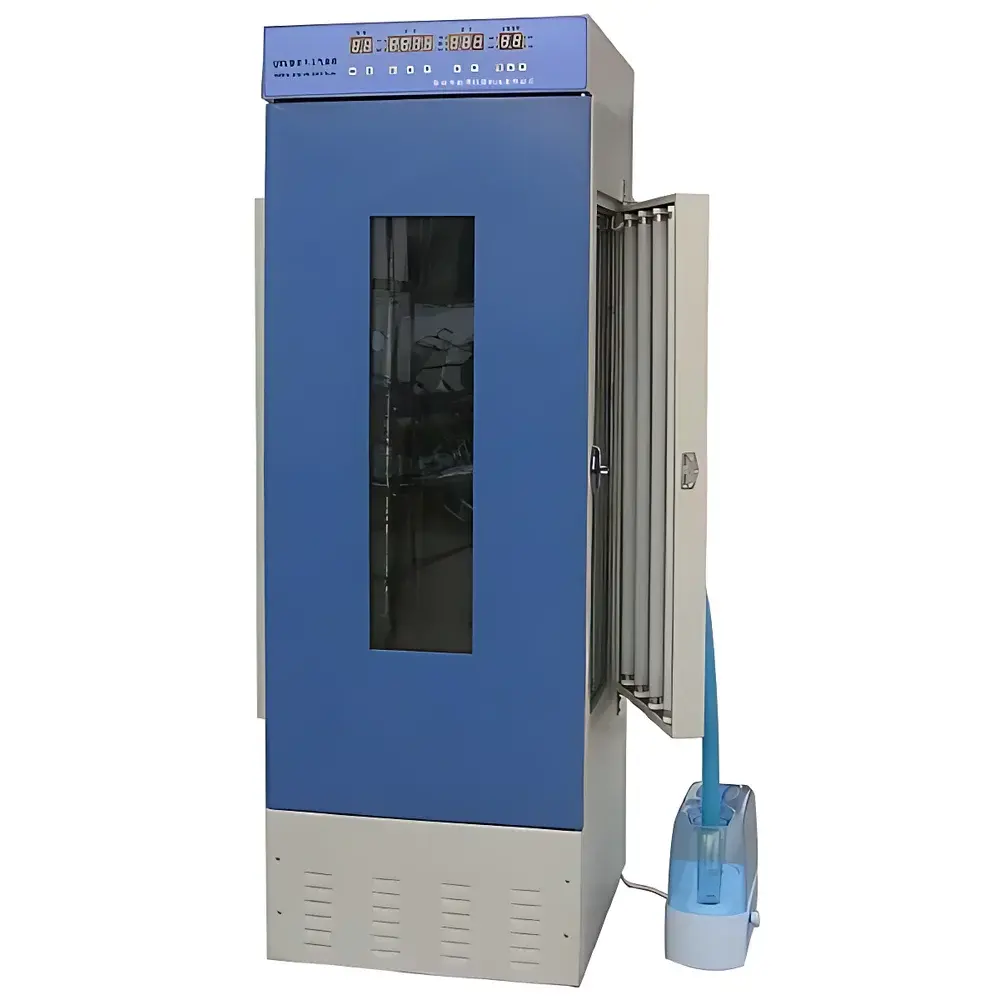
English Product Name
| Origin | Jiangsu, China |
|---|---|
| Manufacturer Type | Authorized Distributor |
| Origin Category | Domestic (China-made) |
| Model | HS-100 / DHS-100 |
| Internal Volume | 100 L |
| Interior Dimensions (W×D×H) | 400 × 500 × 500 mm |
| Temperature Range | HS-type: RT+10°C to 100°C |
| DHS-type | 0°C to 100°C |
| Humidity Range | HS-type: 85–98% RH |
| DHS-type | 45–98% RH |
| Temperature Uniformity | ≤ ±2°C |
| Temperature Fluctuation | ≤ ±0.5°C |
| Humidification Method | Shallow-water tray evaporation (surface evaporation) |
| Construction | Stainless steel inner chamber, polyurethane foam insulation |
| Cooling System | Finned stainless steel heat exchanger with multi-stage evaporator |
| Refrigeration Options | Single-stage or cascade (dual-stage) refrigeration (air-cooled or water-cooled) |
| Compressor | Imported hermetic scroll compressor |
| Controller | Fuji Electric PID temperature & humidity controller (Japan) |
| Sensors | Imported high-accuracy capacitive RH sensor and Pt100 temperature probe |
| Safety Protections | Leakage current protection, low-water-level cutoff, overtemperature cutoff, fast-acting fuse, compressor high-pressure protection |
| Test Conditions | All specifications measured at ambient temperature (QT) = 25°C, empty chamber, steady-state operation |
Overview
The HS-100 and DHS-100 Temperature and Humidity Controlled Environmental Test Chambers are engineered for precision environmental simulation in quality assurance, materials validation, and accelerated aging studies. These chambers operate on the principle of closed-loop thermodynamic control—combining resistive heating, surface-evaporation humidification, and vapor-compression refrigeration—to maintain stable, repeatable thermal and hygroscopic conditions across defined operational envelopes. The HS-100 is optimized for standard high-humidity, elevated-temperature testing (e.g., IEC 60068-2-3, ASTM D4332), while the DHS-100 extends low-temperature capability down to 0°C using a cascade refrigeration system—enabling compliance with broader environmental stress profiles including cold/hot/humidity cycling per MIL-STD-810H Method 502.2 and GB/T 2423.3–2016 (IEC 60068-2-78). Both models feature a seamless stainless steel interior chamber and high-density polyurethane insulation (≥100 mm thickness), minimizing thermal bridging and ensuring long-term stability under continuous duty cycles.
Key Features
- Stainless steel inner chamber and insulated double-wall construction with ≥100 mm polyurethane foam—reducing heat transfer and improving energy efficiency.
- Finned stainless steel evaporator and multi-stage cooling circuit—enhancing dehumidification response and low-temperature ramping performance in DHS configuration.
- Shallow-tray surface evaporation humidification system—providing stable, particle-free RH generation without ultrasonic mist or steam injection, eliminating condensation risk on test specimens.
- Fuji Electric FP23 series PID controller with dual-channel input (Pt100 + capacitive RH sensor)—supporting programmable ramp-soak profiles, real-time deviation alarms, and auto-tuning for load-dependent thermal inertia compensation.
- Cascade refrigeration option (DHS-100 only)—utilizing separate high- and low-stage compressors with R404A/R23 refrigerant pairs—achieving reliable sub-zero dew point control while maintaining ≤±0.5°C temperature fluctuation at 25°C/60% RH setpoints.
- Comprehensive safety architecture: independent overtemperature cutout (mechanical backup), low-water-level interlock, refrigerant high-pressure switch, leakage current detection (30 mA sensitivity), and UL-listed fast-acting fusing.
Sample Compatibility & Compliance
The 100 L working volume (400 × 500 × 500 mm internal dimensions) accommodates standard test specimens—including PCB assemblies, polymer packaging, lithium battery modules, optical lenses, and medical device housings—without obstructing airflow uniformity. Chamber airflow design follows ISO 16750-4 and IEC 60068-3-5 guidelines, ensuring laminar circulation and minimizing localized condensation. All electrical components comply with CE marking requirements (EMC Directive 2014/30/EU, LVD Directive 2014/35/EU). Data logging and alarm events meet GLP/GMP documentation prerequisites when paired with optional Ethernet-enabled data acquisition modules supporting CSV export and timestamped audit trails. The system supports validation protocols aligned with IQ/OQ/PQ frameworks per ASTM E2500 and EU Annex 15.
Software & Data Management
While the base unit operates via the Fuji FP23 front-panel interface, optional PC-based software (ChamberLink™ v3.2) enables remote monitoring, multi-chamber synchronization, and automated report generation compliant with FDA 21 CFR Part 11 (electronic signatures, audit trail, role-based access control). Real-time graphs display temperature and RH deviation against setpoints, with configurable alarm thresholds and email/SMS notifications via SMTP or Modbus TCP integration. Raw data is stored in encrypted SQLite databases with SHA-256 hashing, supporting retrospective analysis and regulatory submission packages.
Applications
- Accelerated moisture absorption testing of hygroscopic polymers (e.g., PA6, PBT) per ISO 62.
- Thermal cycling and humidity soak validation of automotive ECUs per ISO 16750-4.
- Stability testing of pharmaceutical primary packaging per ICH Q1A(R2) and USP .
- Corrosion resistance evaluation of coated metals under cyclic salt-humidity conditions (ASTM B117 + ASTM D2247).
- Pre-conditioning of electronic components prior to HALT/HASS per JEDEC JESD22-A110.
FAQ
What is the difference between HS-100 and DHS-100 configurations?
The HS-100 operates from ambient +10°C to 100°C with humidity up to 98% RH; the DHS-100 adds a cascade refrigeration system enabling operation from 0°C to 100°C while sustaining 45–98% RH—critical for cold-humidity combined stress testing.
Can the chamber be validated for GMP environments?
Yes—when equipped with calibrated NIST-traceable sensors, 21 CFR Part 11-compliant software, and documented IQ/OQ protocols, it meets core requirements for equipment qualification in pharmaceutical and medical device manufacturing.
Is custom chamber size or extended temperature range available?
Custom engineering is supported for non-standard volumes (50–1000 L), extended low-temperature capability (down to –40°C), or specialized corrosion-resistant interiors (e.g., Hastelloy-lined chambers).
What maintenance intervals are recommended?
Compressor oil and refrigerant levels should be verified annually; humidifier trays require weekly cleaning; Pt100 and RH sensors should be recalibrated every 6 months using certified reference standards.



