
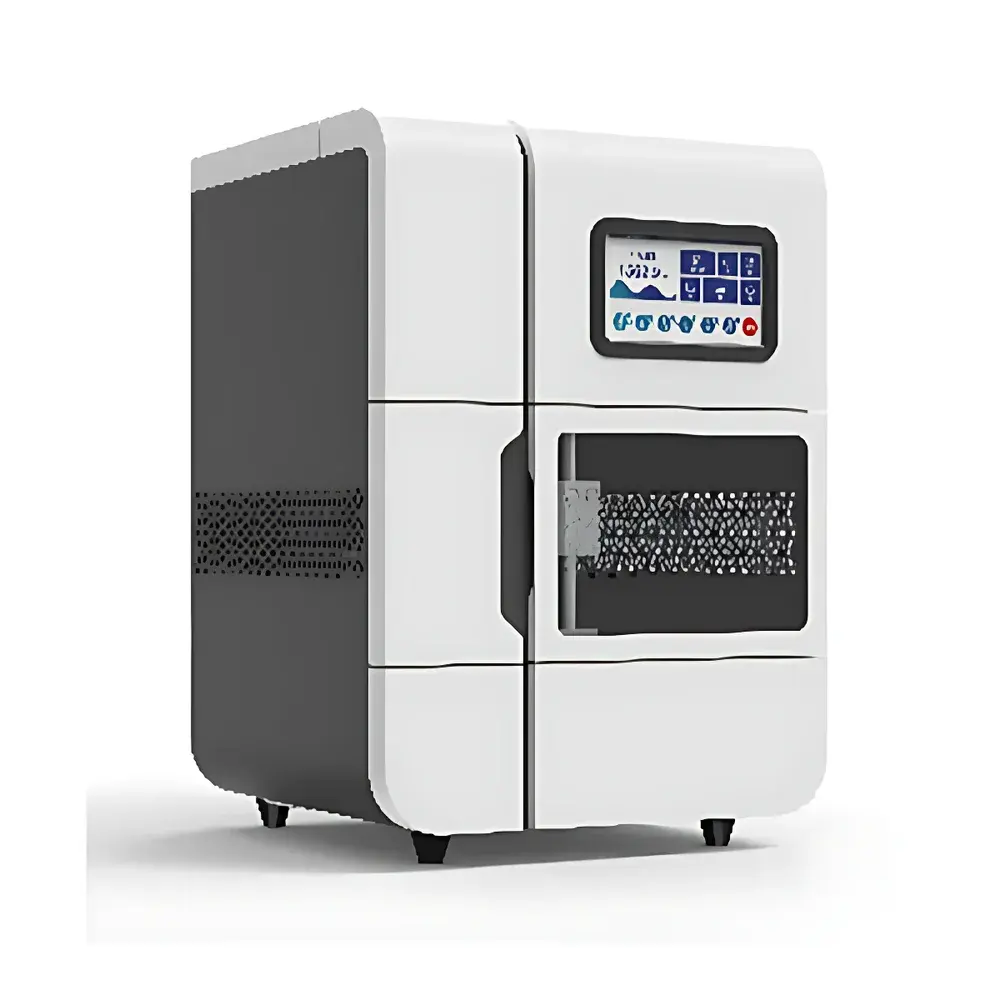
LIN100 Automated Ammonia-Nitrogen Analyzer by Luban Instruments
| Brand | Yoke |
|---|---|
| Origin | Shanghai, China |
| Manufacturer Type | Original Equipment Manufacturer (OEM) |
| Country of Origin | China |
| Model | LIN100 |
| Instrument Type | Laboratory Water Quality Analyzer |
| Analyte | Ammonia Nitrogen (NH₃-N) |
| Measurement Range | 0–100 mg/L (segmented testing) |
| Display | 7-inch capacitive color touchscreen |
| Sample Capacity | 16-position auto-digestion carousel |
| Digestion & Cooling | Integrated digestion heater and active cooling system |
| Reagent Handling | Pre-filled reagent cartridges (Nessler reagent method per HJ 535–2009) |
| Automation Features | Auto-dilution, auto-calibration, unattended batch analysis |
| Connectivity | Wi-Fi, Bluetooth 5.0, USB 2.0, cloud upload (HTTPS/TLS), WeChat Mini Program API |
| Compliance | Fully aligned with HJ 535–2009 “Determination of Ammonia Nitrogen in Water by Nessler’s Reagent Spectrophotometric Method” |
Overview
The LIN100 Automated Ammonia-Nitrogen Analyzer is a benchtop laboratory instrument engineered for high-throughput, regulatory-compliant quantification of ammonia nitrogen (NH₃-N) in surface water, wastewater, drinking water, and industrial effluent samples. It implements the standardized Nessler reagent spectrophotometric method as prescribed in China’s environmental monitoring standard HJ 535–2009 — a technique grounded in the formation of a yellow-brown colloidal complex between ammonium ions and alkaline mercuric potassium iodide under controlled pH and temperature conditions. Absorbance is measured at 420 nm using a precision LED-based optical path with temperature-stabilized photodetector and dual-beam referencing to minimize drift. Unlike manual or semi-automated methods, the LIN100 integrates sample introduction, reagent addition, digestion, cooling, color development, photometric measurement, and data reporting into a single coordinated workflow — eliminating operator-dependent variability and enabling reproducible NH₃-N results across 16 samples per run.
Key Features
- Fully automated analysis cycle: Sample aspiration, reagent dispensing (pre-loaded Nessler cartridges), heating (digestion up to 100 °C), active air-cooling, color development stabilization, and photometric readout are executed without manual intervention.
- Integrated thermal management: Onboard Peltier-assisted cooling module ensures consistent post-digestion temperature control (<±0.5 °C), critical for reaction kinetics and color stability prior to absorbance measurement.
- Segmented-range photometry: The instrument automatically selects optimal optical gain and integration time based on preliminary absorbance screening, supporting accurate quantification across 0–100 mg/L NH₃-N with dynamic range segmentation (e.g., 0–2 mg/L, 2–20 mg/L, 20–100 mg/L) and internal auto-dilution logic when signal saturation is detected.
- Regulatory-grade calibration architecture: Includes multi-point auto-calibration using certified NH₄Cl standards; calibration curves stored with timestamp, operator ID, and audit trail metadata compliant with GLP principles.
- Robust hardware design: Corrosion-resistant fluidic path (PTFE/PFA tubing, ceramic valves), sealed optical chamber with anti-fog coating, and IP20-rated enclosure suitable for ISO/IEC 17025-accredited laboratory environments.
Sample Compatibility & Compliance
The LIN100 accepts liquid aqueous samples with turbidity ≤ 5 NTU and suspended solids < 20 mg/L (centrifugation or filtration recommended if exceeded). It accommodates standard 16.5 mm × 100 mm borosilicate glass tubes or 16.5 mm polypropylene vials. All analytical procedures conform strictly to HJ 535–2009, including reagent purity specifications, digestion time/temperature profiles (10 min @ 100 °C), and absorbance measurement protocol. While not FDA 21 CFR Part 11-certified out-of-the-box, the system supports ALCOA+ data integrity principles: electronic signatures, immutable audit logs, role-based access control (via optional LDAP integration), and encrypted local/cloud storage — facilitating alignment with ISO/IEC 17025:2017 Clause 7.5 and CNAS-CL01 requirements for accredited water testing laboratories.
Software & Data Management
The embedded Linux-based firmware runs a dedicated analytical OS with a responsive 7-inch capacitive touchscreen UI. Data acquisition, processing, and reporting are handled by the LIN100 Control Suite — a desktop application (Windows/macOS) and companion WeChat Mini Program. Raw absorbance values, calibration parameters, dilution factors, QC check results (e.g., blank drift, spike recovery), and final NH₃-N concentrations are exported in CSV, PDF, or XML formats. Cloud synchronization uses TLS 1.2-encrypted HTTPS to a private tenant instance; all uploads include SHA-256 hash verification. Audit trails record every user action (login, method edit, result override, report generation) with UTC timestamps and device MAC address — meeting traceability requirements for third-party audits.
Applications
- Environmental monitoring labs conducting routine compliance testing for municipal wastewater discharge permits (e.g., GB 8978–1996).
- Drinking water treatment plants performing source water and finished water NH₃-N surveillance per GB 5749–2022.
- Industrial effluent QA/QC in chemical, pharmaceutical, and food processing facilities.
- Research institutions studying nitrogen cycling in aquatic ecosystems or evaluating nitrification/denitrification efficiency in bioreactors.
- Educational laboratories requiring robust, low-maintenance instrumentation for undergraduate environmental chemistry curricula.
FAQ
Does the LIN100 comply with international standards such as ISO 7150-1 or ASTM D1426?
The LIN100 implements the reaction chemistry and spectral detection principles equivalent to ISO 7150-1:1984 and ASTM D1426–15a; however, formal conformance statements require method validation per each standard’s specified precision, spike recovery, and interference tolerance criteria — which must be performed in the end-user’s laboratory under their SOPs.
Can the instrument store calibration curves from multiple operators or projects?
Yes. Each calibration event is saved with unique metadata (operator ID, date/time, standard lot number, curve R²), and users may archive, recall, or compare historical curves via the desktop software or cloud dashboard.
Is mercury-free reagent compatibility available?
Standard operation uses HJ 535–2009-specified Nessler reagent containing K₂HgI₄. Mercury-free alternatives (e.g., salicylate-hypochlorite method) are not supported due to incompatible reaction kinetics and optical path design.
What maintenance intervals are recommended for long-term reliability?
Daily: Wipe optical window and sample probe; weekly: flush fluidic path with deionized water; quarterly: verify photometer baseline stability and replace PTFE tubing if visible wear occurs. Full PM (valve actuation test, temperature calibration, optical alignment) is advised every 12 months by certified service personnel.
Related Products







