
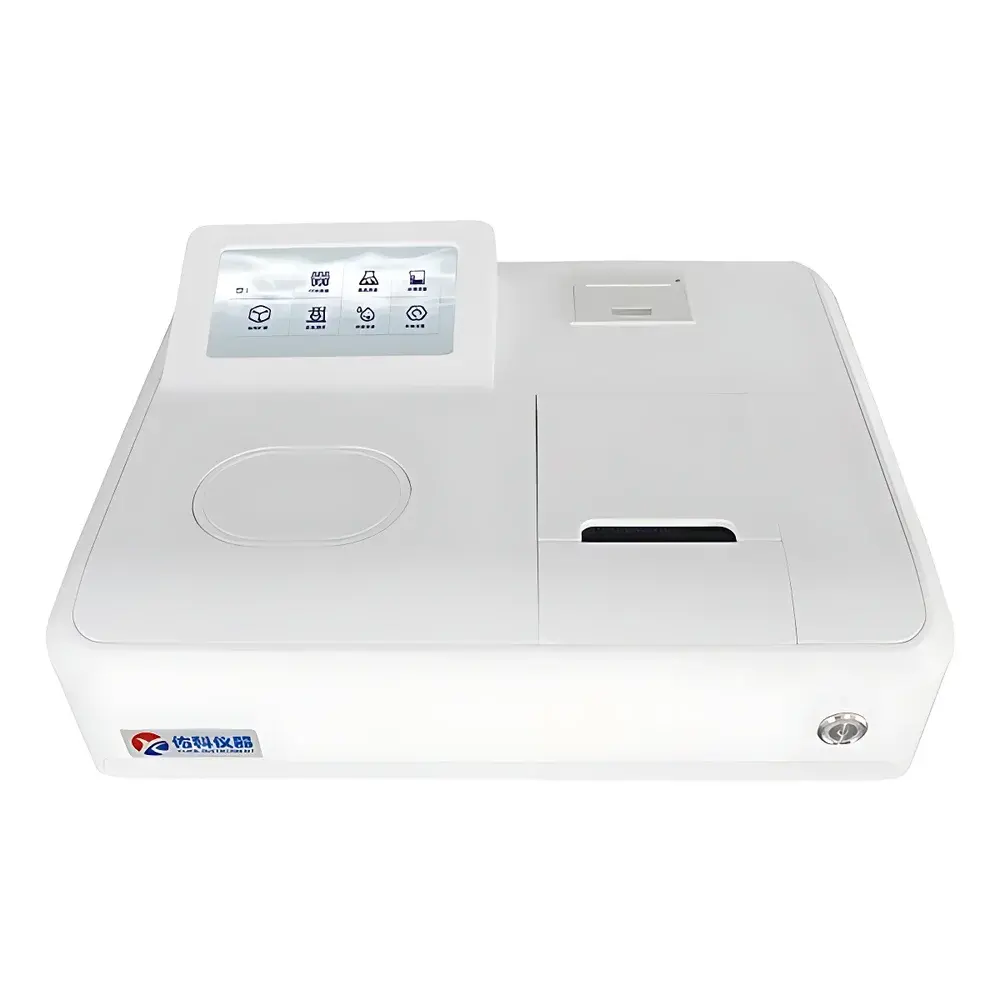
Yoke L4 IoT-Enabled UV-Vis Spectrophotometer
| Brand | Yoke |
|---|---|
| Origin | Shanghai, China |
| Manufacturer Type | Direct Manufacturer |
| Regional Classification | Domestic (China) |
| Model | L4 |
| Price Range | USD 1,400–2,800 |
| Optical Design | Single-Beam |
| Detector | Photodiode Array (PDA) |
| Wavelength Range | 190–1100 nm |
| Automation Level | Motorized Wavelength Scanning |
| Spectral Bandwidth | 4 nm (2 nm optional) |
| Wavelength Accuracy | ±1 nm |
| Stray Light | ≤0.1% T |
Overview
The Yoke L4 IoT-Enabled UV-Vis Spectrophotometer is a single-beam, microprocessor-controlled analytical instrument engineered for routine and research-grade absorbance, transmittance, and concentration measurements across the ultraviolet, visible, and near-infrared spectral regions (190–1100 nm). It employs a Czerny-Turner monochromator architecture incorporating a high-efficiency holographic blazed grating—optimized for throughput and resolution—and utilizes dual broadband sources (deuterium lamp for UV, tungsten-halogen lamp for VIS-NIR) with automatic lamp switching. The photodiode array (PDA) detector enables rapid spectral acquisition without mechanical scanning of the detector, supporting high-speed wavelength sweeps up to 3000 nm/min while maintaining baseline stability (photometric drift ≤±0.002 A/h at 500 nm, 0 A). Designed for laboratory environments requiring regulatory-compliant data integrity, the L4 integrates hardware-level traceability features aligned with GLP and ISO/IEC 17025 operational frameworks.
Key Features
- 7-inch capacitive color touchscreen (1024 × 768 resolution) with intuitive, icon-driven UI—no keyboard or mouse required; supports multi-touch gestures for zoom, pan, and parameter adjustment.
- Embedded Wi-Fi, Bluetooth 5.0, and USB 2.0 interfaces enable seamless connectivity: wireless thermal printing via Bluetooth, local file export to USB flash drives (CSV, TXT, and native .SPC formats), and real-time cloud synchronization through YOKE@Cloud Data platform.
- Dual-source optical system with auto-switching between D₂ and W lamp ensures optimal signal-to-noise ratio across full spectral range; lamp usage time is logged automatically for maintenance scheduling and audit readiness.
- High-fidelity analog front-end using Analog Devices AD7798 24-bit Σ-Δ ADC guarantees low-noise digitization and long-term photometric reproducibility (RSD <0.3% at 0.5 A, n=10).
- Onboard memory stores up to 2000 measurement records and 96 calibration curves; all entries include timestamp, operator ID (optional login), and instrument configuration metadata.
- Preloaded application modules: quantitative analysis (single/multi-point calibration), kinetic assays (time-scan up to 9999 points), nucleic acid/protein quantification (A260/A280, ε-based calculations), derivative spectroscopy (1st–3rd order), and spectral overlay for comparative analysis.
Sample Compatibility & Compliance
The L4 accommodates standard 10-mm rectangular cuvettes (glass, quartz, or plastic), as well as optional micro-volume adapters (e.g., 50–200 µL pathlength). It complies with core performance criteria outlined in ASTM E275, ISO 6223, and USP for spectrophotometric instrumentation validation. All firmware and software modules support audit trail generation per FDA 21 CFR Part 11 requirements when used with Yokelab PC software (v3.2+), including electronic signatures, user access levels, and immutable record retention. Instrument qualification documentation (IQ/OQ templates) and calibration certificate templates are provided upon request for GMP and clinical lab accreditation workflows.
Software & Data Management
Yokelab PC Software (optional standalone license) provides advanced spectral processing—including Savitzky-Golay smoothing, baseline correction, peak integration, and multivariate regression—and exports fully formatted reports compatible with LIMS systems. Raw spectral data (.SPC) is structured per JCAMP-DX v6.00 specification for interoperability with third-party tools (OriginLab, MATLAB, Python SciPy). Cloud-synced datasets are encrypted in transit (TLS 1.2+) and at rest (AES-256), with role-based access control and configurable retention policies. Local backup via USB export produces Excel-readable CSV files containing wavelength, absorbance, transmittance, and metadata columns—enabling direct import into statistical analysis pipelines without format conversion.
Applications
The L4 serves as a primary analytical tool in quality control laboratories for pharmaceutical excipient verification, water quality monitoring (COD, ammonia, nitrate), food safety testing (colorants, preservatives), educational spectroscopy instruction, and environmental sample screening. Its low stray light (<0.1% T at 220 nm) supports accurate measurement of highly absorbing samples such as undiluted protein solutions or concentrated dye formulations. The kinetics module enables enzyme activity assays (e.g., β-galactosidase, LDH), while nucleic acid quantification adheres to MIQE guidelines for qPCR workflow support. Routine QC applications include raw material identification, cleaning validation swab analysis, and stability-indicating method development.
FAQ
Does the L4 meet regulatory requirements for pharmaceutical QC labs?
Yes—the instrument supports 21 CFR Part 11 compliance when paired with Yokelab Software v3.2+, including electronic signatures, audit trails, and user authentication.
Can I perform spectral deconvolution or multicomponent analysis?
Basic multicomponent quantitation (up to 4 analytes) is supported via built-in linear regression; advanced chemometric modeling requires Yokelab Software or third-party tools importing JCAMP-DX files.
Is quartz cuvette compatibility confirmed across the full 190–1100 nm range?
Yes—standard 10-mm quartz cuvettes are validated for use from 190 nm to 2500 nm; UV-grade fused silica is recommended below 200 nm for maximum transmission.
What is the calibration interval recommendation?
Wavelength calibration should be verified annually using NIST-traceable holmium oxide or didymium filters; photometric calibration is recommended before each analytical session using neutral density filters or potassium dichromate solution.
Is remote firmware update supported?
Firmware updates are delivered via YOKE@Cloud Data portal and applied over Wi-Fi; version history and changelogs are archived in instrument logs for audit purposes.





