
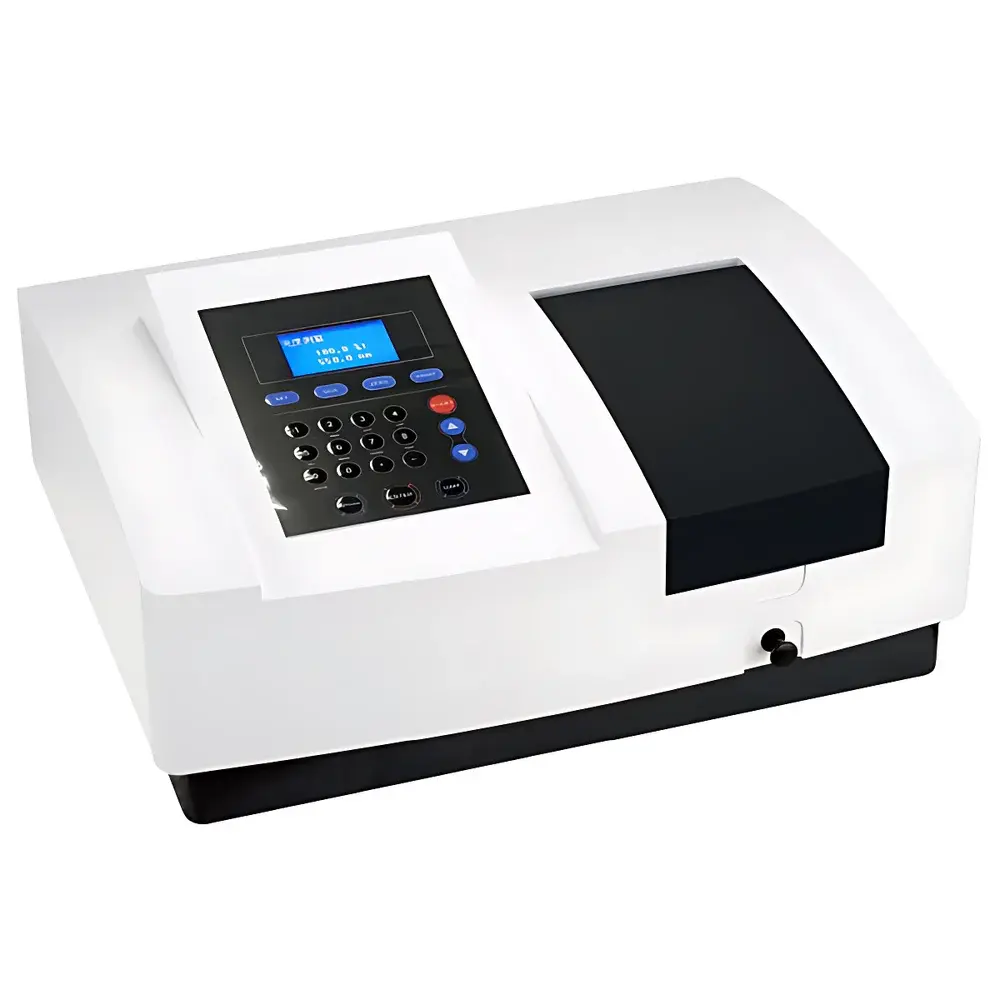
Yoke UV755B Ultraviolet-Visible Spectrophotometer
| Brand | Yoke |
|---|---|
| Origin | Shanghai, China |
| Manufacturer Type | Direct Manufacturer |
| Instrument Architecture | Single-Beam |
| Detector Type | Photocell |
| Wavelength Range | 190–1100 nm |
| Wavelength Drive | Automatic |
| Spectral Bandwidth | 2 nm |
| Wavelength Accuracy | ±1 nm |
| Wavelength Repeatability | ±0.2 nm |
| Photometric Accuracy (Transmittance) | ±0.5% T |
| Photometric Repeatability (Transmittance) | ±0.2% T |
| Transmittance Range | 0.0–200.0% T |
| Absorbance Range | –0.30 to 3.00 A |
| Concentration Display Range | 0–1999 units |
| Stray Light | ≤0.2% T at 220 nm and 360 nm |
| Baseline Stability | ±0.002 A/h at 500 nm |
| RS232 Interface | Standard |
| Software Support | Built-in Quantitative Analysis Module |
| Data Storage | Onboard Microcontroller (51-series) with Curve & Measurement Memory |
| Power Failure Protection | Enabled |
| Self-Diagnostic Functionality | Integrated |
Overview
The Yoke UV755B Ultraviolet-Visible Spectrophotometer is a single-beam, microprocessor-controlled analytical instrument engineered for routine quantitative and qualitative analysis in academic laboratories, quality control environments, and industrial R&D settings. It operates on the principle of Beer–Lambert law-based absorption spectroscopy, measuring the attenuation of ultraviolet and visible light as it passes through a sample solution. With a spectral coverage from 190 nm to 1100 nm—spanning the deep UV, near-UV, visible, and near-infrared regions—the UV755B supports applications ranging from nucleic acid quantification and protein assays to dye concentration profiling and pharmaceutical excipient verification. Its 2 nm spectral bandwidth ensures adequate resolution for most standard absorbance measurements while maintaining optical throughput and signal-to-noise ratio suitable for routine use. The instrument employs a stable tungsten-halogen lamp for the visible/NIR range and a deuterium lamp for the UV range, with automatic lamp switching controlled by the onboard 51-series microcontroller.
Key Features
- Single-beam optical architecture with automated wavelength scanning and real-time photometric calibration
- Integrated 51-series microcontroller enabling on-board storage of up to 200 measurement records and multiple standard curves
- Intelligent self-diagnostic system with error code reporting and power-failure data retention
- Precision mechanical monochromator with grating drive mechanism ensuring ±1 nm wavelength accuracy and ±0.2 nm repeatability
- Dual-lamp configuration (deuterium + tungsten-halogen) with automatic lamp selection based on set wavelength
- Photocell-based detection system optimized for linearity across 0.0–200.0% transmittance and –0.30 to 3.00 A absorbance ranges
- RS232 serial interface compliant with EIA-232 standards for bidirectional communication with PCs or thermal printers
- Built-in quantitative analysis software supporting fixed-wavelength, multi-point calibration, and linear regression-based concentration calculation
Sample Compatibility & Compliance
The UV755B accommodates standard 10 mm pathlength quartz or glass cuvettes (12.5 × 12.5 mm cross-section), compatible with common solvent systems including water, ethanol, methanol, and buffered saline solutions. It meets fundamental performance criteria outlined in ISO 6425:2020 (spectrophotometer performance verification) and aligns with general laboratory requirements specified in ASTM E275–22 (standard practices for describing and measuring performance of UV-Vis spectrophotometers). While not certified for regulated GMP environments out-of-the-box, its data integrity features—including timestamped measurements, non-volatile memory retention, and RS232 audit trail capability—support basic GLP documentation workflows. Stray light performance (≤0.2% T at 220 nm and 360 nm) satisfies typical method validation thresholds for low-absorbance measurements in environmental and biochemical assays.
Software & Data Management
Data acquisition and processing are managed via embedded firmware, eliminating dependency on external host software for core operations. The instrument’s internal memory stores calibration curves, sample IDs, and absorbance/transmittance readings with time stamps. When connected to a PC via RS232, users may export datasets in ASCII-delimited format for further analysis in spreadsheet or statistical packages. Optional third-party software (e.g., Yoke SpectraLink) extends functionality to kinetic scan mode, spectral overlay, and report generation compliant with internal QA templates. All firmware updates are delivered via serial download using standard terminal emulation protocols (e.g., Tera Term), preserving traceability under laboratory-controlled change management procedures.
Applications
- Quantitative determination of DNA, RNA, and proteins using A260/A280 ratios and extinction coefficient methods
- Colorimetric enzyme assays (e.g., ELISA, LDH, ALP) requiring precise endpoint or kinetic absorbance monitoring
- Pharmaceutical raw material identification and assay verification per USP <857> guidelines
- Water quality testing including nitrate, phosphate, and COD analysis using APHA-standard colorimetric methods
- Educational laboratory instruction in analytical chemistry, biochemistry, and physical chemistry curricula
- Industrial QC of dyes, pigments, and transparent polymer films where spectral transmittance profiles are critical
FAQ
Does the UV755B support kinetic or scanning modes?
No—the UV755B is designed for fixed-wavelength and multi-point quantitative analysis only. It does not perform full-spectrum scans or time-resolved kinetic measurements.
Is the instrument compliant with FDA 21 CFR Part 11?
The UV755B lacks electronic signature capability, audit trail logging, and user access controls required for Part 11 compliance. It may be used in non-regulated or pre-validation environments.
Can I use plastic cuvettes with this instrument?
Plastic cuvettes are acceptable only above 340 nm. Below this threshold, UV-grade quartz cuvettes are mandatory to avoid absorption artifacts.
What maintenance is required for long-term stability?
Routine cleaning of the sample compartment and optical windows, annual lamp replacement (deuterium lamp life ≈ 1000 h), and periodic verification against NIST-traceable filters are recommended.
Is printer support included or optional?
Printer connectivity is supported via RS232; however, the thermal printer is an optional accessory and must be purchased separately.



