
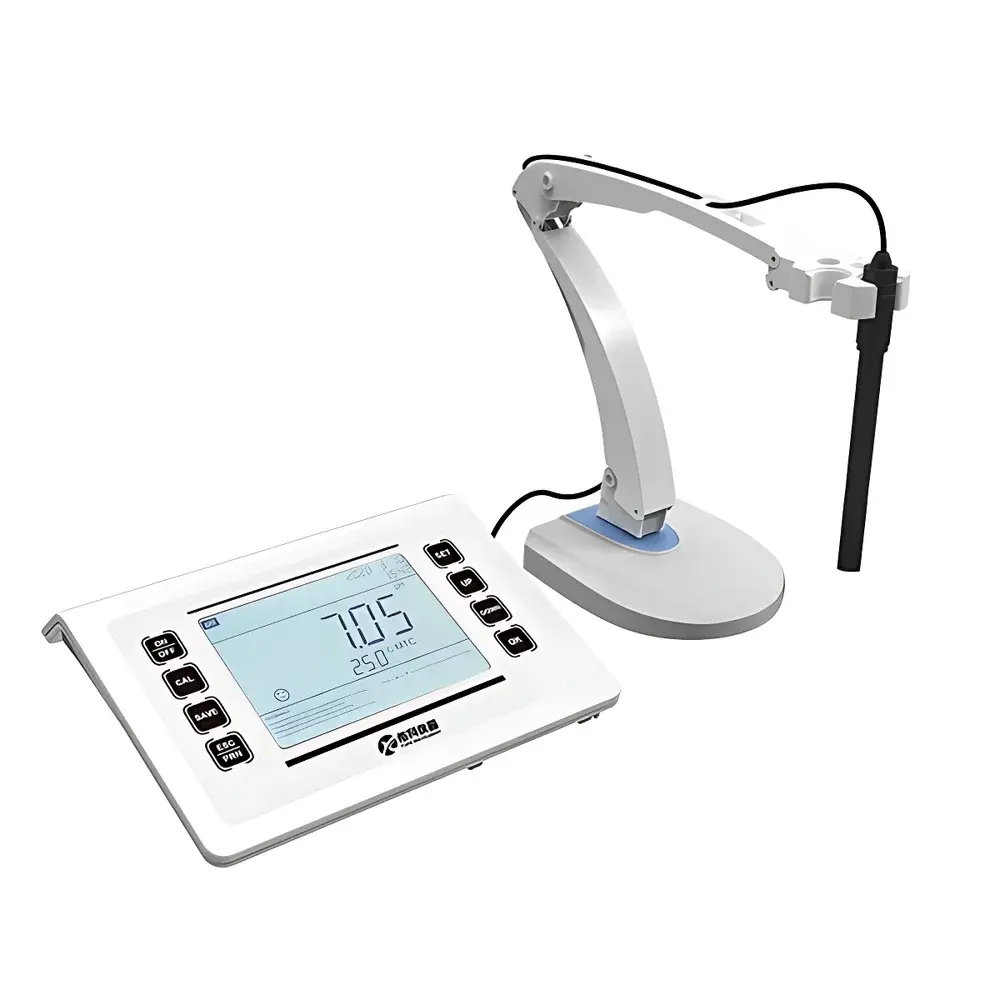
Yoke P901 Benchtop pH Meter
| Brand | Yoke |
|---|---|
| Origin | Shanghai, China |
| Manufacturer Type | Direct Manufacturer |
| Instrument Type | Benchtop |
| Parameter Type | Single-Parameter (pH) |
| pH Range | 0.00–14.00 |
| pH Resolution | 0.01 pH |
| pH Accuracy | ±0.02 pH |
| Temperature Compensation | Automatic (0.0–60.0 °C) |
| Calibration Options | NIST, USA/EU, and Chinese Standard Buffer Series |
| Display | 6.5-inch LED |
| Data Storage Capacity | 2000 sets |
| Connectivity | USB 2.0, Bluetooth 4.0, RS-232 |
| Input Impedance | ≥1×10¹² Ω |
| Input Current | ≤2×10⁻¹² A |
| mV Range | −1200.00 to +1999.00 mV |
| mV Resolution | 1 mV |
| mV Accuracy | ±0.1% FS |
| IP Rating | IP54 |
| Power Supply | 9 V DC / 2 A adapter (110–220 V AC, 50–60 Hz) |
| Dimensions | 160 × 190 × 70 mm |
| Weight | 880 g |
Overview
The Yoke P901 Benchtop pH Meter is a precision electrochemical instrument engineered for reliable, high-reproducibility pH measurement in laboratory, quality control, and educational environments. It operates on the fundamental principle of potentiometric measurement—detecting the potential difference between a pH-sensitive glass electrode and a stable reference electrode immersed in aqueous solution—converted into pH values using the Nernst equation. Designed to meet international laboratory practice standards, the P901 integrates automatic temperature compensation (ATC), intelligent electrode diagnostics, and multi-standard buffer recognition to minimize operator-dependent error and ensure traceable, GLP-compliant results. Its robust architecture supports continuous operation under ambient conditions (5–40 °C, 5–85% RH), while the IP54-rated enclosure provides protection against dust ingress and water splashes—critical for shared lab workbenches or industrial QC stations where environmental exposure is common.
Key Features
- 6.5-inch high-visibility LED display with simultaneous real-time readout of pH, mV, and temperature—optimized for ergonomic viewing and rapid data interpretation.
- Industrial-grade Omron tactile membrane keypad rated for >100,000 actuations, delivering consistent tactile feedback and long-term mechanical reliability.
- Auto-buffer recognition across three internationally accepted calibration series: NIST-traceable (pH 4.01, 7.00, 10.01), US/EU (pH 4.01, 7.00, 9.21), and Chinese national standard buffers (pH 4.00, 6.86, 9.18).
- Integrated Bluetooth 4.0 module enables wireless printing to compatible thermal printers and optional bidirectional data transfer to Windows PCs or Android/iOS devices via dedicated software.
- GLP-compliant data management: Each stored measurement includes timestamp, temperature, electrode ID (if encoded), calibration status, and user-defined sample ID—enabling full audit trail capability.
- Self-diagnostic electrode health assessment—including slope calculation, asymmetry potential, and response time evaluation—to proactively alert users to degraded sensor performance before measurement drift occurs.
Sample Compatibility & Compliance
The P901 is validated for use with standard aqueous solutions, buffered standards, and routine process samples across pharmaceutical, food & beverage, environmental monitoring, and academic research applications. It supports both refillable and gel-filled combination pH electrodes (BNC connector interface) and accommodates temperature probes with Pt1000 or NTC thermistors. All firmware and data handling protocols comply with GLP documentation requirements per ISO/IEC 17025:2017 Annex A and support retrospective review for regulatory audits. While not certified to FDA 21 CFR Part 11 out-of-the-box, its encrypted data logging, immutable timestamps, and user-access controls provide a foundation for internal validation under GMP or ISO 9001 quality systems.
Software & Data Management
The instrument stores up to 2000 measurement records internally, each containing pH/mV/temperature values, calibration metadata, and date/time stamps. Data export is supported via USB 2.0 (mass storage mode) to FAT32-formatted USB drives—output files are saved as CSV, directly importable into Microsoft Excel, LibreOffice Calc, or LIMS platforms without proprietary software. Optional PC software (Yoke LabLink v2.x) provides extended functionality including calibration curve visualization, statistical summary reports (mean, SD, CV%), and batch export for QA documentation. RS-232 serial output enables integration into automated lab workflows or SCADA systems using Modbus RTU or ASCII command protocols.
Applications
- Pharmaceutical QC: Monitoring pH of dissolution media, injectables, and buffer preparations per USP and EP 2.2.3 guidelines.
- Food safety labs: Measuring acidity in dairy products, fermented beverages, and preserved foods per AOAC 973.41 and ISO 2917.
- Environmental testing: Field-deployable bench verification of surface water, wastewater effluents, and soil extracts in accordance with EPA Method 150.1.
- Academic teaching: Demonstrating acid-base equilibria, titration endpoints, and electrode theory in undergraduate chemistry laboratories.
- Biotechnology R&D: Tracking culture medium pH stability during microbial fermentation and cell line expansion protocols.
FAQ
Does the P901 support automatic 3-point calibration?
No—the P901 performs manual 2-point calibration only. Users select two standard buffers from the same recognized series (NIST, US/EU, or Chinese) to establish slope and offset.
Can I use third-party pH electrodes with the P901?
Yes—any BNC-compatible pH electrode (single-junction, double-junction, or gel-filled) with ≥1×10¹² Ω input impedance is functionally compatible.
Is the Bluetooth module mandatory for data export?
No—USB 2.0 and RS-232 interfaces provide wired alternatives; Bluetooth is optional and used exclusively for wireless printing or mobile device pairing.
What does the IP54 rating mean for daily lab use?
IP54 indicates protection against limited dust ingress (no harmful deposits) and water splashes from any direction—suitable for general lab benches but not for wet-process or washdown environments.
How is GLP compliance implemented in the P901’s firmware?
Through mandatory timestamping, non-editable calibration logs, user-accessible audit trails, and immutable storage of electrode diagnostics—features aligned with ISO/IEC 17025 Clause 7.7 on result reporting integrity.





