
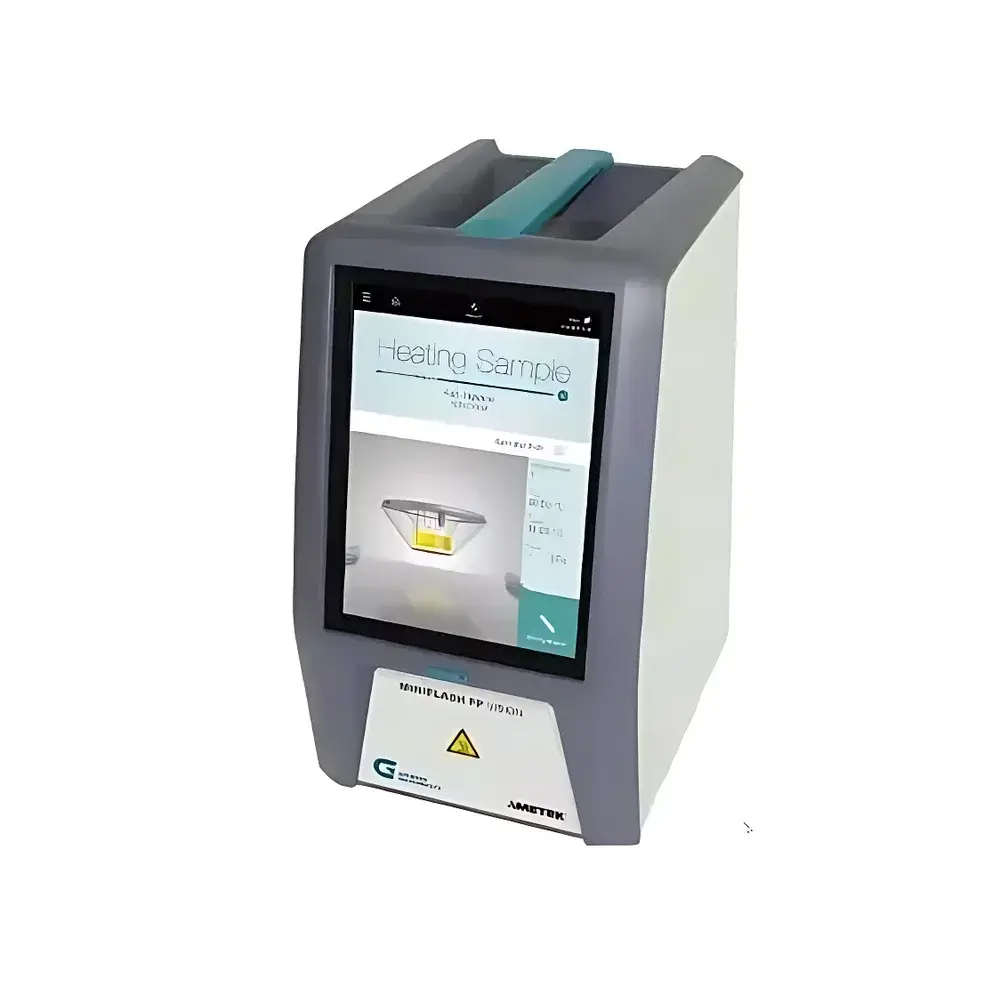
GRABNER MINIFLASH FP VISION Closed-Cup Flash Point Analyzer
| Brand | GRABNER |
|---|---|
| Country of Origin | Austria |
| Model | MINIFLASH FP VISION |
| Detection Method | Closed-Cup |
| Temperature Range | 0–120 °C (standard), down to –25 °C with external coolant circulation |
| Temperature Stability | ±0.05 °C |
| Sample Volume | 1 mL (ASTM D6450/SH/T 0768), 2 mL (ASTM D7094) |
| Throughput | Up to 12 samples/hour |
| Interfaces | 4× USB, 2× LAN |
| Power Supply | 100–240 V AC, 50/60 Hz, max. 180 W |
| Dimensions | 253 × 368 × 277 mm |
| Weight | 10.2–11.2 kg |
Overview
The GRABNER MINIFLASH FP VISION is a state-of-the-art closed-cup flash point analyzer engineered for precision, safety, and regulatory compliance in demanding industrial and laboratory environments. Based on the Peltier-controlled heating/cooling principle and patented flame-detection imaging technology, it implements the ASTM D6450 and D7094 test methods — widely recognized as the most advanced alternatives to traditional Pensky-Martens (ASTM D93/ISO 2719) and Tag (ASTM D56) procedures. Unlike open-cup or conventional closed-cup instruments, the FP VISION operates under fully sealed conditions throughout the entire test cycle, eliminating exposure to volatile vapors, open flames, or uncontrolled combustion events. Its measurement principle relies on controlled thermal ramping, real-time optical flame detection via high-resolution imaging, and intelligent vapor concentration monitoring — enabling reliable flash point determination even for trace-contaminated, highly volatile, or thermally unstable samples where conventional methods fail.
Key Features
- Patented Peltier-based rapid thermal control system enables precise temperature ramping (±0.05 °C stability) and sub-minute cooling between tests — significantly increasing throughput without compromising calibration integrity.
- Integrated high-definition imaging module captures and records the entire ignition event, supporting forensic analysis of flame initiation dynamics and low-level combustible contamination (e.g., fuel dilution in lubricants).
- Automated ignition system with self-cleaning cycle removes carbonaceous residue after each test, ensuring long-term reproducibility and minimizing maintenance downtime.
- Hermetically sealed sample chamber with motorized lid actuation guarantees operator safety, prevents sample spillage, and eliminates odor emission — compliant with OSHA and EU Directive 1999/92/EC (ATEX) workplace exposure guidelines.
- 10-inch full-color capacitive touchscreen with context-sensitive visual navigation requires no prior training; multilingual UI supports English, German, French, Spanish, Chinese, and Japanese.
- Onboard method library includes pre-validated protocols for ASTM D6450/D7094, ISO 3679/3680, IP 523/524, SH/T 0768, and proprietary screening modes for rapid “flash/no-flash” assessment and fuel-dilution quantification.
Sample Compatibility & Compliance
The MINIFLASH FP VISION is validated for use across diverse sample matrices including petroleum distillates, biodiesel blends, jet fuels (JP-5, JP-8), transformer oils, hydraulic fluids, solvents, fragrance concentrates, coatings, and waste streams. Its 1–2 mL sample requirement minimizes hazardous waste generation and reduces consumable costs — aligning with ISO 14001 environmental management principles. Regulatory acceptance includes formal recognition by the U.S. Department of Transportation (DOT), U.S. Environmental Protection Agency (EPA) under RCRA, U.S. Navy Naval Sea Systems Command (NAVSEA), and NATO AEP-30 standards. It satisfies GLP and GMP data integrity requirements through built-in audit trails, electronic signatures (per FDA 21 CFR Part 11), and secure user-role management via GRABNER Cockpit™ software.
Software & Data Management
Native integration with GRABNER Cockpit™ — a centralized laboratory informatics platform — enables remote instrument monitoring, method deployment, result aggregation, and statistical process control per ASTM D6299. The software supports LIMS connectivity via ASTM E1384-compliant HL7 and ASTM E2500-07 message formats. All test logs include timestamped metadata (operator ID, ambient conditions, calibration status, raw image sequences), exportable in PDF/A-1b or CSV format. Digital documentation is embedded directly into the device OS: users access interactive SOPs, calibration certificates, and regulatory guidance documents without external media. Firmware updates are delivered over LAN or USB with cryptographic signature verification to ensure traceability and cybersecurity compliance (IEC 62443-3-3).
Applications
- Petrochemical QA/QC: Routine flash point verification of naphthas, kerosenes, diesel fractions, and reformulated gasoline blends per refinery specifications.
- Aviation & Marine Fuels: Certification testing for Jet A-1, JP-5, and marine distillate fuels under ASTM D1655 and MIL-DTL-5624.
- Lubricant Condition Monitoring: Detection of fuel dilution in engine oils using the integrated fast-screening protocol — correlating flash point depression with hydrocarbon contamination levels.
- Hazardous Materials Classification: UN GHS Category 1–4 flammability assignment for SDS authoring and transport documentation (UN TDG, IATA DGR, IMDG Code).
- Fragrance & Flavor Manufacturing: Compliance testing for IFRA-certified raw materials and finished products where low-flash solvents dominate formulation profiles.
- Power Generation: Transformer oil surveillance per IEEE C57.106 and IEC 60296 standards to detect thermal degradation or hydrocarbon ingress.
FAQ
Does the MINIFLASH FP VISION comply with ASTM D93 equivalence requirements?
Yes. Per ASTM Committee D02’s official statement, results obtained using ASTM D7094 show no statistically significant difference from those generated by ASTM D93 Method A — enabling direct substitution in regulated reporting.
Can it test high-viscosity samples such as heavy fuel oil or bitumen cutbacks?
The FP VISION is optimized for distillate-range materials (viscosity < 20 cSt at 40 °C). For heavier fractions, GRABNER recommends the FPH VISION variant with extended 10–400 °C range and heated sample handling.
Is external cooling required for sub-zero flash point measurements?
Yes. While the standard unit operates from 0–120 °C, achieving –25 °C requires connection to a recirculating chiller (e.g., Huber CC-K10) via the integrated coolant port.
How does the system ensure data integrity for auditable workflows?
All operations generate immutable audit trails with digital signatures, time-stamped actions, and role-based access controls — fully aligned with 21 CFR Part 11, ISO/IEC 17025:2017 Clause 7.7, and EU Annex 11 expectations.
What network security protocols does Cockpit™ support for enterprise deployment?
Cockpit™ implements TLS 1.2+ encryption, LDAP/Active Directory integration, OAuth 2.0 token-based authentication, and configurable firewall rules — meeting NIST SP 800-53 Rev. 5 IA-2 and SI-3 controls.





