
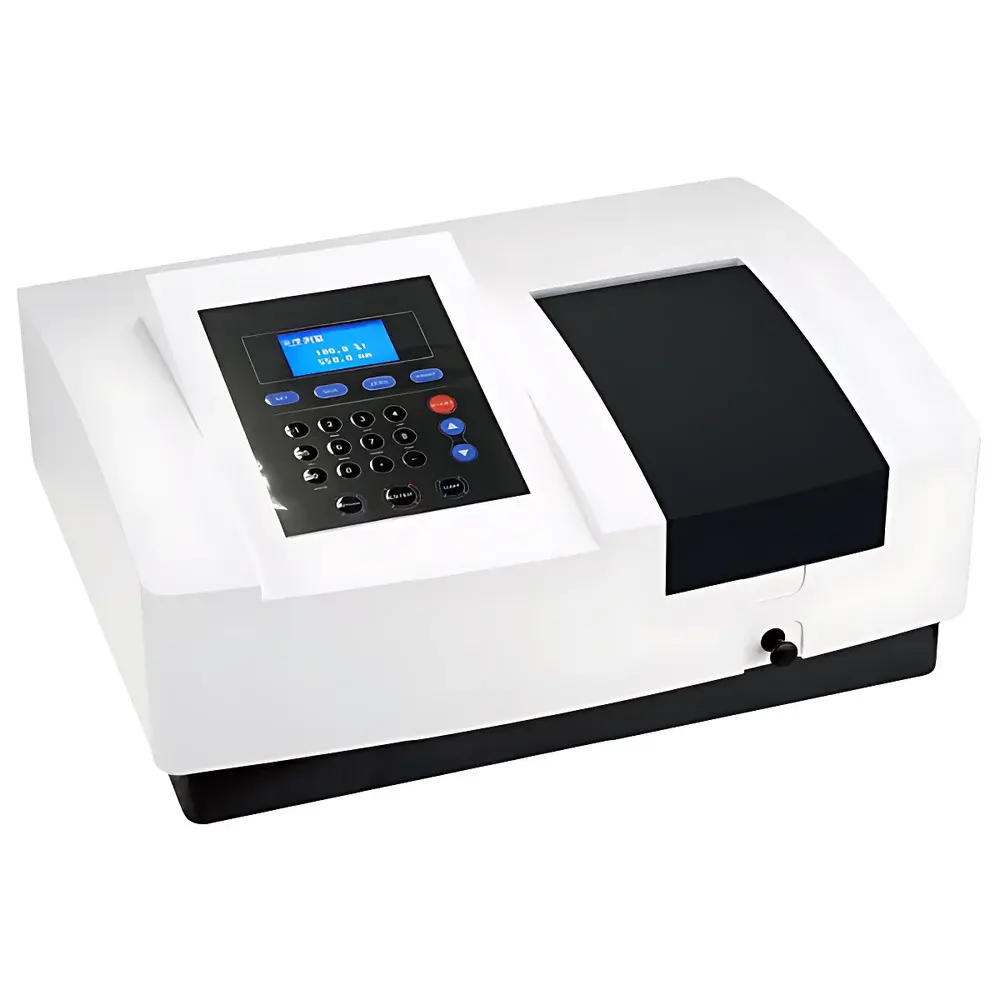
Yoke 7230G Scanning Visible Spectrophotometer
| Brand | Yoke |
|---|---|
| Origin | Shanghai, China |
| Manufacturer Type | Direct Manufacturer |
| Product Origin | Domestic (China) |
| Model | 7230G |
| Price Range | USD 700–1,400 |
| Optical System | Double-Beam Ratio Detection |
| Detector Type | Silicon Photocell |
| Wavelength Range | 320–1100 nm |
| Wavelength Accuracy | ±1 nm |
| Spectral Bandwidth | 4 nm |
| Stray Light | ≤0.1%T @ 360 nm |
| Wavelength Repeatability | ±0.5 nm |
| Photometric Accuracy | ±0.5%T |
| Photometric Repeatability | ±0.2%T |
| Photometric Range | 0–200%T, −0.301–3.000A |
| Baseline Linearity | ±0.004 A |
| Stability | ±0.002 A/h @ 500 nm |
| Display | 128×64 Dot-Matrix LCD |
| Wavelength Drive | Motorized Auto-Scanning |
| Light Source | Imported Tungsten Halogen Lamp |
| Net Weight | 12 kg |
| Software Compatibility | YOKE 3.0 PC Control Software (Optional) |
Overview
The Yoke 7230G Scanning Visible Spectrophotometer is a double-beam ratio-detection instrument engineered for routine quantitative and qualitative analysis in the visible and near-UV spectral region (320–1100 nm). It operates on the principle of Beer–Lambert law-based absorbance measurement, utilizing a precision motorized monochromator with a high-efficiency 1200 lines/mm holographic grating to deliver stable, reproducible spectral scans. Designed for laboratory environments where reliability, ease of operation, and regulatory traceability are essential—including QC labs in pharmaceuticals, food & beverage, environmental testing, and academic teaching—the 7230G integrates robust optical architecture with embedded 32-bit ARM11 microcontroller processing (533 MHz), enabling real-time data acquisition, baseline correction, and multi-point calibration without external computing dependency.
Key Features
- Double-beam optical design with real-time reference beam compensation ensures high photometric stability and minimizes drift from lamp intensity fluctuations or ambient temperature variation.
- Sealed monochromator housing with SiO₂-coated optical surfaces prevents oxidation and contamination, extending optical lifetime and maintaining long-term wavelength fidelity.
- Motorized automatic wavelength scanning across 320–1100 nm with ±1 nm accuracy and 0.5 nm repeatability—calibrated via internal reference peaks and user-accessible wavelength validation routines.
- Wide sample compartment accommodating cuvettes from 5 mm to 100 mm pathlength, supporting standard quartz, glass, and plastic cells for diverse assay configurations.
- Onboard 128×64 dot-matrix LCD display with intuitive menu navigation; capable of storing up to 200 absorbance/transmittance datasets and 100 user-named calibration curves directly on device memory.
- USB 2.0 interface compliant with USB CDC class protocols, enabling plug-and-play connectivity with Windows-based PCs for extended data logging, report generation, and audit-trail-enabled operation when used with YOKE 3.0 software.
- High-stability tungsten-halogen lamp with optimized thermal management delivers consistent radiant output over ≥2,000 hours of operational life.
Sample Compatibility & Compliance
The 7230G accepts standard 10 mm, 20 mm, 50 mm, and 100 mm rectangular cuvettes—compatible with aqueous, organic, and mildly corrosive solutions. Its optical path design accommodates both transmission and reflectance measurements (with optional accessories). The instrument meets core performance criteria aligned with ISO 9001 manufacturing controls and conforms to ASTM E275–22 (Standard Practices for Describing and Measuring Performance of UV-Visible Spectrophotometers). While not FDA 21 CFR Part 11–certified out-of-the-box, YOKE 3.0 software supports configurable electronic signatures, audit trails, and user access levels—enabling laboratories to implement validated workflows compliant with GLP and GMP documentation requirements.
Software & Data Management
YOKE 3.0 is a Windows-native application offering full remote control, spectral scanning, kinetic time-course monitoring, multi-wavelength quantitation, and standard curve interpolation (linear, quadratic, and cubic fitting). Data export is supported in CSV, TXT, and XML formats—compatible with LIMS integration and third-party statistical tools (e.g., JMP, Minitab, Python pandas). All instrument events—including wavelength changes, zeroing, calibration updates, and measurement triggers—are timestamped and logged locally within the software. Optional password-protected user roles (Operator, Supervisor, Administrator) support segregation of duties in regulated environments.
Applications
- Quantitative determination of analytes in water quality testing (e.g., nitrate, phosphate, COD, iron).
- Concentration verification of dyes, pigments, and active pharmaceutical ingredients (APIs) in formulation development.
- Enzyme kinetics assays (e.g., NADH/NADPH oxidation at 340 nm) under controlled temperature conditions (when paired with external Peltier cuvette holders).
- Educational use in undergraduate chemistry and biochemistry laboratories for spectral identification, Beer’s law validation, and method validation exercises.
- Quality control of industrial chemicals, coatings, and cosmetic raw materials via colorimetric index calculation (e.g., APHA, Gardner, Pt-Co).
FAQ
Is the 7230G suitable for UV-range measurements below 320 nm?
No. The instrument’s optical components—including the grating coating, detector responsivity, and lamp output—are optimized for 320–1100 nm. For true UV measurements down to 190 nm, a dedicated UV-Vis spectrophotometer with deuterium lamp and fused silica optics is required.
Can the onboard memory be expanded via SD card or external storage?
No. Internal flash memory is fixed at 2 MB and supports only the specified 200 datasets and 100 curves. Persistent archiving requires periodic transfer via USB to external systems.
Does the instrument support RS-232 or Ethernet communication?
No. Communication is exclusively via USB 2.0 (virtual COM port emulation); no legacy serial or network interfaces are provided.
What maintenance is required for long-term wavelength accuracy?
Annual verification using NIST-traceable holmium oxide or didymium filters is recommended. The sealed monochromator eliminates routine alignment but does not eliminate need for periodic photometric and stray-light verification per ISO/IEC 17025 guidelines.
Is YOKE 3.0 software validated for use in FDA-regulated environments?
The software is supplied as “validated-ready”: it includes features necessary for 21 CFR Part 11 compliance (audit trail, e-signature, role-based access), but final validation—including IQ/OQ/PQ protocols—must be performed by the end-user’s QA department per organizational SOPs.




