
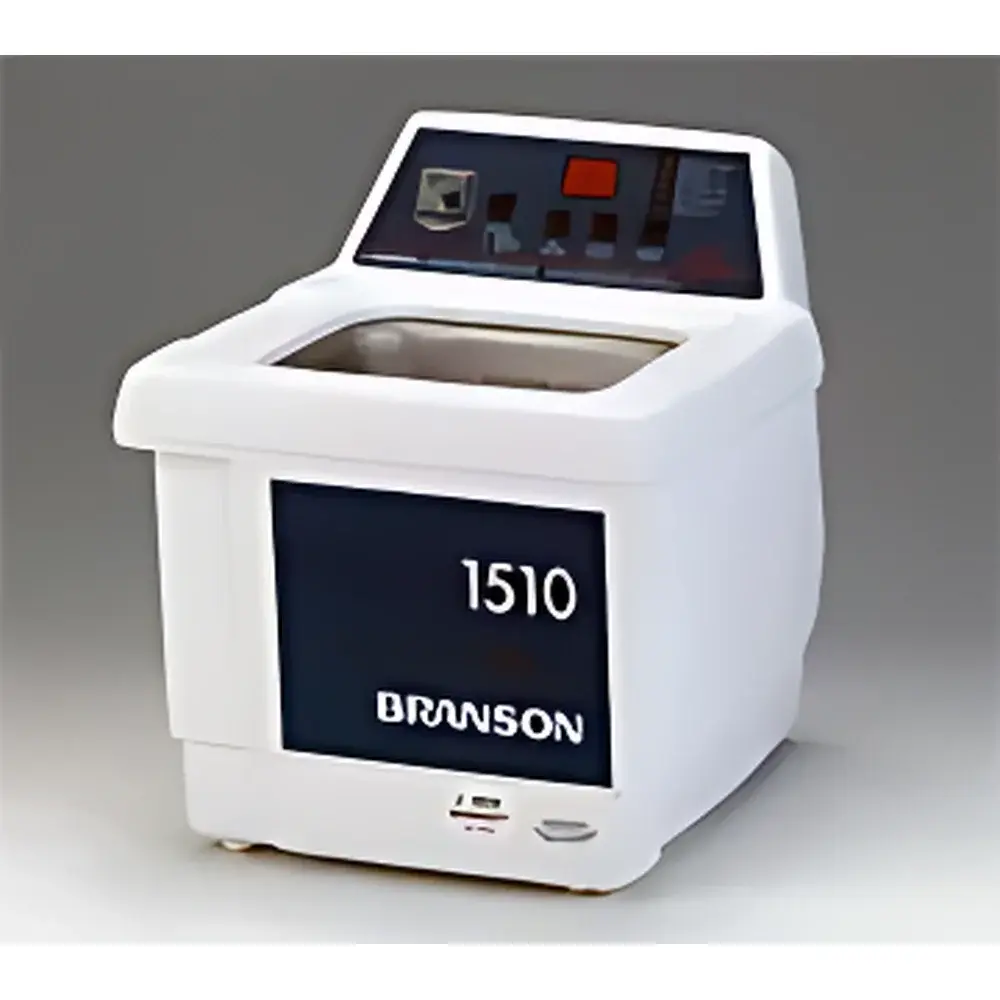
Brookfield B1510E-DTH Ultrasonic Cleaner
| Origin | USA |
|---|---|
| Manufacturer Type | Authorized Distributor |
| Origin Category | Imported |
| Model | B1510E-DTH |
| Price | Upon Request |
| Tank Volume | 1.9 L |
| Chamber Dimensions | 152 × 139 × 101 mm |
| Ultrasonic Frequency | 40 kHz |
| Heating Range | 0–70 °C |
| Timer Range | 1–99 min (digital) |
| Heater Power | 63 W |
| Total Power | 143 W |
| Input Voltage | 220 V, 50/60 Hz |
| Construction Material | Polypropylene (PP) housing |
| Transducer Type | Langevin-type metal-ceramic |
| Mounting | Adhesive-bonded transducers |
| Circuit Orientation | Vertical PCB layout |
| Control Interface | Top-mounted digital panel with dual temperature display (actual & setpoint) |
| Lid Function | Hinged acoustic lid doubles as drip tray |
Overview
The Brookfield B1510E-DTH Ultrasonic Cleaner is an engineered solution for precision laboratory cleaning tasks requiring consistent cavitation energy delivery, thermal stability, and operational reliability. Based on the fundamental principle of ultrasonic cavitation—where high-frequency sound waves (40 kHz) generate microscopic vacuum bubbles in a liquid medium that collapse violently upon reaching resonance—the instrument delivers controlled mechanical energy to dislodge particulate contaminants, organic residues, and biofilm from delicate surfaces without abrasion or solvent-intensive protocols. Designed for routine use in analytical labs, QC/QA environments, and research facilities, this unit integrates digital temperature regulation, programmable timing, and degassing functionality to support standardized cleaning workflows aligned with ISO 13485, ASTM D2603, and USP guidelines for cleaning validation.
Key Features
- Digital microprocessor-controlled interface with real-time dual-display: simultaneous readout of actual bath temperature and user-set target temperature, enabling precise thermal management within ±0.5 °C accuracy across the 0–70 °C range.
- Langevin-type transducer assembly—comprising a metallic front mass bonded to a piezoceramic stack—mounted via high-strength adhesive directly to the tank bottom. This configuration ensures uniform acoustic coupling, minimizes mechanical damping, and extends transducer service life beyond 10,000 operating hours under standard duty cycles.
- Optimized spherical wave propagation architecture, developed from foundational work by early ultrasonic instrumentation pioneers, yields homogeneous energy distribution throughout the 1.9 L cleaning chamber (152 × 139 × 101 mm internal dimensions), eliminating dead zones and improving reproducibility between runs.
- Sweep-frequency modulation (2–5 kHz bandwidth around 40 kHz center frequency) mitigates standing wave formation and node/antinode localization, sustaining continuous cavitation intensity even during extended operation (1–99 min programmable duration).
- Chemically resistant polypropylene (PP) housing rated for exposure to dilute acids (e.g., 10% HNO₃), bases (e.g., 5% NaOH), and common solvents (e.g., isopropanol, acetone), ensuring long-term structural integrity in multi-chemistry lab environments.
- Vertical PCB orientation with conformal coating provides enhanced protection against condensation ingress and humidity-induced corrosion—critical for sustained performance in humidified lab spaces or near steam sterilization areas.
- Top-mounted control panel positioned above the tank rim prevents liquid splash penetration; tactile, overmolded power switch with IP65-rated sealing guarantees reliable actuation over >100,000 cycles.
- Hinged acoustic lid functions both as noise-dampening enclosure (reducing ambient sound pressure by ≥12 dB(A)) and removable drip tray for post-cycle component handling.
Sample Compatibility & Compliance
The B1510E-DTH accommodates a broad spectrum of sample geometries and materials—including glassware (vials, cuvettes, pipette tips), metal instruments (surgical tools, forceps), ceramic substrates, and polymer-based microfluidic chips—without risk of surface pitting or dimensional distortion. Its fixed 40 kHz operating frequency is empirically validated for removal of submicron particulates (<1 µm), proteinaceous films, and dried salt deposits from non-porous surfaces. The unit complies with IEC 61000-6-3 (EMC emissions), IEC 61010-1 (safety for laboratory equipment), and supports GLP/GMP documentation requirements through deterministic timer logging and temperature traceability. Optional accessories—including stainless steel baskets, beaker holders, and ultrasonic cleaning gel inserts—are available to extend compatibility to irregularly shaped or fragile items.
Software & Data Management
While the B1510E-DTH operates as a standalone analog-digital hybrid system without embedded network connectivity, its programmable parameters (time, temperature, sweep profile) are fully auditable via front-panel event history (last 50 cycle logs stored non-volatile memory). For integration into regulated environments, optional RS-232 or USB-to-serial adapters enable connection to LIMS or ELN platforms, supporting 21 CFR Part 11-compliant electronic record generation when paired with validated third-party acquisition software. All firmware updates adhere to ISO/IEC 17025 traceability protocols, with version stamps and calibration verification timestamps retained in device memory.
Applications
- Pre-analytical preparation of HPLC and GC vials to eliminate carryover contamination
- Decontamination of electron microscopy grids and TEM specimen holders prior to imaging
- Cleaning of optical components (lenses, prisms, fiber optic connectors) without micro-scratching
- Removal of flux residues from printed circuit boards (PCBs) in electronics R&D labs
- Depyrogenation of stainless steel surgical instruments in hospital central sterile supply departments (CSSD)
- Surface activation of PDMS microchannels prior to plasma bonding in microfluidics fabrication
FAQ
Is the B1510E-DTH suitable for cleaning delicate MEMS devices?
Yes—its stable 40 kHz output and sweep modulation minimize localized energy concentration, reducing the risk of stiction or structural fatigue in micromachined silicon components when operated in low-power deionized water baths.
Does it meet FDA requirements for cleaning validation in pharmaceutical labs?
The unit supports validation through documented parameter consistency (temperature uniformity mapping per ASTM E2297, cavitation intensity profiling per ISO 13007), and its digital logging capability enables audit-ready records when integrated with compliant data systems.
Can it be used with flammable solvents?
No—this model is rated for aqueous and water-miscible solutions only. Use of flammable solvents requires Class I Division 1 explosion-proof certified units, which are not part of the B1510E-DTH series.
What is the expected transducer lifetime under continuous daily use?
Under typical laboratory conditions (≤4 hrs/day, 5 days/week, ambient temperature ≤30 °C), the Langevin transducers maintain ≥95% nominal output amplitude for ≥8 years, verified via annual acoustic power calibration using calorimetric methods.
Is the PP tank compatible with sodium hypochlorite solutions?
Yes—polypropylene exhibits excellent resistance to diluted bleach (up to 5% NaOCl, pH 7–9); however, prolonged exposure (>2 hr) at elevated temperatures (>50 °C) may accelerate oxidative degradation and is not recommended.



