
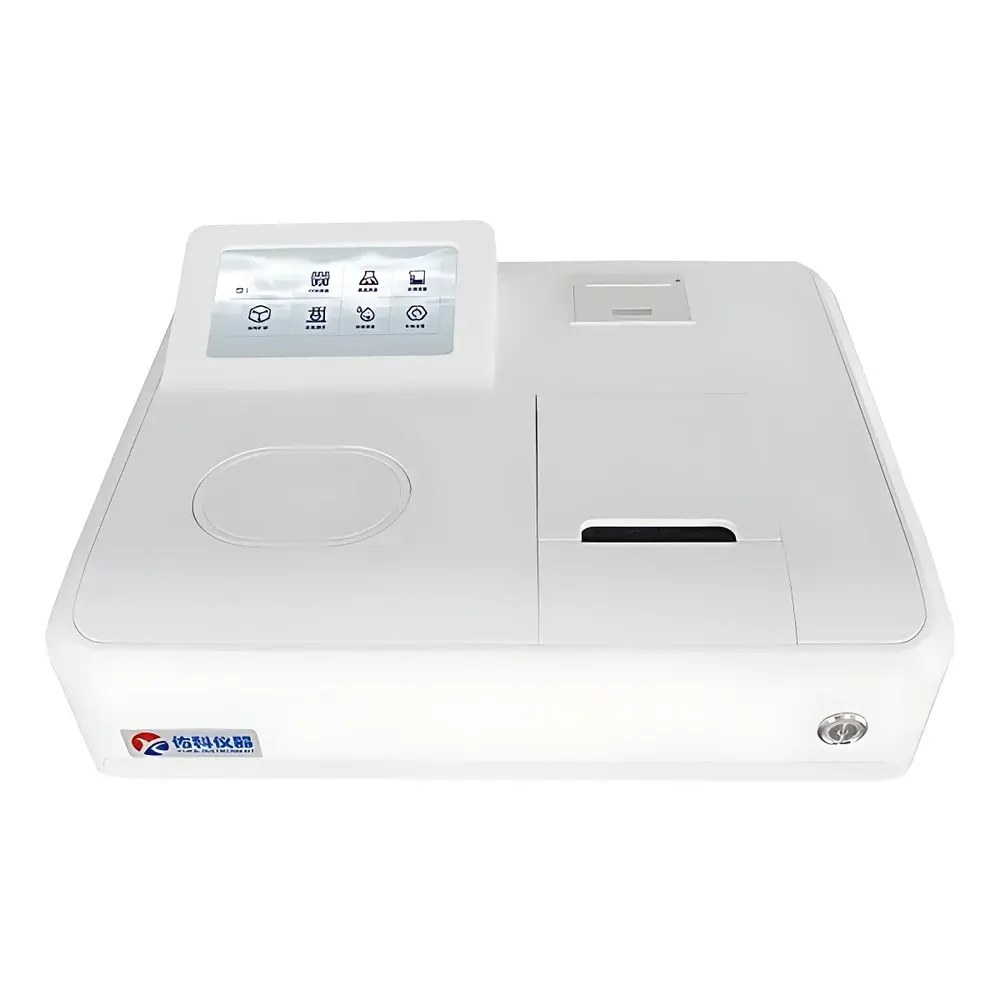
Yoke WZS-188 High-Precision Turbidimeter
| Brand | Yoke |
|---|---|
| Origin | Shanghai, China |
| Manufacturer Type | Direct Manufacturer |
| Instrument Type | Benchtop Laboratory Turbidimeter |
| Model | WZS-188 |
| Measurement Range | 0–4000 NTU |
| Accuracy | ±8% |
| Detection Principle | Nephelometric (90° Scattered Light) Method |
| Display | 5.6-inch Color Touchscreen GUI |
| Data Storage | ≥5000 Records |
| Calibration | 9-Point Calibration with 4-Range Auto-Switching |
| Compliance Standards | GB/T 13200–1991, HJ 1075–2019, GB/T 5750.4–2006 |
| Light Source | Long-Life Cold LED (≥100,000 h), Narrow-Band Interference Filter |
| Connectivity | USB Port, RS-232 Serial Interface |
| Onboard Memory | 512 MB (ARM9 Core) |
Overview
The Yoke WZS-188 High-Precision Turbidimeter is a benchtop laboratory instrument engineered for reliable, repeatable turbidity measurement in drinking water, wastewater, environmental monitoring, and process control applications. It operates on the nephelometric principle—measuring the intensity of light scattered at a 90° angle by suspended particles in aqueous samples—ensuring compliance with internationally recognized optical detection methodologies. Designed to meet the functional requirements of ISO 7027-1:2016 (optical properties of turbidimeters) and aligned with U.S. EPA Method 180.1 and Standard Methods 2130B, the WZS-188 delivers traceable, standardized turbidity quantification across four auto-ranging segments (0–10, 10–100, 100–1000, and 1000–4000 NTU), minimizing manual range selection errors and optimizing signal-to-noise ratio across its full 0–4000 NTU dynamic range.
Key Features
- 5.6-inch capacitive color touchscreen with intuitive graphical user interface (GUI), supporting multi-language navigation and context-sensitive operation prompts
- Narrow-band interference filter system coupled with a high-stability cold LED light source (rated lifetime ≥100,000 hours), ensuring spectral consistency and long-term photometric stability
- Four-segment automatic range switching with nine-point calibration capability—enabling precise interpolation across low-, mid-, and high-turbidity domains
- Onboard ARM9 processor with 512 MB flash memory, enabling rapid data processing, real-time curve fitting, and responsive touchscreen interaction
- Built-in thermal printer for immediate hardcopy output of current measurements, calibration reports, and stored datasets—supporting GLP-compliant documentation workflows
- Integrated USB host port and RS-232 serial interface for bidirectional data exchange with LIMS, external PCs, or networked lab infrastructure
- Expandable calibration library: preloaded with five factory-certified calibration curves and support for up to 195 user-defined curves—including segmented K-factor adjustment for non-linear sample matrices
Sample Compatibility & Compliance
The WZS-188 is validated for use with clear to highly turbid aqueous samples, including potable water, surface water, secondary effluent, membrane filtrate, and coagulation/flocculation process streams. Its optical path design accommodates standard 25-mm round glass cuvettes (10-mm path length), and optional quartz or disposable plastic cuvettes may be employed depending on sample chemistry and contamination risk. All turbidity measurements adhere to national regulatory frameworks: GB/T 13200–1991 (Chinese national standard for turbidity determination), HJ 1075–2019 (environmental monitoring method for turbidity in surface water and wastewater), and GB/T 5750.4–2006 (standard methods for drinking water quality analysis). While not certified to ISO/IEC 17025 for accredited testing, the instrument supports audit-ready data logging essential for internal QA/QC, GMP-aligned water system validation, and municipal utility reporting.
Software & Data Management
Data integrity is maintained through timestamped storage of ≥5000 measurement records, each containing sample ID, operator ID (configurable), date/time stamp, NTU value, measurement range, calibration status, and cuvette ID (if tagged). The embedded firmware implements write-once, append-only storage logic to prevent accidental overwriting. USB mass storage mode allows export of CSV-formatted datasets for post-processing in Excel, MATLAB, or statistical analysis platforms. Firmware updates are delivered via USB stick, preserving configuration settings and calibration history. Audit trail functionality—though not full 21 CFR Part 11 compliant—records all critical events (e.g., calibration initiation, range change, zero adjustment) with operator attribution and timestamps, satisfying basic GLP documentation requirements for non-regulated laboratories.
Applications
- Drinking water treatment: verification of filtration efficiency, monitoring of clarifier effluent, and distribution system integrity checks
- Wastewater management: assessment of activated sludge settleability, membrane bioreactor (MBR) permeate clarity, and tertiary disinfection readiness
- Environmental field labs: rapid turbidity screening in rivers, lakes, and reservoirs per HJ 1075–2019 protocols
- Pharmaceutical water systems: routine monitoring of purified water (PW) and water for injection (WFI) loop returns where particulate load correlates with biofilm risk
- Educational laboratories: demonstration of scattering theory, calibration methodology, and ISO 7027 optical alignment principles
FAQ
What turbidity standards are compatible with the WZS-188?
Formazin-based primary standards (e.g., 10, 100, 400, 800, and 2000 NTU) and AMCO AEPA-1 polymer standards are fully supported. The instrument ships with long-life U.S.-sourced formazin reference solutions traceable to NIST SRM 2102.
Does the WZS-188 support automatic temperature compensation?
No—temperature correction is not applied automatically. Users must record ambient and sample temperature separately; compensation calculations (if required) follow ISO 7027 Annex B guidelines and are performed externally.
Can the WZS-188 measure turbidity in colored or highly absorbing samples?
Yes, but with limitations. The 90° nephelometric geometry minimizes absorption interference relative to transmittance-based methods. However, for samples with strong absorbance at 860 nm (the default LED wavelength), users should verify linearity using matrix-matched standards.
Is the built-in printer capable of generating calibration certificates?
The thermal printer outputs raw measurement logs and calibration verification reports—not formal certificates. For regulatory submissions, exported CSV data must be compiled into validated templates per organizational SOP.
How often does the instrument require recalibration?
Calibration frequency follows risk-based assessment per ISO/IEC 17025 Clause 7.7. For routine QC use, daily zero and span verification is recommended; full 9-point calibration every 7 days or after maintenance, transport, or exposure to extreme environmental conditions.





