
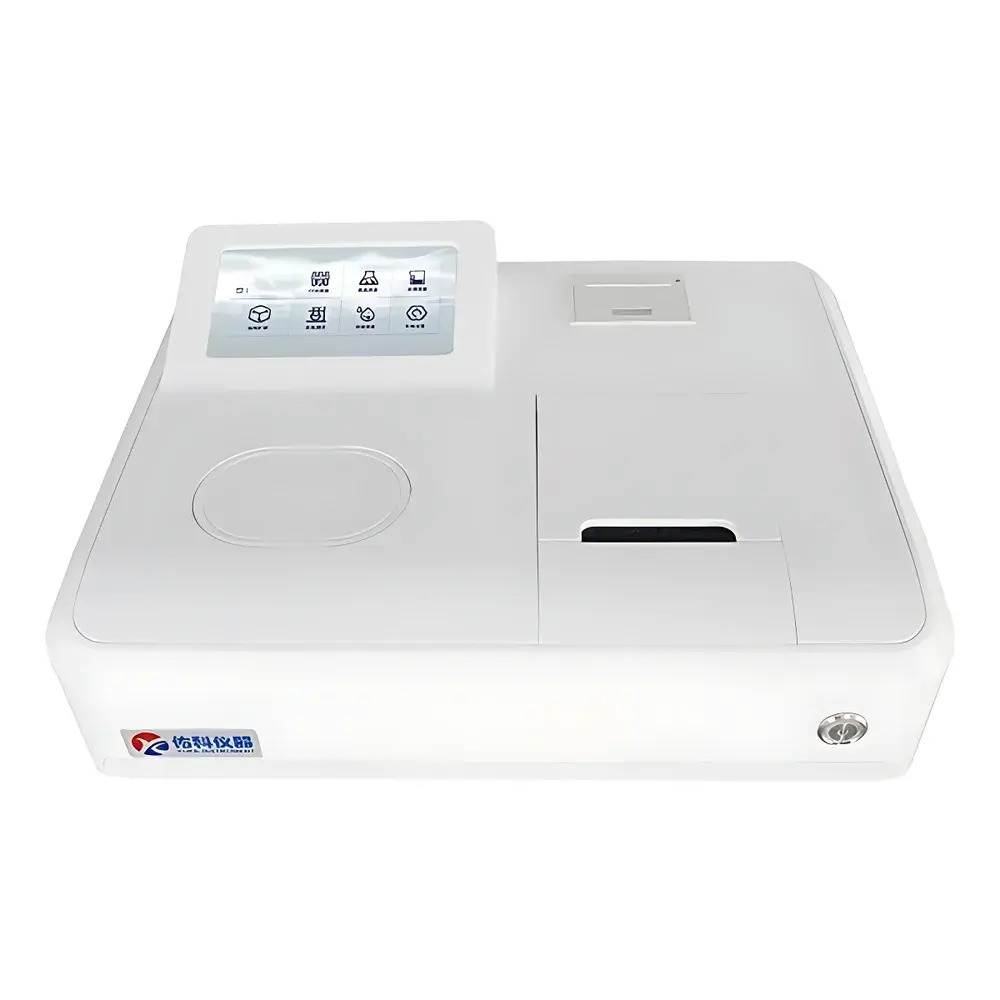
Yoke ITS2004 Multi-Parameter Water Quality Analyzer
| Brand | Yoke |
|---|---|
| Origin | Shanghai, China |
| Manufacturer Type | Direct Manufacturer |
| Product Category | Domestic (China-Made) |
| Model | ITS2004 |
| Price Range | USD 1,400–4,200 (est.) |
| Instrument Type | Benchtop Laboratory Water Quality Analyzer |
| Measurable Parameters | COD, Ammonia-N, Total Phosphorus, Total Nitrogen |
| Wavelength Accuracy | ±0.5 nm |
| Display | 5.6-inch Color Touchscreen GUI |
| Data Storage | ≥5,000 records |
| Preloaded Calibration Curves | 5 factory curves + 195 user-expandable curves |
| Light Source | Cold LED with Narrow-Band Interference Filters |
| Light Source Lifetime | ≥100,000 hours |
| Processor | ARM9 core |
| Internal Memory | 512 MB |
| Data Interfaces | USB 2.0, RS-232 |
| Measurement Method Compliance | GB/T 11914–1989 (COD), HJ 535–2009 (NH₃-N), GB/T 11893–1989 (TP), HJ 636–2012 (TN) |
| Reagent Compatibility | Lab-YY Pre-formulated Digestion & Detection Kits |
Overview
The Yoke ITS2004 Multi-Parameter Water Quality Analyzer is a benchtop spectrophotometric analyzer engineered for routine, high-throughput quantification of four critical water quality indicators—Chemical Oxygen Demand (COD), Ammonia-Nitrogen (NH₃-N), Total Phosphorus (TP), and Total Nitrogen (TN)—in municipal wastewater, surface water, industrial effluent, and drinking water treatment laboratories. It operates on the principle of narrow-band interference filter-based absorbance photometry, utilizing cold LED light sources across defined spectral bands (e.g., 620 nm for COD, 420 nm for NH₃-N, 700 nm for TP, and 220/275 nm dual-wavelength for TN). The instrument implements standardized Chinese environmental monitoring methods—including GB/T 11914–1989 (COD), HJ 535–2009 (NH₃-N), GB/T 11893–1989 (TP), and HJ 636–2012 (TN)—ensuring methodological alignment with national regulatory reporting requirements. Its optical architecture minimizes stray light and thermal drift, enabling stable baseline performance over extended operation cycles without recalibration between daily batches.
Key Features
- 5.6-inch capacitive color touchscreen with intuitive graphical user interface (GUI), supporting multi-language prompts and context-sensitive operation guidance.
- Dual-range measurement capability per parameter: e.g., COD (10–100 mg/L low range; 100–1000 mg/L high range); NH₃-N (0.05–100 mg/L, segmented calibration); TP (0.01–15 mg/L); TN (0–80 mg/L).
- High-precision optical system featuring ±0.5 nm wavelength accuracy and temperature-compensated photodetectors to ensure inter-day reproducibility ≤3% RSD (n=10, mid-range standards).
- Onboard thermal printer enabling immediate hardcopy output of current measurements, stored datasets, or calibration reports—no external peripherals required.
- ARM9-based embedded control architecture with 512 MB internal memory, supporting ≥5,000 data records with timestamp, operator ID, and method ID metadata.
- Expandable calibration library: 5 pre-validated factory curves plus up to 195 user-defined curves, each supporting variable K-factors and polynomial fitting (linear, quadratic, cubic).
- Cold LED illumination with >100,000-hour lifetime and minimal heat generation—eliminating thermal lensing effects in cuvette compartments and enabling uninterrupted 8-hour shift operation.
- USB 2.0 host port for direct export of CSV-formatted datasets to flash drives; RS-232 serial interface for integration into LIMS or SCADA environments via Modbus RTU protocol.
Sample Compatibility & Compliance
The ITS2004 accepts standard 10 mm, 20 mm, or 30 mm rectangular quartz or high-transmittance glass cuvettes (supplied with optional cuvette holder kit). Sample volume requirement is 2.5–5.0 mL per test, compatible with both manual pipetting and automated liquid handlers. All detection methodologies comply with China’s Ministry of Ecology and Environment (MEE) standard methods and are technically equivalent to ISO 6060 (COD), ISO 7150-1 (NH₃-N), ISO 6878 (TP), and ISO 11905-1 (TN) for cross-border data acceptability. While not certified under FDA 21 CFR Part 11 or EU Annex 11, the system supports GLP-aligned workflows through audit-trail-capable data logging (when used with external time-stamped storage media) and full traceability of curve edits, reagent lot numbers, and operator entries.
Software & Data Management
Data acquisition, calibration management, and report generation are handled entirely onboard—no PC dependency required. Each measurement record stores sample ID, date/time stamp, selected method, measured absorbance, calculated concentration, curve ID, and operator code. Exported CSV files include column headers compliant with common laboratory informatics systems (e.g., LabWare LIMS, Thermo Fisher SampleManager). User-defined curve creation supports manual entry of standard concentrations and corresponding absorbances, with real-time residual error display during fitting. Firmware updates are delivered via USB stick and include version-controlled changelogs traceable to MEE validation guidelines.
Applications
The ITS2004 serves as a primary analytical tool in municipal wastewater treatment plants (WWTPs) for daily compliance monitoring against discharge limits (e.g., GB 18918–2002); in environmental monitoring stations conducting surface water quality assessment (e.g., “National Surface Water Quality Assessment Scheme”); in food & beverage and pharmaceutical manufacturing facilities performing influent/effluent QC; and in academic and research laboratories conducting nutrient cycling studies or method validation exercises. Its modular reagent compatibility with Lab-YY pre-dosed vials reduces hands-on time by >60% versus classical wet chemistry protocols—particularly valuable in high-sample-volume settings where throughput and analyst safety are prioritized.
FAQ
Does the ITS2004 support remote data upload to cloud-based platforms?
No—the device lacks built-in Wi-Fi or Ethernet connectivity. Data transfer is limited to USB mass storage export or RS-232 serial transmission to locally connected PCs or PLCs.
Can third-party reagents be used with this instrument?
Yes, provided they conform to the same digestion chemistry and spectral response profiles specified in the referenced national standards. However, Yoke recommends Lab-YY kits to maintain calibration integrity and minimize inter-kit variability.
Is firmware validation documentation available for GMP-regulated labs?
Yoke provides IQ/OQ documentation templates upon request, but formal PQ execution must be performed by the end-user lab per ISO/IEC 17025 or CNAS-CL01 requirements.
What is the recommended maintenance interval for optical alignment verification?
Optical alignment is factory-set and non-adjustable; users should perform blank absorbance verification weekly using deionized water and conduct full system performance checks (per Appendix A of Yoke Service Manual Rev. 3.2) every six months.
How does the ITS2004 handle turbid or colored samples?
For highly turbid samples (>50 NTU), centrifugation or filtration (0.45 µm membrane) is required prior to analysis. For colored matrices, the TN module applies dual-wavelength correction (220 nm – 2×275 nm) to compensate for background absorbance interference.







