
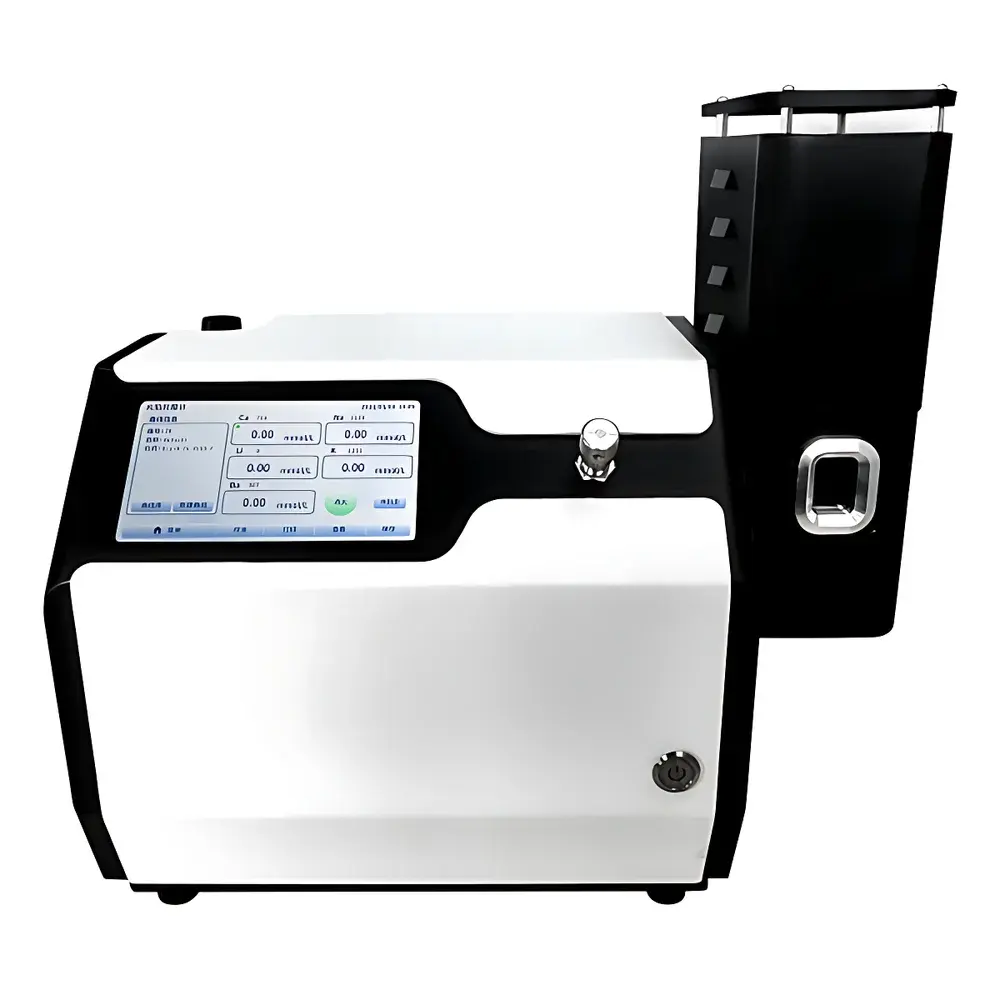
Yoke FP6400 Multi-Element Flame Photometer
| Brand | Yoke |
|---|---|
| Origin | Shanghai, China |
| Manufacturer | Yoke Instrument Co., Ltd. |
| Model | FP6400 |
| Detection Limits | K ≤ 0.004 mmol/L |
| Response Time | ≤ 8 s |
| Repeatability | ≤ 3% |
| Detection Elements | K, Na (simultaneous), Li, Ca |
| Light Source | Liquefied Petroleum Gas (LPG) flame |
| Detector | Silicon photodiode |
| Wavelength Selection | Interference filters |
| Calibration Method | Linear regression |
| Display | 7-inch capacitive touchscreen LCD |
| Data Export | USB flash drive & USB port |
| Safety Features | Flame-out detection, gas leak alarm |
| Connectivity | Cloud-enabled remote monitoring & data sync |
Overview
The Yoke FP6400 Multi-Element Flame Photometer is a benchtop atomic emission spectrometer engineered for quantitative analysis of alkali and alkaline earth metals—specifically potassium (K), sodium (Na), lithium (Li), and calcium (Ca)—in aqueous solutions. It operates on the principle of flame atomic emission spectroscopy (FAES): sample aerosols are introduced into a stable, stoichiometric LPG–air flame, where thermal energy excites valence electrons of target metal ions. Upon relaxation, characteristic wavelength photons are emitted and isolated via interference filters before detection by a calibrated silicon photodiode. The instrument’s optical path and flame geometry are optimized to minimize spectral interferences and matrix effects, ensuring high specificity for K and Na in simultaneous dual-channel measurement mode. Designed for routine clinical, agricultural, food safety, and industrial QC laboratories, the FP6400 delivers trace-level sensitivity (K LOD ≤ 0.004 mmol/L), rapid response (<8 s per sample), and analytical repeatability ≤3% RSD under GLP-compliant operating conditions.
Key Features
- Simultaneous dual-channel detection of potassium and sodium with independent signal processing and real-time ratio calculation
- Expandable multi-element capability supporting lithium and calcium quantification via dedicated filter modules and calibration protocols
- 7-inch high-resolution capacitive touchscreen interface with intuitive icon-driven navigation and on-screen calibration wizard
- Integrated safety architecture including automatic flame extinction detection, LPG leak sensing with audible/visual alarm, and fail-safe gas shutoff logic
- On-board linear regression engine for automatic calibration curve generation, slope/intercept reporting, and correlation coefficient (R²) validation
- USB host port for direct export of raw intensity values, calibration parameters, and audit-ready CSV reports to external storage devices
- Cloud connectivity via embedded Ethernet/Wi-Fi module enabling remote firmware updates, centralized data logging, and instrument status monitoring through Yoke LabLink™ platform
- Compact footprint (W×D×H: 420 × 360 × 310 mm) and modular gas-air delivery design compatible with standard lab-grade air compressors and LPG cylinders
Sample Compatibility & Compliance
The FP6400 accepts clarified aqueous samples—including serum, plasma, urine, plant digests, food extracts, and industrial process waters—with minimal pretreatment (e.g., dilution or acidification to pH <2). Sample introduction uses a precision nebulizer and impact bead desolvation system to ensure consistent aerosol generation and reduce salt deposition. The instrument meets ISO 9001 manufacturing standards and supports compliance with clinical laboratory regulatory frameworks including CLIA, CAP, and ISO 15189 when operated within validated SOPs. Its calibration traceability aligns with NIST SRM 956 (Sodium Chloride) and custom-certified multi-element standards. All operational logs—including calibration events, user actions, and error codes—are time-stamped and stored locally for ≥12 months, satisfying basic FDA 21 CFR Part 11 data integrity requirements for non-GMP environments.
Software & Data Management
Instrument control and data acquisition are managed via embedded Linux-based firmware with a responsive GUI. Raw analog signals from the photodiode are digitized at 16-bit resolution and processed using adaptive baseline correction and peak-hold integration algorithms. Calibration curves are stored as encrypted binary files with metadata (date, operator ID, standard lot number). Data export supports comma-separated values (CSV) with column headers compliant with LIMS ingestion protocols. Optional PC software (Yoke DataStudio v3.2) provides advanced features: batch report generation with customizable templates, statistical process control (SPC) charting, outlier detection via Grubbs’ test, and automated PDF certificate generation per ISO/IEC 17025 Annex A.5 guidelines.
Applications
- Clinical Diagnostics: Quantitative monitoring of serum K⁺/Na⁺ electrolyte balance and therapeutic drug monitoring (TDM) of lithium carbonate in psychiatric patients
- Agricultural Science: Soil extract analysis for exchangeable K⁺ and Ca²⁺ to inform fertilizer formulation and cation exchange capacity (CEC) modeling
- Food & Beverage Quality Control: Sodium content verification in processed foods (per FDA nutrition labeling regulations) and potassium profiling in dairy products and fruit juices
- Pharmaceutical Manufacturing: Excipient purity testing (e.g., NaCl residual quantification in lyophilized formulations) and water-for-injection (WFI) conductivity correlation studies
- Environmental Monitoring: Surface water and wastewater analysis for alkali metal contamination following ASTM D1293 and ISO 10523 protocols
FAQ
What gases are required for operation?
The FP6400 uses liquefied petroleum gas (LPG) as fuel and compressed, oil-free air (≥0.6 MPa, dew point ≤−20°C) as oxidant. A JYT-0.6 left-hand thread pressure regulator is mandatory for LPG cylinder connection.
Can the instrument be integrated into a LIMS environment?
Yes—via USB virtual COM port or Ethernet TCP/IP socket, supporting ASTM E1384 and HL7-compatible data streaming when paired with Yoke DataStudio middleware.
Is lithium quantification linear across therapeutic ranges?
Calibration linearity (r² ≥ 0.999) is verified from 0.2 to 1.2 mmol/L Li⁺ using matrix-matched standards; recovery in human serum is 97–103% per CLSI EP17-A2 protocol.
How often does the nebulizer require maintenance?
Under normal use (≤50 samples/day), inspect and clean the nebulizer capillary weekly with 10% nitric acid; replace the impact bead every 6 months or after 2,000 injections.
Does the system support 21 CFR Part 11 compliance?
The base configuration provides electronic signature readiness and audit trail logging; full Part 11 compliance requires optional Yoke SecureAccess™ license enabling role-based access control, biometric login, and digital certificate signing.





