
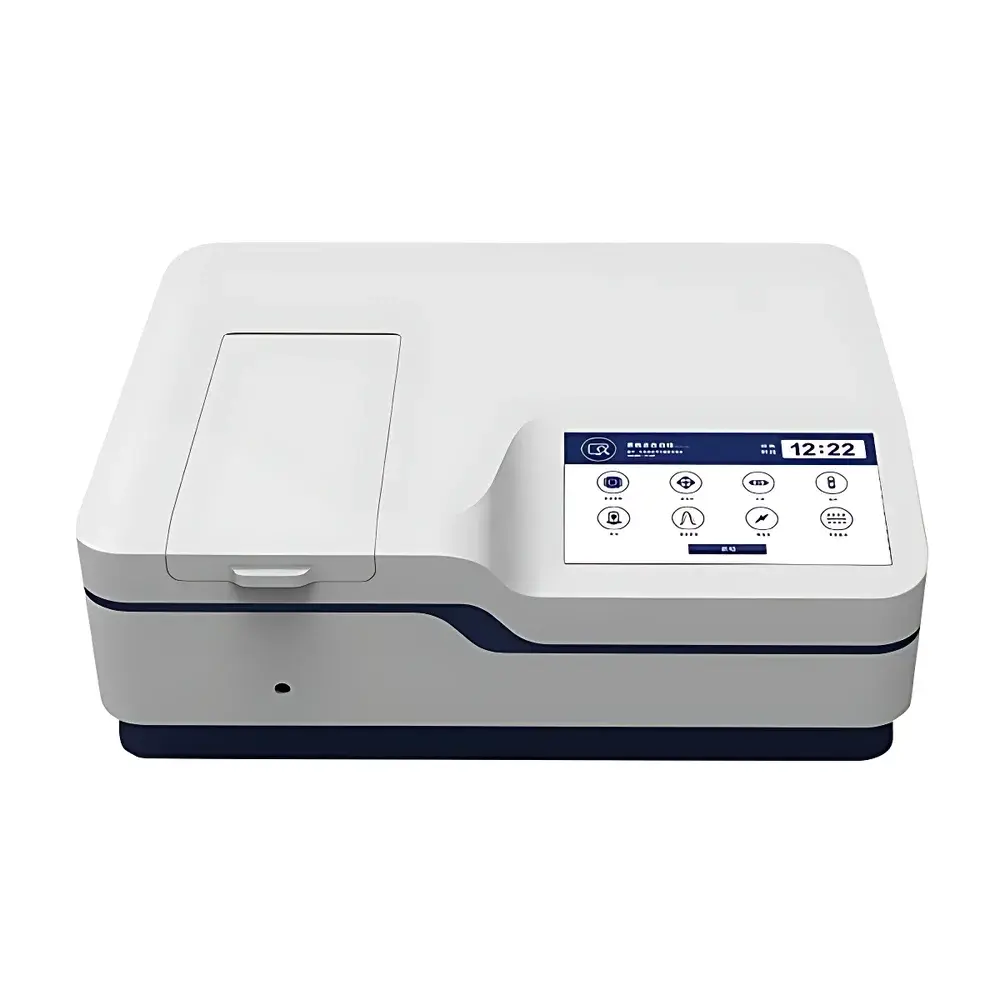
Yoke U7S Dual-Beam UV-Vis Spectrophotometer with Photomultiplier Tube (PMT) Detection
| Brand | Yoke |
|---|---|
| Origin | Shanghai, China |
| Manufacturer Type | OEM Manufacturer |
| Model | U7S |
| Instrument Architecture | Dual-Beam |
| Detector Type | Photomultiplier Tube (PMT) |
| Wavelength Range | 190–1100 nm |
| Wavelength Accuracy | ±0.3 nm (full range), ±0.1 nm at 656.1 nm |
| Spectral Bandwidth | 0.1–5.0 nm continuously adjustable |
| Stray Light | ≤0.01% T at 220 nm |
| Photometric Accuracy | ±0.3% T |
| Baseline Stability | ±0.0002 A at 500 nm |
| Wavelength Repeatability | ±0.1 nm |
| Display | 10.1″ capacitive touchscreen (1024 × 800) |
| Data Storage | Internal 16 GB + USB HOST support (up to 5000 spectra or 500 calibration curves) |
| Processor | ARM12 embedded system |
| Optical Design | Suspended optical bench with reinforced aluminum baseplate |
| Patented Photodetection Module | ZL 2010 2 0562320.3 |
Overview
The Yoke U7S Dual-Beam UV-Vis Spectrophotometer is an advanced analytical instrument engineered for high-sensitivity absorbance and transmittance measurements across the ultraviolet, visible, and near-infrared spectral regions (190–1100 nm). It employs a dual-beam optical architecture with a CT (Czerny-Turner) monochromator and real-time beam ratio detection, enabling continuous compensation for source drift and environmental fluctuations. Unlike conventional instruments relying on silicon photodiodes, the U7S integrates a high-gain, low-noise Hamamatsu photomultiplier tube (PMT) detector—optimized for sub-nanomolar concentration quantification and low-light spectral acquisition. Its pulsed xenon lamp eliminates the need for routine lamp replacement over a typical service life exceeding 7 years, significantly reducing long-term operational cost and downtime. The optical path is mechanically isolated via a suspended optical bench mounted on a thickened aluminum baseplate, minimizing vibration-induced wavelength shift and thermal drift. This design ensures reproducible baseline stability of ±0.0002 A at 500 nm—critical for kinetic assays and trace-level analysis.
Key Features
- 10.1-inch full-color capacitive touchscreen interface (1024 × 800 resolution) enables standalone operation—no external PC required for spectrum acquisition, quantitative analysis, or kinetic monitoring.
- Continuously adjustable spectral bandwidth (0.1–5.0 nm) supports method flexibility: narrow bandwidths for high-resolution peak deconvolution; wider settings for increased signal-to-noise in low-concentration applications.
- Embedded ARM12 processor and 16 GB internal flash memory allow storage of up to 5000 full-spectrum scans or 500 multi-point calibration curves—ideal for GLP-compliant lab environments requiring audit-ready data retention.
- Patented photodetection module (Chinese Patent ZL 2010 2 0562320.3) enhances signal fidelity by decoupling optical and electronic noise pathways—achieving stray light performance ≤0.01% T at 220 nm and photometric accuracy of ±0.3% T.
- Dual-layer chassis architecture physically separates optical and electronic compartments, preventing electromagnetic interference and ensuring long-term photometric reproducibility under variable ambient conditions.
- Multiple export formats supported directly via USB HOST: CSV (for Excel-compatible quantitative reports), QUA (native spectral format), TXT (ASCII tabular data), and BMP (publication-grade spectral plots).
Sample Compatibility & Compliance
The U7S accommodates standard 10 mm pathlength cuvettes (quartz, fused silica, or high-transmission glass) and supports optional accessories including micro-volume adapters (down to 2 µL), temperature-controlled cells (±0.1 °C), and fiber-optic probes for remote or in-situ measurement. Its optical design conforms to ISO 9001-certified manufacturing protocols and meets core performance criteria referenced in ASTM E275 (Standard Practices for Describing and Measuring Performance of UV-Vis Spectrophotometers) and USP (Spectrophotometry and Light-Scattering). While not pre-certified for FDA 21 CFR Part 11, the instrument’s embedded audit trail functionality—including timestamped user logins, parameter change history, and immutable data export logs—enables laboratories to configure compliant workflows aligned with GMP/GLP documentation requirements.
Software & Data Management
The onboard operating system provides intuitive graphical navigation through five primary modules: Photometric Mode (single-wavelength absorbance/transmittance), Spectrum Scan (full-range or user-defined wavelength sweeps), Quantitative Analysis (linear/nonlinear calibration with up to 10 standards), Kinetic Mode (time-resolved absorbance tracking at fixed or scanning wavelengths), and Multi-Wavelength Analysis (simultaneous monitoring at up to 10 user-defined λ points). All data are stored with metadata (date/time, operator ID, method name, instrument serial number). Exported files retain native formatting without dependency on proprietary software—CSV files open directly in Excel; BMP images require no viewer plugin. RS-232C serial output enables integration with LIMS systems; USB Drive mode supports direct connection to networked PCs for centralized data archiving.
Applications
The U7S delivers reliable performance across regulated and research-intensive domains. In pharmaceutical QC labs, it supports assay validation per ICH Q2(R2) guidelines for active ingredient quantification and degradation product profiling. In environmental testing, its low stray light and PMT sensitivity enable accurate nitrate/nitrite determination in wastewater at sub-ppb levels (EPA Method 353.2). Academic and biotech users apply it to protein quantification (Bradford/Lowry/BCA), enzyme kinetics (NADH/NADPH monitoring at 340 nm), DNA/RNA purity assessment (A260/A280 ratios), and nanoparticle characterization (surface plasmon resonance band analysis). Food safety labs utilize its photometric precision for colorimetric pesticide residue screening and antioxidant capacity assays (e.g., DPPH radical scavenging).
FAQ
What is the expected lifetime of the xenon lamp?
The pulsed xenon light source is rated for ≥10⁹ flashes and typically operates for >7 years under standard usage (8 h/day, 5 days/week) without degradation in intensity or spectral output.
Does the instrument support compliance with FDA 21 CFR Part 11?
While the U7S does not include out-of-the-box electronic signature or role-based access control, its embedded logging architecture—recording all method changes, measurement events, and user actions with timestamps—provides the foundational data integrity required to build a Part 11-compliant workflow using validated third-party LIMS or ELN systems.
Can the U7S perform kinetic measurements with time resolution better than 1 second?
Yes—the embedded firmware supports minimum sampling intervals of 0.5 seconds per data point, enabling robust monitoring of rapid enzymatic reactions or photochemical processes when paired with stabilized temperature control.
Is the PMT detector cooled to reduce dark current?
No—the Hamamatsu R928P PMT operates at ambient temperature, optimized for high quantum efficiency (>25% at 250 nm) and low afterpulse characteristics. Cooling is unnecessary given the instrument’s stray light suppression and signal averaging capabilities.
What calibration standards are recommended for wavelength verification?
Holmium oxide (Ho₂O₃) in 10% perchloric acid is recommended for verification across 200–650 nm; didymium glass filters provide secondary checks at 529, 573, and 681 nm per NIST SRM 2034 guidelines.




