
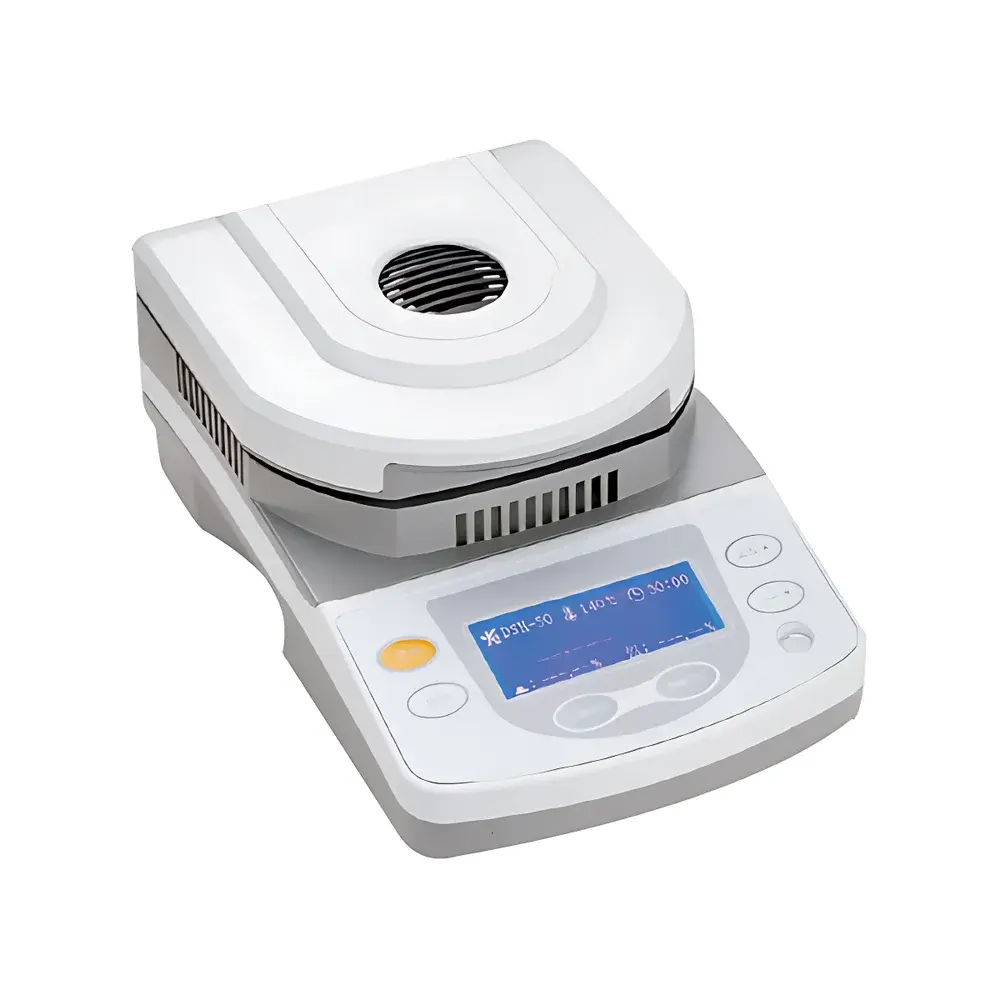
Yoke DSH-50A-1 Halogen Moisture Analyzer
| Brand | Yoke |
|---|---|
| Origin | Shanghai, China |
| Manufacturer Type | Direct Manufacturer |
| Model | DSH-50A-1 |
| Weighing Range | 0–50 g |
| Readability | 1 mg |
| Repeatability (3 g sample) | ±0.2% |
| Recommended Sample Mass | 3–10 g |
| Minimum Sample Mass | 0.5 g |
| Heating Time Range | 1–99 min (adjustable in 1-min increments) |
| Temperature Control Range | 50–180 °C |
| Heating Source | Halogen Lamp |
| Display | Backlit Dot-Matrix LCD |
| Interface | RS232 |
| Endpoint Modes | Timed & Automatic |
| Displayed Parameters | Moisture %, Solid %, Weight (g), Elapsed Time, Date |
| Pan Diameter | 100 mm |
| Dimensions (W×D×H) | 265 × 160 × 150 mm |
| Net Weight | 5 kg |
| Gross Weight | 6 kg |
Overview
The Yoke DSH-50A-1 Halogen Moisture Analyzer is a precision laboratory instrument engineered for rapid, gravimetric determination of moisture content in solid and semi-solid materials. It operates on the principle of loss-on-drying (LOD), where a pre-weighed sample is subjected to controlled halogen lamp heating under defined thermal conditions; the mass loss—attributed primarily to volatilization of water—is measured in real time by a high-stability weighing sensor. This method complies with standardized gravimetric protocols referenced in ASTM E1447, ISO 712, and USP , and serves as a validated alternative to classical oven-drying for routine quality control in pharmaceutical, food, chemical, and polymer laboratories. The DSH-50A-1 integrates a thermally isolated load cell architecture to minimize thermal drift during extended heating cycles, ensuring measurement integrity across variable ambient conditions.
Key Features
- Backlit dot-matrix LCD display with optimized contrast and viewing angle—designed for legibility under low-illumination lab environments and compatible with standard PPE usage.
- Dedicated membrane keypad with tactile feedback for reliable operation in gloves or high-hygiene settings; no capacitive or touch-sensitive surfaces susceptible to contamination or false activation.
- Halogen heating module delivering uniform radiant energy distribution across the 100 mm diameter sample pan—enabling faster thermal response (typical ramp to setpoint ≤ 60 s) and improved reproducibility versus traditional infrared or convection ovens.
- Thermally shielded weighing sensor with internal temperature compensation—reducing thermal interference from the heating element and supporting consistent 1 mg readability throughout the full 0–50 g range.
- Configurable endpoint logic: user-selectable timed drying (1–99 min) or automatic termination based on mass stabilization criteria (programmable sensitivity threshold).
- RS232 serial interface compliant with standard ASCII command sets—enabling seamless integration into LIMS environments or automated data logging systems without proprietary drivers.
Sample Compatibility & Compliance
The DSH-50A-1 accommodates a broad spectrum of non-volatile, thermally stable matrices including powders (e.g., APIs, excipients, flour), granules (feedstock, catalysts), pastes (coatings, adhesives), and thin-film solids (films, membranes). Samples must be homogeneous and uniformly distributed across the pan surface to ensure representative heating and avoid localized charring. For regulatory applications, the instrument supports documentation workflows aligned with GLP and GMP requirements: all measurements record timestamp, operator ID (via optional external login), set parameters (temperature, duration), and raw mass data—facilitating audit-ready traceability. While not inherently 21 CFR Part 11 compliant, its RS232 output enables connection to validated third-party data acquisition software with electronic signature and audit trail capabilities.
Software & Data Management
No embedded operating system or proprietary software is bundled with the DSH-50A-1; instead, it relies on industry-standard serial communication for interoperability. Raw output includes ASCII-formatted lines containing moisture %, solid %, final weight, elapsed time, and date stamp—structured for direct ingestion into Excel, LabVIEW, or enterprise QC platforms. Optional PC-based utilities (available separately) provide batch reporting, statistical process control (SPC) charting, and CSV export with metadata tagging. All displayed parameters are recalculated in real time using internally stored calibration coefficients traceable to NIST-traceable mass standards.
Applications
- Pharmaceutical manufacturing: verification of residual solvent levels in dried intermediates per ICH Q5C guidelines.
- Food processing: routine monitoring of moisture in cereal grains, dairy powders, and snack products to ensure shelf-life compliance.
- Polymer production: quantification of hygroscopic water in nylon, PET, and engineering resins prior to extrusion or molding.
- Environmental testing labs: analysis of soil moisture content in accordance with EPA Method 9071B.
- Academic research: method development for accelerated stability studies requiring high-throughput LOD screening.
FAQ
What calibration standards are recommended for routine verification?
NIST-traceable stainless steel weights (e.g., 10 g and 20 g) should be used daily for span verification; temperature calibration requires a certified RTD probe placed at pan center.
Can the DSH-50A-1 be used for volatile organic compound (VOC) analysis?
No—it measures total mass loss, not compound-specific volatiles; for VOC identification, coupling with GC-MS or TGA-FTIR is required.
Is the halogen lamp replaceable by the end user?
Yes—the lamp assembly is field-replaceable using standard Torx tools; typical service life exceeds 5,000 hours under normal use.
Does the instrument support multi-step heating programs?
No—the DSH-50A-1 implements single-stage heating only; multi-ramp protocols require external programmable controllers or higher-tier models.
How is thermal uniformity across the pan verified?
Uniformity is validated per ISO 17025-accredited procedures using a grid of calibrated thermocouples; published data confirms ±2.5 °C deviation at 100 °C across the central 80 mm diameter.
Related Products






